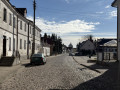
Tykocin, a Baroque gem on the banks of the Narew

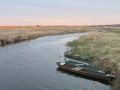
Situated on the banks of the River Narew, on the edge of Podlasie, Tykocin is regarded as one of Poland’s most beautiful small Baroque towns and was for a long time a major centre of Jewish life in the country. This easy circular walk first follows the ‘bulwary’ promenade along the river, opposite the old metal bridge and its willow-lined banks. It then heads into the heart of the town, from the Great Synagogue to the vast square where the statue of Hetman Czarniecki and the Baroque Church of the Holy Trinity stand, before meandering through the cobbled streets lined with traditional wooden houses.

Details

102121358
Creation:
Last update:
Last review:
  • Walking
    Activity: Walking
  • ↔
    Distance: 1.83 mi
  • ◔
    Average duration: 0h 50 
  • ▲
    Difficulty: Easy

  • ⚐
    Back to start: Yes
  • ↗
    Ascent: + 26 ft
  • ↘
    Descent: - 20 ft

  • ▲
    Highest point: 374 ft
  • ▼
    Lowest point: 331 ft

Photos

Description of the walk

Park in the car park on Stefana Czarnieckiego Square, between the Church of the Holy Trinity and the old metal bridge.

(S/E) From the car park, head towards the bridge and turn left just before it to join the Bulwary promenade, a paved path running westwards along the River Narew. Cross a small branch of the river via a footbridge, then continue to the dam.

(1) At the Jaz Tykocin dam, leave the riverbank and head up to the left towards the Old Town. Join Browarna Street, follow it to the left, then turn right onto the path between the houses and join Józefa Piłsudskiego Street. Turn left and head for the Great Synagogue, a massive Baroque building dominating its cobbled square.

(2) At the Great Synagogue, continue towards the centre. Cross the small branch of the Narew River again, then carry on straight ahead along the cobbled Złota Street. Continue on to Stefana Czarnieckiego Square, passing the statue of Hetman Stefan Czarniecki.

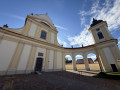
(3) Reach the imposing Church of the Holy Trinity, walk beneath its quarter-circle arcades and go round the building. On emerging, turn left and continue along the cobbled 11 Listopada Street, lined with traditional wooden houses. Pass the White Eagle monument, then continue to number 30 on the street.

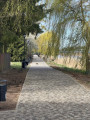
(4) Turn left down the cobbled path to rejoin the bulwary promenade and walk along the Narew to the left. Shaded by weeping willows and dotted with benches, the paved path offers views of the river and its reeds. Follow it to the metal bridge and return to the car park (S/E).

Waypoints

  1. S/E : mi 0 - alt. 351 ft - Car park at Stefana Czarnieckiego Square
  2. 1 : mi 0.38 - alt. 341 ft - Narew Dam (Jaz Tykocin) - Narew
  3. 2 : mi 0.59 - alt. 354 ft - Grande synagogue de Tykocin (Wielka Synagoga w Tykocinie)
  4. 3 : mi 0.89 - alt. 367 ft - Église de la Sainte-Trinité de Tykocin
  5. 4 : mi 1.37 - alt. 358 ft - Leave 11 Listopada Street
  6. S/E : mi 1.83 - alt. 358 ft - Car park at Stefana Czarnieckiego Square

Notes

The village is accessible by road.

The streets and squares are largely paved with uneven cobblestones, which can be slippery in wet or icy conditions. Sturdy footwear is recommended. In winter, the promenade and the cobblestones may be covered in snow or ice.

The Great Synagogue houses a museum of Jewish culture, and the Church of the Holy Trinity is open to visitors. Opening times vary depending on the season. Please check before you visit.

Cafés and restaurants can be found in the town centre, particularly near the synagogue and the Grande Place.

Worth a visit

(2) The Great Synagogue (Wielka Synagoga), built in 1642, is the second-largest surviving synagogue in Poland. Its massive, cubic brick structure, flanked by a corner turret, is a reminder of the time when Tykocin had a predominantly Jewish population. Devastated during the German occupation and subsequently restored in the 1970s, it has housed a museum dedicated to Jewish culture since 1977, a branch of the Podlasie Regional Museum in Białystok. Nearby, a plaque commemorates the Zamenhof family.

(3) The Church of the Holy Trinity, a three-nave basilica, was built between 1742 and 1750 thanks to funding from Hetman Jan Klemens Branicki. Visitors can admire its polychrome decoration and the paintings by Szymon Czechowicz that adorn the gilded Baroque high altar. Its silhouette, featuring two towers connected to the main body of the building by quarter-circle galleries, frames the Main Square.

(3) On the same square stands the statue of Stefan Czarniecki, the hetman who defeated the Swedes. Commissioned between 1761 and 1763 by his grandson Jan Klemens Branicki and carved from sandstone by the French sculptor Pierre Coudray, it is considered the second-oldest secular monument in Poland, after Sigismund’s Column in Warsaw.

(S/E) The old metal bridge spanning the Narew is an early 20th-century truss bridge, originally erected on the Oder and then reassembled in Tykocin after the Second World War. A promenade and an educational trail have been laid out along the river, around the bridge.

On the opposite bank of the Narew stands Tykocin Castle, a 16th-century royal castle enlarged by Sigismund II Augustus. Dismantled after the fire of 1734 – the materials from which were used to build the church – it has been under reconstruction since 2002. It can be seen from the promenade or the bridge.

For more walks, use our search engine .

The GPS track and description are the property of this route's author. Please do not copy them without permission.