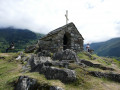
Turon de Néouvielle and Pic des Trois Conseillers from Lienz

The Néouvielle Massif is impressive for the diversity of its landscapes, peaks, lakes, "eternal ice" and abundant wildlife. The Turon de Néouvielle is named after this prestigious massif and is located in one of the easternmost areas of the "Core Zone of the Pyrenees National Park". This area of the PNP extends over territories with altitudes never falling below 1,067 m and peaking at 3,298 m at the Pique Longue du Vignemale. It is home to extremely varied landscapes.

On the Turon de Néouvielle trail, there are numerous glacial mountain lakes, granite rocks, sharp ridges and a few grassy areas with diverse wildlife. An exceptional sight! This route takes you to two of the 3000-metre peaks in the area. It can be done in one or two days, with a break at the Refuge de la Glère, in a heavenly location.

Details

80785766
Creation:
Last update:
Last review:
  • Walking
    Activity: Walking
  • ↔
    Distance: 19.31 km
  • ◔
    Average duration: 10h 00 
  • ▲
    Difficulty: Extremely difficult

  • ⚐
    Back to start: Yes
  • ↗
    Ascent: + 1,575 m
  • ↘
    Descent: - 1,568 m

  • ▲
    Highest point: 3,028 m
  • ▼
    Lowest point: 1,504 m

Photos

Description of the walk

Take the D918, cross the village of Barèges (65) and climb towards Tourmalet. Shortly before the Tournaboup ski resort, turn right onto the small, well-signposted hairpin mountain road. The start is at a place called Le Lienz, where there is a huge car park in front of the "Chez Louisette" inn, which can be used in both summer and winter, at an altitude of 1504 metres.

NB: if you are lucky and the cattle grid leading up to Camp Rollot is open, you can drive up there. There is parking for around 50 vehicles at Camp Rollot, at an altitude of 1,557 metres.

(S/E) Head east on the access road to the car park. After about 150 m, turn right in the middle of the trees onto a path that climbs south-south-east through the mountain pastures. You will reach the buildings (and tents in summer) of Camp Rollot.

(1) Then take the wide track that continues south-south-east and then south. Follow the Ruisseau de la Glère stream on your left. The path continues like this for about 3 km.

(2) Cross a track twice and continue climbing along the path. Join the track and follow it to the left for about 100 metres. Then take the path on the right and cross the track again. On the other side, turn right onto the path (do not cross the Ruisseau de la Glère). Shortly afterwards, turn left and climb, leaving the EDF facilities on your left. This will take you to the northern tip (downstream) of Lac de la Glère.

(3) Turn right and climb quickly to the Refuge de la Glère.

(4) Cross the terrace of the refuge and take the well-marked trail south towards Turon de Néouvielle and Lac det Mail. From there, you will find regular but widely spaced yellow markings, as well as numerous cairns.

(5) At a fork, leave the main marked trail, go left and head towards the western tip of Lac de Coume Escure. Turn right to rejoin the main trail.

(6) Continue climbing south-southeast, then southeast.

(7) Cross a stream on a narrow footbridge (deck missing). Shortly after, you will reach a trail junction.

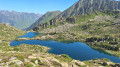
(8) Continue straight ahead (south-east, leaving the path leading to the Refuge Packe on your right). Enter the heart of the Pyrenees National Park, pass between two small lakes and reach the magnificent Lac det Mail.

(9) Follow the lake on your right on the trail, which remains clearly visible and well marked. The terrain is granitic and lunar, with rocks polished by the ancient glacier and scattered boulders. Water is everywhere, between streams, puddles, lakes and small lakes. The slope becomes steeper. Even in the middle of summer, it is not uncommon to find the first snowfields here at around 2,600 m, but there is no need to cross them. You will arrive at the northern tip of the first and largest of the Lacs Verts (Green Lakes).

(10) Continue south and pass a large ledge towards the Lacs de Maniportet, which are still invisible. Reach the eastern shore of the Lac Bleu de Maniportet.

(11) Continue south between this large lake and its smaller counterpart on the left, Lac Cœur Bleu. Climb up through scree, keeping Lac Glacé de Maniportet on your right. Reach the bottom of the small Cirque de Maniportet, where you can still see a large snowfield. The trail follows the ridge separating the Lac Glacé and the snowfield of the Glacier de Maniportet. In summer, you can avoid the last snowfields by going around them. This will take you to a ridge just below the summit.

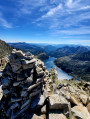
(12) Follow the ridge to the right and quickly reach the Turon de Néouvielle, where two large cairns stand (bivouac possible). From here, the 360° view is breathtaking (see § Nearby).

(13) Descend the ridge you came up (north-northeast).

(12) Leave the path you came up on to your left and continue along the ridge (north-east). Follow the ridge line to reach the summit of the Premier Conseiller (marked on the OSM map).

(14) Continue north-east along the ridge and pass the Second Conseiller (not marked on the maps).Progress is slow over the piled-up rocks and 45° sloping slabs. Make grade 2 climbing steps. Reach a large ledge (5 to 8 m). To avoid grade 3 climbing steps, leave the ridge line and descend as soon as you can see a cairned ledge a few dozen metres below the ridge line on the south-east slope. Once you reach it, this ledge is roughly on the contour line. Follow it as far as possible. When it comes to an impassable rock face, take a near-vertical chimney on the left that climbs back up to the ridge line. This ledge passage takes about 20 minutes. This brings you to the summit of the Pic des Trois Conseillers, marked by a large cairn.

(15) Head northeast, descending through boulders and scree towards the nearby Brèche de Néouvielle, about a hundred metres below.

(16) Turn left and take this narrow, letterbox-like breach. Descend the scree towards Lac Cœur Bleu (north-west).

(17) Leave the lake on your right and continue off-trail towards the north. Follow Lac Vert Allongé on your right and rejoin the junction you took on the way up.

(10) Continue north and descend via the same route as on the way up.

(6) Keep left on the marked trail (do not make the detour to Lac de Coume Escure).

(5) Follow the path downhill in the opposite direction to the way you came until you reach the Lienz car park (S/E).

Waypoints

  1. S/E : km 0 - alt. 1,504 m - Lienz car park
  2. 1 : km 0.5 - alt. 1,557 m - Camp Rollot
  3. 2 : km 3.28 - alt. 1,805 m - Crossing tracks
  4. 3 : km 4.42 - alt. 2,102 m - Lac de la Glère
  5. 4 : km 4.53 - alt. 2,145 m - Refuge de la Glère (2153m)
  6. 5 : km 4.86 - alt. 2,150 m - Northern junction of the loop - Lac de Coume Escure (2145 m)
  7. 6 : km 5.02 - alt. 2,164 m - Southern junction of the loop - Lac de Coume Escure (2145 m)
  8. 7 : km 5.35 - alt. 2,200 m - Footbridge
  9. 8 : km 5.56 - alt. 2,234 m - Crossroads
  10. 9 : km 6.25 - alt. 2,339 m - Lac det Mail
  11. 10 : km 7.78 - alt. 2,619 m - Northern junction of the summit loop - Lac Vert allongé
  12. 11 : km 8.23 - alt. 2,666 m - Lac Bleu (Réserve de Néouvielle)
  13. 12 : km 9.37 - alt. 3,006 m - Southern junction of the summit loop - Crête
  14. 13 : km 9.46 - alt. 3,028 m - Turon de Néouvielle
  15. 14 : km 9.76 - alt. 2,992 m - Premier Conseiller (3035 m)
  16. 15 : km 10.07 - alt. 3,000 m - Pic des Trois Conseillers (3039 m)
  17. 16 : km 10.28 - alt. 2,914 m - Brèche de Néouvielle (2926 m)
  18. 17 : km 11.05 - alt. 2,671 m - Lac Cœur Bleu
  19. S/E : km 19.31 - alt. 1,504 m - Lienz car park

Notes

The description is based on a solo summer hike at the end of July 2025. No persistent snow on the trail.

In winter, only attempt this route if you are fully proficient in snowshoeing or ski touring and crampons/ice axe use.

Parking at the start
At an altitude of 1,504 m (Lienz car park), there is an official car park, marked on road maps. It is free of charge.

Time indicated
I completed this route in 10.5 hours, including a 1-hour break at the summit and photo breaks (for a total of >3 hours), leaving the car park at 6 a.m. This is a fairly short time. Allow between 10 and 12 hours.

Difficulty
This hike is classified as Extremely Difficult for a number of reasons: significant elevation gain; no climbing but exposed ledges between (14) and (15); extremely steep sections (> 55%) between (13) and (16); challenging descent over boulders between (16) and (17); partial lack of signposting; high mountain conditions. The IBP Index is 195 HKG, which corresponds to a Very Difficult route for a hiker with average physical fitness .

Variants:

  • Depending on your physical condition, it may be worth cycling up to the Refuge de la Glère, parking there and then picking up your bike on the way back to save valuable time on the descent (30-45 minutes).
  • The descent via the ridge, the Pic des Trois Conseillers and the Brèche de Néouvielle can be replaced by a descent via the western serrat of the Turon de Néouvielle: take the ridge to the north-west as you leave the Turon, then at around 2911 m, head north onto the serrat, leaving the Lac Glacé and the Lac Bleu on your right. Then rejoin the descent path near . This saves about 3/4 hour compared to the Brèche de Néouvielle.
  • On the descent to Lac det Mail (9), you can take a detour, leaving Lac de l'Oueil Nègre and its small lakes on your left, allowing you to pass between the lakes, puddles and streams, whose music delights the ears and whose flow refreshes the midday air!

  • In general, there are many variations that are rather less fast on the ascent, as on the descent, from Lac de Coume Escure to the glacial cirque of Maniportet, without any risk of getting lost or encountering impassable passages.

Water
There are no drinking water points along the route. In spring and summer, meltwater from snowfields, springs, lakes, rivers and runoff are not guaranteed to be drinkable, even though there are no herds grazing in this area above Lac det Mail (9). Bring at least 2.5 litres per person and/or a filter or purification tablets.

Shelter
There is no other shelter on the route apart from the Refuge de la Glère (4).

Equipment
In summer, bring the usual equipment for high-altitude hiking, including hiking boots, suitable clothing, rain gear, water, food, a survival blanket, a knife, a compass, a map, a whistle, sunglasses, a hat, sunscreen, and UV-protective lip balm.

Visitor
During spring and summer weekends, the route is very busy all the way to the summit. Whatever the season, don't forget to tell someone where you are going and let them know if you change your plans by text or phone.

Check the weather forecast.
If you notice any errors in the signposting or place names on your route or on the map you are using, you can become a contributor and report them:
- marking errors, safety issues, conflicts of use, environment: click here.
- mapping errors, place names: here.

Worth a visit

(13) At the summit of Turon de Néouvielle

Looking down, to the south-east, is the majestic Lac de Cap de Long and its dam.

Looking down towards the south-west, you can see the twin lakes of Bugarret and Couyela det Mey.

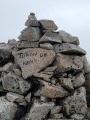
Looking north from the ridge towards Lake Cap de Long, the rocky outcrop bears the names of the astronomer Vidal and the chemist Reboul , who undertook the general levelling of the Pyrenees on 2 August 1797 by climbing this first 3,000-metre peak in the Pyrenees! Unfortunately, the IGN does not record this feat on its maps..

To the south-southwest are Pic Long (3,192 m) and, nestled at its foot, the charming Lac Tourrat, 550 m below. On its flanks are the remains of the Lac Tourrat glacier. In the distance, Mont Perdu (3,349 m) 18 km away, the Cylindre du Marboré (3,325 m) and a few peaks of the Cirque de Gavarnie, including the Epaule at 3,073 m.

And of course, to the north-east, the Turon-3 Conseillers-Néouvielle ridge, with the lord of the manor, the Pic de Néouvielle, at 3,091 m!

In the far north, the Pic du Midi de Bigorre at 2,876 m.

In the far south-west, the Vignemale Massif, with its highest point, the Pique Longue at 3,298 m.

Toponymy

  • the word Néouvielle comes from Nèu vielha, composed of nèu meaning "neve, snow" and vielha meaning "old, ancient in time". Indeed, the northern and western slopes of Néouvielle featured three small glaciers, now almost disappeared, and snowfields. The mountain of Nèu Bielhe is a high-altitude pasture area of Betpouey, in the Barèges valley.
  • lac de Cap de Long incorporates the former natural lake of Cap de Long, which means "the head (of the valley) of (Pic) Long".
  • lac de Coume Escure: Coume means "combe" (valley), escure means "dark, obscure", so the lake of the dark valley.
    Source: Wikipedia

Pyrenees National Park

The Pyrenees National Park, also known as the Western Pyrenees National Park, was created by Pierre Chimits in March 1967 and is one of France's eleven national parks. It is located in the south of the country in the western part of the Pyrenees mountain range, straddling the departments of Hautes-Pyrénées (now Occitanie) and Pyrénées-Atlantiques (now Nouvelle-Aquitaine).

See the PNP website

Néouvielle Regional Reserve

The Néouvielle National Nature Reserve (RNN4) is a national nature reserve located in the Occitanie region. Created in 1935 and classified in 1968, it covers an area of 2,313 hectares to the north-east of the Pic de Néouvielle in the Pyrenees mountain range. Ranging in altitude from 1,800 to 3,091 metres, it is a site rich in flora and fauna. It is home to nearly 370 animal species and 570 species of algae.
See the Reserve's website

Other walks in the area

For more walks, use our search engine .

The GPS track and description are the property of this route's author. Please do not copy them without permission.