Country:
 City:
City:


To start the hike, head to Melecey in the Haute-Saône department between the RD9 and Fallon. Park in the centre of the village near the church.
This route is actually the "Mirabelles" hike but in reverse (signposted "mirabelle/torcol", yellow arrow)
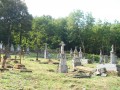
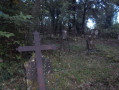
(S/E) Take the RD90 towards Fallon and after about 100 metres, take the path that climbs to the right (signposted "ancien cimetière" or "old cemetery"). The climb is steep but short, and you will soon see the first crosses of the old cemetery.
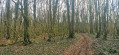
(1) After wandering among the crosses, go to the top right of the cemetery and descend the small, well-marked path to a meadow. Turn right, then 50 m further on, turn sharply left and take a straight, roughly stony path between the pastures that enters the woods and leads to a good forest road. Continue straight ahead.
(2) At the end, take the hollow trench on the left, near the Peute-Vue stream (called the Bilbois stream in its upper reaches), which marks the boundary between the communes of Fallon and Melecey, as indicated by an old stone marker on the left side of the path. You will come to a crossroads with a sign for Fallon 30 minutes. Continue straight ahead and at the bottom of the descent, take a good, almost straight path on the left which leads to a carriage road.
(3) After passing the water tower, descend to the village of Fallon. Take the time to go to the centre of the village to admire the fountain with its three basins (one of the oldest fountains in the department).
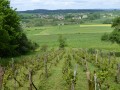
(4) Return to the main road towards Abbenans and turn left onto Rue des Vignes, which has been replaced by mirabelle plum orchards. At the end of the road, take a path on the right that climbs steeply up the hillside with a few steps to make the climb easier.
(5) Continue right on the beautiful path carved into the hillside, which follows the 400-metre contour line and goes around the hill to come out onto the pastures near the memorial to those shot on 10 September 1944. Take a moment to remember these two unfortunate men who died just a few days before the village was liberated.
(6) Continue downhill to the right along the Allée du Souvenir and turn left onto the good stone farm track between the pastures for 300 m. Turn sharp left and climb towards the woods. After climbing a small embankment, turn right and follow the path that runs along the edge of the woods about ten metres inside the forest. At the end, turn sharply left to climb through the woods towards the top of the hill on a short section ofthe GR®®59. After 300 m, leave theGR®®, which continues to climb, and turn right towards the west. The path turns slightly to the left, following the contour lines.
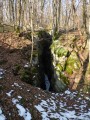
(7) On both sides of the path, you will already see traces of mining activity in this area, where iron ore was mined in the 19th century. At a large crossroads, continue straight ahead to reach the foot of the "Grande Raie", a fault more than 15 m deep, which was mined using the "dépiquage" technique.
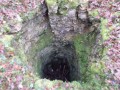
(8) Walk along the left side of this site, following the wooden fence. At the top, turn right and follow the path. You will see a first shaft on your left.
(9) A few dozen metres further on, there is a second one on the right. These three well-maintained sites with information panels give an insight into the work carried out at the time
Continue eastwards. At the crossroads at the entrance to the woods, you will see the pilgrims' stele. Take the path that climbs straight up through the meadows, following the red and white markings ofthe GR®®59, which will take you to a good path that leads to the centre of the village of Bournois.
(10) After the square, turn left towards the GAEC de la Motte and climb gently towards the Virgin of Grammont. Pass in front of the farm and then, near the telephone relay antenna, leave theGR®®59, which continues straight ahead, and turn left onto theGRP®® marked in yellow and blue.
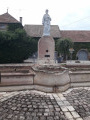
(11) Here is an old, deep ditch that you must cross to climb the old medieval mound. On the left are probably the remains of the walls of a 14th-century enclosure or small feudal castle. Cross a second ditch, then go back to the viewpoint where a Virgin Mary statue, cast in Fallon of course, has been installed, overlooking the valley and protecting the inhabitants of the villages.
(12) Take in the panoramic view of the valley villages and the Vosges mountains in the background, where you can see the Chapel of Ronchamp. Then head back down, skirting the hill on the left and following the yellow and blue GRP®® markings again. The easy path descends gently. At the edge of the woods, pass an electricity pylon and then the water tower to reach the village of Bournois.
(13) Before entering the village at the junction with a tarmac road, leave the yellow and blue markings and turn right between the hedges to continue downhill. On the left, there are beautiful views of Fallon Castle.
(14) Before the Fallon ponds, at the junction of the two routes, take the road on the right between a large hedge on the left and a pasture on the right, which continues as a path through a hedge. At the exit, take the tarmac road on the left to reach the village of Mélecey (S/E).





 Visorando Member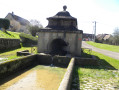


 Easy
Easy 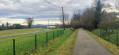
 Difficult