


Refine your search for walks in Saint-Genest-de-Beauzon
Saint-Genest-de-Beauzon walks


 The unfinished church of Saint-Genest-de-Beauzon
 Visorando Member
 7.05 mi
 +1,047 ft
 -1,043 ft
 4h 10
4h 10
 Moderate
 Departure from Saint-Genest-de-Beauzon (Ardèche)
Saint-Genest-de-Beauzon is a strange commune, made up of scattered hamlets in the southern foothills of the Cévennes Ardéchoises, with an isolated town hall near an unfinished church that has only its walls remaining. Landscapes, old houses, historical curiosities and geological sites punctuate this route.
Amidst sandstone and olive trees, the church of Payzac and the Chapel of Sainte-Appolonie
 6.99 mi
+1,001 ft
-1,004 ft
4h 05
Moderate
Departure from Les Assions (Ardèche)
6.99 mi
+1,001 ft
-1,004 ft
4h 05
Moderate
Departure from Les Assions (Ardèche)
An easy walk through woods, vineyards and olive groves at the foot of the Ardèche Cévennes. Beautiful views at both ends of the route.
The Bourbouillet Trail
 9.22 mi
+413 ft
-404 ft
4h 35
Moderate
Departure from Lablachère (Ardèche)
9.22 mi
+413 ft
-404 ft
4h 35
Moderate
Departure from Lablachère (Ardèche)
Les Gras, the limestone plateaus of southern Ardèche, may seem monotonous at first glance. This route allows you to discover varied vegetation and sometimes surprising terrain. Walking here in spring, with the green of the woods, or in autumn, with the beautiful colours, may be preferable to summer, with its high temperatures; however, part of the route is shaded. The hike passes near a karstic cave (caution!) where the underground river of the Bourbouillet resurgence flows.
Circular route from Lablachère to Rosières along the edge of La Baume
8.84 mi
+568 ft
-558 ft
4h 35
Moderate
Departure from Lablachère (Ardèche)
This is an easy hike, but it includes a fairly slippery ford and two passages that may be submerged in the event of flooding or storms. In this case, simply stay on the west bank until you reach Rosières. Conversely, in hot weather, set off at dawn and take enough water with you. The section between Garel and Rosières is shaded by riparian vegetation and cliffs; only the climb after Le Freyssinet will be hot. After that, the cliff-top path (not at all vertiginous) is slightly windy and very pleasant.
Balcon de Joyeuse circular loop
 3.64 mi
+174 ft
-187 ft
1h 50
3.64 mi
+174 ft
-187 ft
1h 50
 Easy
Departure from Lablachère (Ardèche)
Easy
Departure from Lablachère (Ardèche)
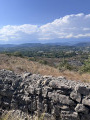
The path winds across the aptly named Plaine des Mûres plateau, which runs along the foot of the Cévennes. There are beautiful panoramic views of the Monts d’Ardèche Regional Nature Park.You’ll discover this arid, rocky plateau, which is home to the Mediterranean heath.A very easy walk with very little elevation gain and few technical difficulties.
From Chassezac to Sentier Roche via Sentier des Drystone Shelters
8.05 mi
+1,342 ft
-1,319 ft
4h 50
 Difficult
Departure from Berrias-et-Casteljau (Ardèche)
Difficult
Departure from Berrias-et-Casteljau (Ardèche)
A very pleasant hike along the Chassezac, then on the Sentier des Drystone Shelters. Return via the Sentier Roche and a small wood in Païolive. Superb landscape of the Ardèche Cévennes.I recommend using the GPX track as there are countless small paths.Hike for experienced hikers. I rated the walk as difficult not because of its length or elevation gain, but because of the many rocky areas and scree slopes to cross. It is physically demanding between (9) and (10) and from (15) to (S/E) Warning: do not attempt this hike in rainy weather as the rocky, limestone terrain is very slippery.
The Païolive Woods
 5.69 mi
+509 ft
-499 ft
3h 05
Moderate
Departure from Les Vans (Ardèche)
5.69 mi
+509 ft
-499 ft
3h 05
Moderate
Departure from Les Vans (Ardèche)
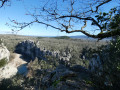
Discover a particularly interesting wood above the town of Les Vans.Comments about this route: I did this route in 2013, and it turns out that some signs have been added since then (signposts and probably markings), which is to be expected. Hikers can then explore other trails but will always find something unique and interesting in this remarkable wood, with no chance of getting lost.
The Château de Valoubières at the start of Cédat
4.76 mi
+682 ft
-679 ft
2h 45
Easy
Departure from Planzolles (Ardèche)
A short hike around the hamlet of Cédat between Lablachère and Planzolles: a varied walk through vineyards and forests of chestnut, pine and oak trees. This hike is not difficult and is suitable for families with children. The route can also be done by mountain bike. The route takes in the magnificent Château de Valoubières and passes through the hamlets of Civade, Le Coulet and Le Cellier.
The Vignal Circular Route
 2.72 mi
+272 ft
-269 ft
1h 30
Easy
Departure from Lablachère (Ardèche)
2.72 mi
+272 ft
-269 ft
1h 30
Easy
Departure from Lablachère (Ardèche)
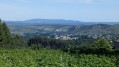
A short walk above Le Vignal, in the commune of Lablachère, with views of the village, Notre-Dame de Bon Secours, the Plateau des Gras, the Rocher de Sampzon and, in good weather, the Trois Becs and Mont Ventoux.
Casteljau Peninsula - La Grotte du Renard
 2.48 mi
+741 ft
-738 ft
1h 45
Moderate
Departure from Berrias-et-Casteljau (Ardèche)
2.48 mi
+741 ft
-738 ft
1h 45
Moderate
Departure from Berrias-et-Casteljau (Ardèche)
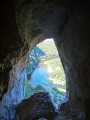
A beautiful loop that allows you to discover the Chassezac Gorges with passages at river level and others on the heights with beautiful views. For the more adventurous, there is the possibility of exploring caves.
And to wash off (depending on the season), you can relax in the river.
Ideal for children, although the cliff passages require parents' full attention.
The Bois de Païolive (small loop)
 3.20 mi
+256 ft
-256 ft
1h 40
Easy
Departure from Les Vans (Ardèche)
3.20 mi
+256 ft
-256 ft
1h 40
Easy
Departure from Les Vans (Ardèche)
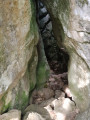
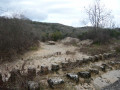
The Païolive forest is an ancient forest in the south of the Ardèche, occupied since prehistoric times, with a remarkable geological context and biodiversity. It overlooks the Chassezac gorges. In this karstic landscape, there are numerous zoomorphic rocks, a multitude of trails and viewpoints, not to mention many caves. Much of the walk is shaded. Really very nice.
Circular loop through the Bois de Païolive and Ruisseau du Granzon
 10.20 mi
+709 ft
-696 ft
5h 20
Moderate
Departure from Les Vans (Ardèche)
10.20 mi
+709 ft
-696 ft
5h 20
Moderate
Departure from Les Vans (Ardèche)
After crossing the Bois de Païolive, the route follows the Ruisseau du Granzon. After climbing out of the canyon, the return journey is via the plateau. An enchanting route and landscape. The use of GPS and the Visorando app may be necessary.
From the Rochers de Païolive to the resurgences of the Ruisseau de Granzon
 7.88 mi
+561 ft
-531 ft
4h 05
Difficult
Departure from Les Vans (Ardèche)
7.88 mi
+561 ft
-531 ft
4h 05
Difficult
Departure from Les Vans (Ardèche)
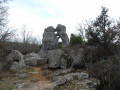
This unmarked route, which sometimes even leaves the trails, requires an IGN map and GPS, and leads to remote and wild areas of the Bois de Païolive and the upper part of the Ruisseau du Granzon.
Around Païolive: from necropolis to hermitage, from desert to forest
 7.15 mi
+623 ft
-640 ft
3h 50
Moderate
Departure from Berrias-et-Casteljau (Ardèche)
7.15 mi
+623 ft
-640 ft
3h 50
Moderate
Departure from Berrias-et-Casteljau (Ardèche)
This hike will take you to a megalithic necropolis and a desert plain inhabited long ago by those who were buried there. It will take you to the village of Berrias, up to the Païolive woods, which you will cross, and then to the hermitage of Saint-Eugène, which is still in use, before allowing you to admire the Chassezac gorges from the magnificent cliff.
A short tour of Les Gras de Perret
 5.66 mi
+331 ft
-331 ft
2h 55
Moderate
Departure from Joyeuse (Ardèche)
5.66 mi
+331 ft
-331 ft
2h 55
Moderate
Departure from Joyeuse (Ardèche)
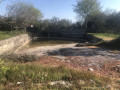
The gras are limestone plateaus characteristic of southern Ardèche. Here you can see low vegetation or trees: picards, junipers, Mediterranean shrubs, old mulberry trees left over from silkworm farming, various oaks and Montpellier maples. You will cross a karst landscape that is sometimes spectacular. This hike also offers a view from the top of the Beaume cliffs. You can stray from the path in search of karstic caves ( be careful at Réméjadou) and dolmens, sometimes lost in the woods.
Moulin de Marceau and return via Bavancel from Planzolle
 4.41 mi
+574 ft
-591 ft
2h 30
Easy
Departure from Planzolles (Ardèche)
4.41 mi
+574 ft
-591 ft
2h 30
Easy
Departure from Planzolles (Ardèche)
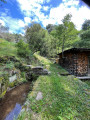
A short walk with little elevation gain, allowing you to discover an old mill (5) hidden at the bottom of the valley, all in a very Mediterranean setting. The return trip through the hamlet of Bavancel offers magnificent views.
From hamlet to bridge around Payzac
9.81 mi
+2,320 ft
-2,343 ft
6h 30
Difficult
Departure from Payzac (Ardèche)
A magnificent hike in the Cévennes, mostly on trails through chestnut and arbutus trees.
Around Berrias-et-Casteljau
 7.57 mi
+433 ft
-417 ft
3h 50
Moderate
Departure from Berrias-et-Casteljau (Ardèche)
7.57 mi
+433 ft
-417 ft
3h 50
Moderate
Departure from Berrias-et-Casteljau (Ardèche)
A hike to discover the banks of the Chassezac, the villages of Berrias and Casteljau, Ardèche hamlets with, as a bonus, a passage through the Bois de Païolive and a view of the Gorges du Chassezac.
At the start, when you walk along the Chassezac and in the Bois de Païolive, there are many paths. A GPS may be useful.
Between chaos and heath north of Chassezac
 9.93 mi
+817 ft
-830 ft
5h 15
Moderate
Departure from Chandolas (Ardèche)
9.93 mi
+817 ft
-830 ft
5h 15
Moderate
Departure from Chandolas (Ardèche)
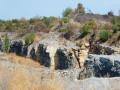
This route offers beautiful views of the cliffs and gorges of the Chassezac, rocky terrain, ancient dry stone constructions and a return route through a landscape of heath that is perhaps less poetic but nevertheless typical of the southern Ardèche.
Short tour of the drystone shelters at Maison Neuve
 6.57 mi
+558 ft
-558 ft
3h 30
Moderate
Departure from Chandolas (Ardèche)
6.57 mi
+558 ft
-558 ft
3h 30
Moderate
Departure from Chandolas (Ardèche)
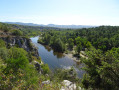
This family hike begins with magnificent views of the Chassezac gorges, then crosses a karstic rocky chaos in a Tolkien-esque forest. Further on, you will find drystone shelters, ancient dry stone shelters. The return journey offers a classic route through the limestone landscapes of southern Ardèche along a small road that is little used out of season (those allergic to tarmac will find some alternative routes through heath).
Heath and the Chassezac cliff face from Chandolas
 12.01 mi
+850 ft
-869 ft
6h 15
Difficult
Departure from Chandolas (Ardèche)
12.01 mi
+850 ft
-869 ft
6h 15
Difficult
Departure from Chandolas (Ardèche)
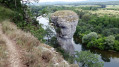
A long route through the heath around Chandolas with some very wild paths. The highlight is a final section along a ledge above Chassezac, which is dizzying but not difficult provided you remain cautious. The use of a map app is strongly recommended, preferably OpenStreetMap, as there are many tracks in the heath.