Refuge des Merveilles - Baisse de Camp

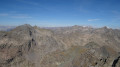
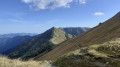
The fifth stage ofthe GR®52, where southern landscapes give way to mountain scenery. Challenging due to its elevation gain, this stage follows the old Italian border, where you’ll discover numerous military remains. Notably at Authion, where one of the last battles in France took place, resulting in the deaths of 273 French soldiers just a few weeks before the armistice of 8 May 1945. The views here are fabulous.

This walk is part of a multi-day hike: Mercantour route via the GR®52

Details

498716
Creation:
Last update:
Last review:
  • Walking
    Activity: Walking
  • ↔
    Distance: 8.26 mi
  • ◔
    Average duration: 5h 30 
  • ▲
    Difficulty: Difficult

  • ⚐
    Back to start: No
  • ↗
    Ascent: + 1,946 ft
  • ↘
    Descent: - 3,150 ft

  • ▲
    Highest point: 7,989 ft
  • ▼
    Lowest point: 5,728 ft

Photos

Description of the walk

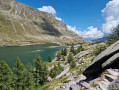
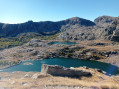
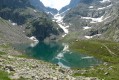
(S) From the Refuge des Merveilles on the shores of Lac Long Supérieur, rejoin theGR®52through the Vallée des Merveilles towards the Pas du Diable. Pass by several lakes, including the Lac Fourca reservoir.

(1) Stay on theGR® to reach Lac Trem and the large Lac de la Muta.

(2). Continue westwards to reach the Lacs du Diable.

(3) Turn left and climb Pas du Diable.

(4) Begin the difficult descent due south then south-south-west ((5) source of the Caïros), down to the Baisse Cavaline.

(6) Continue south-west, passing directly below the Cime de Raus and reaching the pass of the same name; note the blockhouses on the Tuo slope.

(7) From the Col de Raus, continue the descent towards the Baisse de Saint-Véran along the Ortiguier ridge. Note the Vacherie de Pampriasque down below on the left.

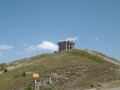
(8) Continue along theGR® south-east towards the Pointe des Trois Communes. On a clear day, look out for the fort at the summit of the Authion, which remains in view all along the path on the Ortiguier ridge.

(9) Climb briefly up to the left to the Pointe des Trois Communes (history of the fort and the battle). Retrace your steps.

(9) Head west-south-west, pass in front of the military barracks and begin the descent to Baisse de Camp. Join the D68 at marker 244.

(10) Follow the road opposite (still heading west-south-west) until you reach the ski lift.

(11) Leave the road and continue on theGR® to the right. Turn left as you descend the ski run to reach Baisse de Camp and the stopover lodge l’Estive (E).

Waypoints

  1. S : mi 0 - alt. 6,959 ft - Refuge des Merveilles
  2. 1 : mi 0.26 - alt. 7,103 ft - Lac Fourca
  3. 2 : mi 0.97 - alt. 7,431 ft - Lac de la Muta
  4. 3 : mi 1.71 - alt. 7,904 ft - Lacs du Diable
  5. 4 : mi 1.83 - alt. 7,989 ft - Pas du Diable
  6. 5 : mi 2.6 - alt. 7,044 ft - Caïros (rivière)
  7. 6 : mi 3.28 - alt. 6,883 ft - Baisse Cavaline
  8. 7 : mi 3.99 - alt. 6,545 ft - Le col de Raus
  9. 8 : mi 4.88 - alt. 6,115 ft - La baisse de St Véran
  10. 9 : mi 6.32 - alt. 6,755 ft - Access to Pointe des Trois Communes - l'Authion
  11. 10 : mi 7.43 - alt. 6,191 ft - Rd68 - Baisse de Tueis
  12. 11 : mi 7.87 - alt. 6,056 ft - Waymark 244
  13. E : mi 8.26 - alt. 5,728 ft - La Baisse de Camp

Notes

There are no water sources on this section, so please make sure you take enough water with you (especially in summer).

This route passes through a protected area, which may be subject to special regulations:

Worth a visit

(9) Around L’Authion, numerous military remains—forts, barracks and blockhouses—bear witness to history.
At Authion, one of the last battles in France took place in April 1945, in which 273 French soldiers were killed, just a few weeks before the end of the war. Here, a route offers visitors the chance to explore this historic site from the end of the Second World War.
Two websites on the history of the Authion massif:
Authion
Vesubie
The Authion route is a 10km circular route, freely accessible to vehicles between May and November, depending on snow conditions. It offers the chance to explore this exceptional fortified complex.
The Authion massif is a range of peaks situated opposite the Italian border in the central part of the Mercantour National Park. A true natural fortress, it overlooks the Vésubie and Roya valleys and, for this reason, was considered a strategic location.

During the 1880s, following the deterioration of relations between France and Italy, extensive fortification works began. In 1943, the Authion was occupied by the German army.

Cabanes Vieilles Barracks
Built in 1890 to house troops on manoeuvres in L’Authion, the camp underwent numerous extensions. In 1939, nearly 1,500 men were stationed there.

Plan Caval
Of the six blocks under construction, only the three infantry blocks were cast and reinforced.
- Block 4 is equipped with a embrasure for a twin machine-gun mount, two embrasures for light machine guns and a turret for a twin machine-gun mount.
- Block 5 is equipped with a turret for a lookout and a light machine gun.
- Block 6 is equipped with two embrasures for twin machine guns.

The Redoubt of the Three Communes
Built between 1897 and 1899 on the site of a former Sardinian battery, the Redoute des Trois Communes is the first fort in the Alpes-Maritimes to be built of reinforced concrete. Only the gorge-facing façade is built of cut stone. Pentagonal in shape, it is surrounded by a moat. Perched on the highest point of the Authion massif at an altitude of 2,080 metres, it overlooks the Ortiguié ridge leading to the Col de Raus and the former border. Its role was to protect the forts of La Forca and Mille Fourches. Occupied by the Germans in 1943, the front of the fort suffered damage during the French attack on 12 April 1945.

Tête de L'Authion Barracks
Barracks built at the foot of the Redoute des Trois Communes at an altitude of 2,074 metres

Fort de la Forca
Built between 1889 and 1891 at an altitude of 2,078 m, the fort has a façade flanked by two double concrete caponiers. Occupied by the Germans, on 10 April 1945 fighter-bombers attacked the fort, which was subsequently occupied by the French on 12 April.

Fort de Mille Fourche
Situated at an altitude of 2,048 metres, the fort was built between 1889 and 1891 on the site of a former Austro-Sardinian redoubt. It operated in tandem with Fort de la Forca, of which it is a replica. Occupied by the Germans, it sustained serious damage during the French attack on 11 April 1945.

Always be cautious and plan ahead when you're outdoors. Visorando and the author of this route cannot be held responsible for any accidents occurring on this route.

The GR® and PR® markings are the intellectual property of the Fédération Française de Randonnée Pédestre.

Reviews and comments

5 / 5
Based on 2 reviews

Reliability of the description
5 / 5
Ease of following the route
5 / 5
Route interest
5 / 5
Véronique D
Véronique D

Overall rating : 5 / 5

Date of your route : Jul 10, 2024
Reliability of the description : ★★★★★ Very good
Ease of following the route : ★★★★★ Very good
Route interest : ★★★★★ Very good
Very busy route : Yes

Even at the start of July, there are plenty of people around. Which can be nice, as you meet some lovely people.
The Valley of Wonders certainly lives up to its name. Once we’ve left the lakes behind, there’s no more water until Camp d’Argent.
There’s a technical descent after the lakes. Despite my kit, I managed it, so...
Magnificent views!

Machine-translated

isa13
isa13
• Edited:

Overall rating : 5 / 5

Date of your route : Aug 28, 2019
Reliability of the description : ★★★★★ Very good
Ease of following the route : ★★★★★ Very good
Route interest : ★★★★★ Very good

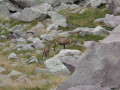
Once again, this is a beautiful route offering the chance to see a wide variety of landscapes. The rocky terrain gradually gives way to “meadows” and forests. It is also the last stretch where you can spot chamois and marmots.

Machine-translated

Other walks in the area

For more walks, use our search engine .

The GPS track and description are the property of this route's author. Please do not copy them without permission.