Country:

 City:
City:


Park in the small car park at the top of the village of Le Sappey.
(S/E) Continue along the road, which climbs steeply, until you reach the village of Le Crêt, the last one before the trail.
(1) You’ll quickly pass through the village, and when you reach the car park for hikers, turn left, walk past the signpost for the marked trails in the area, and turn right before the first house. This is the start of the track leading up to the Col de la Buffaz.
As you go, ignore the paths branching off to the left. Pass the chalets at La Grosse Pierre, then those at La Cloie, before crossing the Nant de Thuy.
(2) The track was just waiting to cross this stream to gather momentum and set off once more up the slope. Brace yourself, as the kilometre and a half to the pass may seem quite steep! As you approach the Suets chalets, you’ll cross a stretch of meadow, but the track soon returns to the shade for the rest of the climb. At least you’re walking in the shade without having to suffer the added discomfort of the beating sun. When, as you pass the final hairpin bend, you catch a glimpse of the edge of the forest, it means the Col de la Buffaz is very close.
(3) Cross the pass along its summit ridge, passing the mountain chalet, and begin the climb up the ridge above it. Although it is just as steep as the track, it is a path well-suited to human feet, as well as to those of the many sheep that graze here. This means that in wet weather, it can get a bit muddy.
Follow the ridge until you reach the Chalet de l’Ovine, where the track curves to the right to reach the pass of the same name. Between the chalet and the pass, you reach the highest point of the route, although this section is largely level.
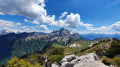
(4) After winding beneath the ridge, the path cuts across it just before the Pointe de Puvat, which juts skywards like a blade. As soon as you’ve crossed the pass, the track descends the slope in a series of tight hairpin bends, before continuing in a straight line along the other side of the ridge. It continues in this manner until it reaches a very damp, level stretch.
(5) Ignore the path on the left leading directly to the Notre-Dame des Neiges Chapel and head right. Cross a fence, then a stream, and ignore the path on the right that climbs towards the Chalet des Auges to begin the descent, heading left between two boulders. The path winds down through a forest of tall trees until it reaches a wet area which you cross via a footbridge. When you reach the mountain pastures again, the ground is so waterlogged that a water collection system has been installed there (a large concrete structure at the edge of the path). The place is aptly named: Les Mouilles!
(6) After passing through another fence, let the path leading to the Maison du Plateau branch off slightly to the right, and take the one on the left towards Le Paccot.
Once past the Mouilles chalets, turn left across the pastures to follow a small valley leading directly to the Paccot restaurant, easily spotted by its huge car park.
(7) Cut across the track running alongside the car park to join a path that descends towards the Ruisseau du Paccot. Cross it via a makeshift bridge, before veering left and heading uphill towards a patch of sparse woodland. The track disappears into this scattered woodland until it reaches the fence of an alpine pasture (no dogs allowed); cross it until you reach the hamlet known as “Le Dran”. As you pass, note the depressions in the limestone plateau that dot the route. The deepest is perhaps the “Trou de l’Enfer” (Hell’s Hole) marked on the map. It certainly suggests the karst cavities that this limestone plateau must conceal.
(8) The track leading up to the Notre-Dame des Neiges Chapel, whose silhouette can be seen in the distance on the hill, follows the wooded edge that marks the boundary of the Plaine du Dran. This mountain pasture, dominated by the Pointe de la Québlette, gives an impression of immensity, with only the scattered chalets providing a sense of scale.
(9) The chapel stands at the highest point of the western slope of the plain. Its modest appearance conceals a lovely fresco depicting the Flight into Egypt, reproduced on the interior wall within a winter setting.
After passing the last chalet beyond the chapel, the track begins its descent above the Ruisseau de l’Adroit. It winds down the mountainside until it reaches La Rosière, where the wooded landscape gives way to pastureland.
(10) Go round the hamlet’s buildings to the right before leaving the track and turning left onto the path that winds its way between the boulders. Cross the lower part of the clearing where the Chalet de la Rosière is situated, before climbing the opposite slope, following a rather perilous path that winds its way up through the woods until you reach the Chalet de la Têtaz. Please note, this path is poorly marked and very steep in places. It is likely to be slippery in wet weather.
(11) The Chalet de la Têtaz stands on the ridge marking the end of the Montagne du Sappey. Is it used by the Water and Forestry officials who manage the surrounding forests? In any case, the padlock securing it rules out its use as a refuge, as indicated on the IGN map. Walk past the chalet to reach the viewpoint overlooking the village of Thuy and the valleys that converge there.
Shortly after the viewpoint, let the path leading to Le Crêt branch off to the left and head down the slope to the right, crossing the magnificent beech forest overlooking the village of Le Sappey.
Shortly before reaching the first houses in the village, you’ll come to meadows through which the path winds, running alongside a fence. Just before reaching the village chapel, leave the path that appears to have been privatised, walk past a chalet and reach the passage leading to the small building.
When you come out onto the road, there are just a few metres left to walk to the left to reach the starting point (S/E).

 Visorando Member

 Moderate
 Extremely difficult
 Very difficult
 Easy
Easy