Country:
 City:
City:


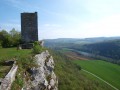
(S) Visitor car park at the castle, in front of the old village school on the street of the same name. Follow the directions carefully, as the route is not signposted. When you leave the car park, turn left. At the sign (Parking visiteur du château), turn right until you reach the edge of the woods, where you will find a dead-end road called Rue des Ruines. Take the gravel path on the right that climbs up to the keep. You will come to a wooden gate and, on the right, in front of a telecommunications antenna, the path turns left shortly afterwards.
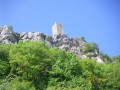
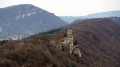
(1) You are now at the ruins. At the top of this highest point, a complex of fortifications was built, probably dating from the Middle Ages, between the10th and13th centuries. The remains of the castle have been listed as a historic monument since 8 June 1926. All that remains today are the outer walls and the keep, the former residence of the lord and his family, which probably had four floors. The castle had a breathtaking view of the village and the Doubs valley. You will also have a view of the chapel of Notre-Dame du Mont on the opposite bank.
(2) Passing in front of the keep, you will come to a small passage between two walls forming a fairly high step, which you descend. With extreme caution, you can climb the left-hand wall to reach an unsecured viewpoint over the village. After the step, take the rocky path on the right, which runs along the cliff and borders the precipice on small passages. You must tread carefully and watch your step, as the rocky outcrops could cause you to trip. Good footwear is essential and walking sticks are recommended. Do not rely on the GPX track, as this path does not appear on the map and I traced it by eye.
(3) About 800 metres from the keep, you will come to another path going uphill. Stay on the ridge, ignoring the paths that descend perpendicularly. From time to time, taking care to remain cautious, you will discover unsecured viewpoints over the Doubs valley and the Jura mountains. You will cross the typical forest that crowns our limestone mountains around Besançon, accompanied by the scent of boxwood.
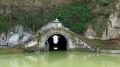
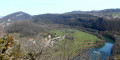
(4) When the trail begins its descent towards Rancenay, you will enjoy beautiful unobstructed views, particularly at the Double Écluse, a small area near a metal pole fixed in the rock, which offers an ideal picnic spot with a magnificent 180° view of the Côte de Planoise, the village of Rancenay, its church and the mountains of Larnod and Busy.
(5) At a small marker, the trail turns left and descends at a right angle for 100 metres, joining another wider path below, which you take on the right to reach Rancenay. Before leaving the woods, you will pass a picnic table.
(6). Walk alongside the town hall and, at the stop sign, turn left down Rue Principale until you reach the calvary, then turn right into Rue de Lavaux, which you leave 200 metres further on at a no-entry sign and turn right into Chemin sous la Grette (a dead-end road). You will walk alongside old quarries on your right. The road ends at the edge of a pasture blocked by large stones and barbed wire, which you can easily cross.
(7) Turn right immediately, following the edge of the woods. On the hill opposite, hidden in the vegetation, you will see the Rocher de Valmy. You will cross fields and pastures. The ideal time for this hike is when the grass is low or the hay and second crop have been gathered so that, out of respect for our Comtois farmers, you do not " triper " (an old word in our dialect meaning to trample or crush) the fodder. At the end of the first pasture, there is a lovely view of the banks of the Doubs and, near the riverbank, a passageway in the fence allows you to reach the second pasture. Follow the riverbank and there is another passageway to cross the barbed wire without damage. You will probably have to squeeze through or step over (if you have long walking sticks like me) a barbed wire fence between pastures.
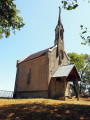
(8) On the other side of the Doubs, in the wooded hillside of Comice (the climb towards Larnod), look for the national road in a gap or among the rocks surrounded by greenery. Then walk up the pasture perpendicular to the river and, after a little searching, you will find the path that will lead you through orchards to the beautifully named church of Notre-Dame de l'Assomption des Champs. The church was first mentioned in 1341 as a chapel belonging to the Lord of Montferrand. A bell tower porch, topped with a Franche-Comté imperial dome, was built in 1725.
(9) Head back up Rue de l'Église towards the centre of the village. Keep an eye out for a pretty medieval gargoyle with a demon's head on an old section of wall on the right. You will come back to Rue Principale, which you should take down to the left to leave the village.
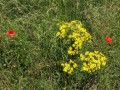
(10) You will follow the mountain and the banks of the Doubs along a small, sunny road lined with wheat fields dotted with poppies. Take a quick look at the Double Écluse (double lock) on the other bank and at the foot of the mountain at the numerous small huts, from the most modest to the most opulent, belonging to fishermen from Besançon or people seeking peace and nature. We come back to the keep on its hill and, in line with the road, the Chapel of Notre-Dame du Mont.
(11) Immediately at the entrance to the village of Montferrand, after a view of the Château de Thoraise, turn right onto Rue des Ranchots. After 150 metres, you will see a path on the right-hand side of the embankment that climbs and winds through the woods and leads to the telecommunications pylon. From there, follow the same route back to the car park.
 The route includes ledges and unsecured viewpoints. Follow the description carefully, as this route is not marked.


 Visorando Member
 Easy
Easy