Les sentiers des Charbonniers à l'Est de la Chartreuse de Montrieux

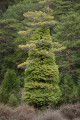
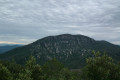
This circular route passes through several areas formerly used by charcoal burners, several boundary markers erected in the 19th century, and the Chartreuse de Montrieux-le-Jeune. There is a panoramic viewpoint stretching from La Loube mountain to Mont Coudon. From there, you can see a unique set of ridge-shaped rocks. Most of the hike takes place in the undergrowth, crossing an oak forest with some remarkable specimens, then ending along the cool banks of the Gapeau, which are so pleasant to walk along in summer.

A GPX track is required for this route.

Details

26305818
Creation:
Last update:
Last review:
  • Walking
    Activity: Walking
  • ↔
    Distance: 9.75 km
  • ◔
    Average duration: 4h 00 
  • ▲
    Difficulty: Moderate

  • ⚐
    Back to start: Yes
  • ↗
    Ascent: + 415 m
  • ↘
    Descent: - 414 m

  • ▲
    Highest point: 623 m
  • ▼
    Lowest point: 220 m

Photos

Description of the walk

How to get to the start of the hike.
On the D202 between the villages of Signes and Méounes-lès-Montrieux, go to the junction of the road leading to the Chartreuse de Montrieux. The junction is marked by a large metal cross and information signs. You can park nearby or in the unmarked car park just after the ford, on the right-hand side of the road leading up to the Chartreuse (this road is closed to motor vehicles).

The start and finish of the circular route are at the information signs.

(S/E) Follow the road (yellow markings) to the three-way junction.

(1) Continue straight ahead to the Chartreuse de Montrieux. The track on the left is the return route.

(2) Chartreuse de Montrieux-le-Jeune (water point opposite). Turn around and return to the three-way junction.

(1) Leave the tarmac road and follow the track on the right, continuing straight ahead until you reach the junction of the two circular paths, marked by an underground cistern and a sign reading: "Protection incendie MMX7" (Fire protection MMX7).

(3) Turn right towards the east onto the track marked by the number 4 painted on an oak tree, then head south until you reach the second hairpin bend.

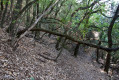
(4) Take a path between two oak trees, which is steep for a few metres. Its starting point is marked by a few stones at the foot of the oak tree on the left. Follow the cairns. After about 30 metres, descend to the right onto the path marked by cairns on either side (the path ascending to the left is no longer passable).
The path then climbs southwards, where a few blue dots complement the cairns (see § 2 in "Practical information").
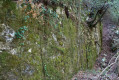
Cross a charcoal burner's platform with blackened ground and a rock in the middle, then further on, pass a clearly visible mossy rock topped with a cairn.
Please note: from here, the trail may be hidden by a carpet of leaves: after the rock, turn slightly to the left and then to the right.

(5) At the first large cairn on the right a few metres away, the path straightens out towards the south and joins a second large cairn. Leave the latter on your left and keep close to it so as not to lose the path, as the terrain can be confusing.
Pass the remains of a charcoal burner's hut on your left, then join the track at a hairpin bend.

(6) Take this track on the right, which initially heads south. Here, it is possible to shorten the circular route by taking a first alternative route: see point 3 in "Practical information". Pass a memorial stone on the left, set back from the track, then join a crossroads of tracks and paths.

(7) Then turn right onto the unmarked path heading west-northwest (shortcut possible, see point 3 in "Practical information").

(8) At the intersection of paths, turn left heading due south. On the right under the trees is a charcoal burner's hut. The path climbs and initially heads south (yellow markings). Cross the track and continue straight ahead on the path (a cairn on a rock marks the location). At the start of a series of hairpin bends, leave the path on the right and turn left (yellow markings). You will reach a shaded clearing.

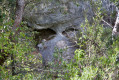
(9) At the Y in the clearing, turn left towards the east-north-east, then join a track. Follow it to the left, climbing up to the relay station on your right. Descend slightly to the left, passing the first wooden post, then to the north-west of the relay station. Clearing has significantly altered the terrain for about 50 metres, but there is no risk of getting lost: follow the cairns to an isolated rock that is clearly visible as soon as you pass the relay station. Leave this rock on your right, where a blue arrow indicates the direction to follow. Pass an imposing rectangular boundary marker built of dry stone. Further on, you will see a path on the right that leads to a rocky slab hidden by vegetation.

(10) Reach the slab, where you will find another embedded marker and a beautiful panoramic view. Take the path that first heads north-east and then north (yellow markings). At a right-hand bend where you need to lean against a rock, just after passing it, take a detour to the left onto a charcoal burner's platform between some large rocks, then rejoin the yellow trail. About 250 m further on, the trail heads north onto the Plaine de Jean Blanc, passes a charcoal burner's platform on the right, then joins a track. Turn right onto the track and follow it for about 30 metres, then turn left onto the path marked in blue. Join a track and continue for about 300 metres, then look for a path on the right.

(11) Take the path on the right (marked in yellow) which heads east for a short while. Ignore the various paths on the left and right. The path then heads north, and before joining the track, pass a path on the right marked in blue.

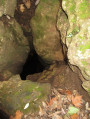
(12) Turn onto the track on the left, which heads west-southwest, marked 4 on a tree after the change of direction. Pass two large, deep crevasses overgrown with vegetation on the left.
Pass a platform with a large oak tree on your right (this is the start of a path that you do not take: it is visible on the IGN map). Return to the junction of the two circular paths you passed on the way out.

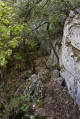
(3) Leave the track at the MMX7 fire protection sign and 20 metres later, turn right onto the path heading west-northwest, marked at its start by a small marker on the left. Caution: do not confuse this path with the track to the left of the marker. On the path, pass another overturned marker bearing the number 38, then a remarkable rock that looks like a wall.

(13) At the bottom of the valley, take a sharp right turn towards the east. From this turn, continue for about 200 metres and look for a path on the left.

(14) Turn left onto this unmarked but clearly visible path, which initially heads north, goes around the Grand Bosquet, then runs along the banks of the Gapeau. Ignore a few more or less visible paths leading off to the right that go to the riverbank. Stay on the path furthest to the left and finally join the (S/E).


Waypoints

  1. S/E : km 0 - alt. 222 m - Information boards on the edge of the D202. Near the - Gapeau (fleuve)
  2. 1 : km 0.8 - alt. 286 m - Three-way junction, round trip to La Chartreuse
  3. 2 : km 1.12 - alt. 294 m - Water source - Chartreuse de Montrieux Le Jeune et point d'eau
  4. 3 : km 1.78 - alt. 304 m - Crossroads of the two circulars
  5. 4 : km 2.03 - alt. 345 m - The trail starts at the hairpin bend.
  6. 5 : km 2.23 - alt. 394 m - First large cairn
  7. 6 : km 2.45 - alt. 397 m - Continue south on the trail.
  8. 7 : km 2.75 - alt. 409 m - Turn right onto the barely visible trail.
  9. 8 : km 2.87 - alt. 408 m - Charcoal burner's hut, turn left heading south.
  10. 9 : km 4.05 - alt. 606 m - At the fork, continue eastwards.
  11. 10 : km 4.39 - alt. 608 m - Detour on rocky slab - Boundary stone and beautiful view
  12. 11 : km 5.53 - alt. 366 m - At the intersection, turn east.
  13. 12 : km 6.88 - alt. 282 m - At the crossroads, turn west onto the track.
  14. 13 : km 7.91 - alt. 286 m - Take a sharp right turn towards the east.
  15. 14 : km 8.06 - alt. 276 m - Unmarked trail
  16. S/E : km 9.75 - alt. 222 m - Information boards on the side of the D202

Notes

1 - Access to the Var forest areas exposed to the risk of forest fires:
https://www.risque-prevention-incendie.f...

2 - Reading the terrain while hiking:
To view the trails, feel free to change the map background: switch from IGN to OSM Trails, as one complements the other.
- From (4) to (6), the trail is only marked by cairns, stones placed in the hollows of branches and blue paint marks at the foot of some shrubs. This section is sometimes hidden by leaves on the ground, so you need to be careful.

3 - There are two options for shortening the circular:
- (6), turn left onto the track, then join the yellow-marked trail at point (11). This shortens the circular route by approximately 2.7 km.
- (7), turn left onto the track, then join the blue-marked path on the left and then the point (11). This reduces the circular route by approximately 2.1 km.

4 - Water points:
1/ On this route: the fountain opposite the Chartreuse.
2/ Outside this route: the spring located next to the pond south of the Chartreuse. After (8), at the intersection with the yellow-marked trail, turn right onto the latter. At the intersection, turn left and descend to the spring (round trip: approximately 1.7 km).

There is no shelter along the route.

Standard hiking equipment is sufficient.

Due to the steepness of some sections and the leaves on the ground that make them slippery, it is best to follow this trail in the direction described.

Worth a visit

During the hike
- Numerous charcoal kiln platforms and a few huts belonging to their operators line this route: hikers should be curious and sometimes stray from the path to search for traces leading to these disappearing remains.
These platforms can be identified by the blackened ground caused by the combustion process involved in turning wood into charcoal.
Seventy-five years later, vegetation is still struggling to reclaim the land marked by this craft, which came to an end after the Second World War.
http://randojp.free.fr/0-Diaporamas/Four...
See the article by Ada Acovitsioti-Hameau (ASER Centre-Var): "The habitat of forest craftsmen in the middle of Provence - the example of charcoal burners".

- At the beginning of the 19th century, a map of the communes was drawn up.
The municipal boundaries were defined by large dry stone walls called clapiers, approximately 5 m long by 1.2 m wide and 0.8 m high.
These walls are clearly visible on the paths on either side of the relay antenna.
http://randojp.free.fr/0-Diaporamas/Born...

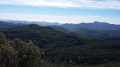
- (10): a panoramic viewpoint stretches from La Loube mountain to Mont Coudon.
In the distance, the Hyères Islands are clearly visible.
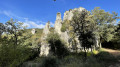
To the north-northwest, you can see a remarkable group of ridge-shaped rocks, which can be seen on the left at the start of the hike from the road leading up to La Chartreuse.
The village of Méounes, nestled at the foot of the hills, stands out in the heart of a green setting.

Near the hike
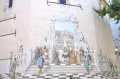
- La Chartreuse de Montrieux, which is not open to visitors.
However, a small chapel built into its façade is often open.

- The spring and basin located 500 m south of La Chartreuse.
(Marked as "Bassin de la Source" on OSM).

- The unmissable Aiguilles de Valbelle, which are the subject of several guidebooks on Visorando.

Reviews and comments

3.7 / 5
Based on 6 reviews

Reliability of the description
3.5 / 5
Ease of following the route
3 / 5
Route interest
4.5 / 5
Fibie83
Fibie83

Overall rating : 4.3 / 5

Date of your route : May 27, 2025
Reliability of the description : ★★★★☆ Good
Ease of following the route : ★★★★☆ Good
Route interest : ★★★★★ Very good
Very busy route : No

A very pleasant hike, in the shade and cool on this hot day.
The landscapes were very varied, with lots of flowers to brighten up our hike.
GPS essential
Thanks to the author who found some well-hidden and exotic paths.

Machine-translated

rumax
rumax

Message to Patricia 83210:
Sorry you had some difficulties.
When writing this guide, I posted a photo showing point no. 3, which caused you problems: the start of the path to the large cairns.
That said, a few months after this hike was published, someone added blue dots to make it easier to find.
If you use the app, the trail is visible on the OSM map, and you should feel free to use it in addition to the IGN map.
Nature is indeed reclaiming its rights, and it would probably be a good idea for all of us to put a pair of secateurs in our rucksacks so that we can do a bit of collaborative maintenance.
If I go back there, I'll make sure to do so.
Happy hiking in the future.
Kind regards, rumax.

Machine-translated

Patricia 83210
Patricia 83210

Overall rating : 3.3 / 5

Date of your route : Apr 07, 2025
Reliability of the description : ★★★☆☆ Average
Ease of following the route : ★★★☆☆ Average
Route interest : ★★★★☆ Good
Very busy route : No

At location No. 3, it is very poorly marked and not visible at all because no one does this hike. The vegetation has taken over and you can't see much.

Machine-translated

Stophe
Stophe

Overall rating : 4.3 / 5

Date of your route : Apr 06, 2025
Reliability of the description : ★★★★★ Very good
Ease of following the route : ★★★☆☆ Average
Route interest : ★★★★★ Very good
Very busy route : No

Although a little difficult to follow, this route is very pleasant and offers a variety of different atmospheres. The trail is not very busy, except at intersections with other paths. I really enjoyed this hike and would recommend it to anyone who likes a bit of adventure in areas where nature is quickly reclaiming its rights, but less so to those who prefer well-marked, easy-to-follow routes.

Machine-translated

jcrando83
jcrando83
• Edited:

Overall rating : 4.3 / 5

Date of your route : Jun 27, 2023
Reliability of the description : ★★★★☆ Good
Ease of following the route : ★★★★☆ Good
Route interest : ★★★★★ Very good
Very busy route : No

Hello,
Between checkpoints 1 and 2, it was best to follow the cairns and blue markings. It's not easy because the terrain is very steep in this area, but with a little care, you can get there without too much trouble.
Having followed this trail at the beginning of summer, it was ideal because 90% of it is in the woods.
A very beautiful hike.
A small suggestion: it would be nice to add a little detour to admire the Chartreuse.
Well done for this trail!

Machine-translated

madi83
madi83
• Edited:

Overall rating : 2.3 / 5

Date of your route : May 28, 2023
Reliability of the description : ★★☆☆☆ Disappointing
Ease of following the route : ★★☆☆☆ Disappointing
Route interest : ★★★☆☆ Average
Very busy route : No

After leaving the trail, the track proved impossible to follow. Overgrown with a tangle of sarsaparilla and dead wood, with landmarks that were virtually invisible despite a few rocks marked with large blue dots, the steep terrain was impassable. We managed, as best we could, to return to the trail to the east, which took us to point 6.
From then on, the walk was very pleasant in the shady, uncrowded undergrowth, away from the path leading to the charterhouse. We will do it again, taking a short route through the off-trail section by turning left at point 1.

Machine-translated

Makabou
Makabou
• Edited:

Overall rating : 3.3 / 5

Date of your route : Sep 28, 2022
Reliability of the description : ★★★☆☆ Average
Ease of following the route : ★★☆☆☆ Disappointing
Route interest : ★★★★★ Very good
Very busy route : No

Hello, we only covered two-thirds of this hike. The markings (white marks) are almost invisible and often blend in with natural markings. You have to be very careful not to get lost, even with the cairns (piles of stones of varying sizes). This hike is not the easiest. It is quite physically demanding, but we still managed it despite our age (67 and 64 years old and without much experience), though not without difficulty... That said, we enjoyed the extensive panoramic views, including one overlooking the sea. Magnificent. We ended this walk with a picnic on the banks of the small (at this point) river Le Gapeau under a magnificent and very pleasant canopy of trees.

Machine-translated

Other walks in the area

For more walks, use our search engine .

The GPS track and description are the property of this route's author. Please do not copy them without permission.