Country:
 City:
City:


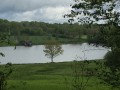
Park easily by the lake, where the Route de l'Aigle and Route de Sainte Gauburge separate, in a small car park at the entrance to the path leading to the Saint-Évroult leisure centre. However, there are several other parking options.
(S/E) Take the Route de Sainte-Guburge (D31).
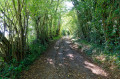
(1) Just after a house, a path branches off to the left. It is a pretty sunken path between the trees. The start is marked by a municipal sign. Take this path, which is the "real" start of the hike. The path quickly turns eastwards until it reaches a fork.
(2). Take the bridle path on the right that heads south-east. The path continues in the same direction for a long time. Its name appears on a few signs that you will pass: Chemin de la Grande Traverse. Various markings are visible. Some are used for hunting, others indicate footpaths or bridleways, and there is even a mountain bike route. Ignore the several paths that generally branch off perpendicularly or sometimes diagonally to continue in the same direction until you reach the edge of the Étang de Saint-Clair.
(3) In fact, there are several ponds (Débuzot, Buzot, Petit Étang) that you can visit if you wish before continuing on the route described.
Now take a path that branches off to the right along the Étang de Saint-Clair in a south-westerly direction, following the bed of a barely visible stream.
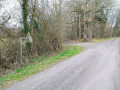
(4) This will take you to the D230, a very small, quiet tarmac road, which you follow to the left towards the south. The road climbs gently until it reaches a plateau.
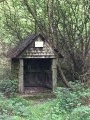
(5) A path then branches off to the right. A sign attached to a tree and a number (46) can be used as a landmark. This straight path is the Ligne des Essarts. You will soon arrive at a new pond, the Étang de l'Essart. On the left, a small wooden hut has a sign indicating "Fontaine de l'Essart". The word essart refers to a clearing in the forest. In the past, this was often where charcoal was made.
(6) Immediately after, there is a large forest house on the right. Many rhododendrons have taken root here. It is an introduced species but is protected in Normandy. In Ireland, on the other hand, it is considered a dangerous invasive species. It is true that it colonises all the undergrowth on the island, whereas it remains more discreet in Normandy. We are now on a wide, passable but unpaved forest road.
(7) The path crosses the D31 road perpendicularly and continues into the forest. The path, now more rural, descends to a place called Pont de la Lune.
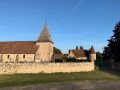
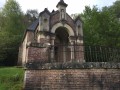
(8) At this point, the suggested route makes a detour to the left towards the south-west to visit the charming site of the Chapel of Saint-Evroult and its fountain, where the source of the Charentonne river is located.
(9) Return to Pont de la Lune and this time take the straight path opposite, which heads north-east to the Étang de la Charentonne
(10) It makes a sharp left turn to the north-west and passes over the dyke that maintains the pond.
(11) It joins the D50, which you follow to the right until you reach Saint-Evroult. Then turn right onto Route de l'Aigle to quickly return to the lake shore and the starting point (S/E).



 Visorando Member
 Easy
Easy  Association / Club / Walk leader