The Corniches Paretti, the Calanque du Devenson, the Couloir des Huluberlus

This route, combining hiking and climbing, will take you from Luminy to the Calanque du Devenson, reputed to be the most difficult of the Calanques to access, via the Balcon du Socle de La Candelle, the Pas de l'Oeil de Verre and the Corniches Paretti.
The ascent will be via the Corniche Aérienne and the Couloir des Huluberlus. The more traditional return route will take you along the Crête du Devenson, the Vallon de La Candelle and the Sentier des Treize Contours before returning to Luminy.

You are in the Calanques National Park, which is subject to specific regulations. Failure to comply with these regulations may result in a fine of up to €1,500.

Details

807329
Creation:
Last update:
Last review:
  • Walking
    Activity: Walking
  • ↔
    Distance: 12.53 km
  • ◔
    Duration according to the author: 7 hrs 
  • ▲
    Difficulty: Extremely difficult

  • ⚐
    Back to start: Yes
  • ↗
    Ascent: + 863 m
  • ↘
    Descent: - 863 m

  • ▲
    Highest point: 433 m
  • ▼
    Lowest point: 0 m

Photos

Description of the walk

Departure from the Luminy car park.

(S/E) Take the track leading to the Col de Sugiton (Blue trail no. 6 and Yellow trail no. 6a).

(1) At Col de Sugiton, take theGR®51-98opposite (east). Continue along the track that passes below the ruins of a Jas (Yellow Trail No. 6, Green Trail No. 6 andGR®). The track then makes a sharp turn to the right. After 300m, these three trails leave the track for a stony path on the left (south-east) joining the "Sentier des Treize Contours" which will be taken on the way back.

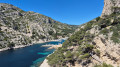
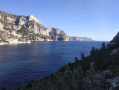
(2) Stay on the track (south), continuing along the balcony above the Falaise des Toits until you reach a barrier (on the right at the edge of the cliff, with a beautiful view of the Aiguille de Sugiton and Cap Morgiou). Cross the barrier and follow the old Red Trail No. 6, which is now partially erased. The track quickly turns into a magnificent balcony path (south-east) passing successively above the Rocher du Torpilleur, the Calanque des Pierres Tombées and the Rocher du Tonneau.

Near the Tour de Pise, at the bottom of the Couloir du Candellon, walk along the Socle de la Candelle. The path is now wilder and more chaotic, and you will need to climb over a few fallen trees. Look out over the magnificent slabs of La Commune and La Lecque, ideal for sunbathing after a swim.

As you approach the Calanque Saint-Jean de Dieu, the path along the cliff becomes more exposed. You will come out at the bottom of the Val Vierge above the calanque. Follow the red markings as best you can as they climb up the Val Vierge and lead to the Pas de l'Oeil de Verre.

(3) Climb this 15-metre rocky outcrop, which is easily passable using the chain in place. Look up to see the famous "eye of glass" on the right-hand wall.

Follow the path for about 200m to an intersection. Leave the red trail and turn right (south-west) onto the green trail no. 9 (green markings and two black crosses) leading to the Corniches Paretti.
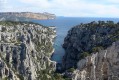
Walk along the impressive wall of La Concave, the largest overhang in the Calanques, featuring a series of three "Du Grec" routes ending with the Directissime from 1966, which is a true masterpiece.

Follow the green markings. The trail includes a few climbing steps on the ascent and descent and some more or less exposed traverses. Shortly after La Concave, cross the Grand Couloir du Devenson.
Above the Anse des Enfers, follow the path, which becomes narrower as it approaches the Petit Couloir du Devenson, at the foot of which rises the Aiguille du Devenson.

You will arrive at a ridge overlooking the couloir at the intersection with the Tracé Brun, which leads directly to the top of the Devenson cliffs on the left.

(4) Continue to the right towards the sea until you reach a small pass on the ridge leading to the foot of the Aiguille du Devenson (green markings and cairns).
From the small pass, the route becomes more difficult and exposed, overlooking the sea below with several very exposed rocky passages to cross.

(5) Descend via a short downclimb to the bottom of the Petit Couloir (east), cross it and climb up a rocky outcrop on the right via a short climb.
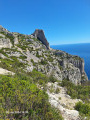
Follow the green markings. The path follows a series of narrow, exposed ledges, with rocky outcrops and promontories to climb over and descend.

Above Anse de la Baume, the trail moves away from the sea and climbs up through the pine trees.
A gentle descent leads to the foot of the Grande Arête du Devenson spur, the gateway to the impressive Cirque du Devenson.
An easy descent leads to the top of the cove. A steep, earthy descent (carved steps) leads to a small scree slope leading to the beach at the bottom of the Calanque du Devenson.

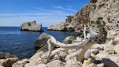
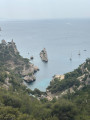
(6) The large, more or less flat boulders at the water's edge are ideal for picnics and sunbathing after a swim. The Cirque du Devenson dominates with its steep walls. To the east, the wall of the Tour Save plunging into the sea prevents any continuity of the path. The view extends towards the cliffs of Eissadon, Oule, Castelviel and, in the distance, towards the Soubeyrannes cliffs and the Bec de l'Aigle.

Leave the cove by retracing your steps for about 200 metres shortly after the Grande Arête until you reach a visible three-way junction where a path branches off to the right (west).
The Black Trail No. 8 of the Corniche Aérienne begins here, heading towards a large pine tree suspended about fifteen metres from the foot of the cliff.

Follow this path, marked by a black circle on the rock face. You will come out onto a small cove where a blue inscription with an arrow pointing to the left indicates "Grande Baume and Couloir des Hurluberlus via the Corniche Aérienne 1921". Reach the pine tree by traversing upwards to the left. Cross the small ledge above to an equipped belay station (2 stainless steel bolts).
Climb the path that follows towards a rocky ledge with a very visible crack. Climb this second ledge following the crack to an equipped belay station (pigtail, historically used for abseiling, and stainless steel bolt).

Note: These two short pitches, with a difficulty rating between III and IV, have now been cleaned and cleared of unstable holds and are protected by numerous stainless steel bolts.
Follow the path that climbs diagonally to the left to a flat area below the Grande Baume du Devenson (scree and rocks).

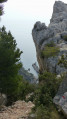
(7) Continue to follow the Tracé Noir by taking the path to the right (east) through the vegetation. Reach a small rocky outcrop to the right of the Baume, climb up it to reach the Couloir des Huluberlus. Climb up the couloir and reach a rocky passage on the left crossing above the Grande Baume. This exposed but easy and well-protected passage marks the end of the difficulties.

Follow the steep path to the ridge where you join the Sentier Vert n°8 just after the Col du Devenson. You will soon reach the intersection with theGR®51-98(Vallon des Charbonniers) where the Petit Couloir du Devenson ascent route begins nearby.

(8) Follow the Green andGR® trails up the ridge (north-west) to above the Concave before descending to the Col des Charbonniers. Continue to the intersection where you leave the Green trail and stay on theGR® which climbs up to the left (west) of the Vallon de la Candelle. Follow this path along the slopes of Cap Gros. Cross the valley to join the Yellow No. 6 and Green No. 6 trails going up to Col de la Candelle.

(9) Descend via the Sentier des Treize Contours (marked yellow no. 6, green no. 6 andGR®) which winds beneath the slopes of Mont Puget along the Promontoire des Américains. After a descent over slippery rocks, cross the Chemin du Centaure to rejoin the route taken on the way up.

(2) At the intersection, take the track in the opposite direction towards the Col de Sugiton.

(1) From there, head to the Luminy car park (S/E).

Waypoints

  1. S/E : km 0 - alt. 141 m - Luminy car park
  2. 1 : km 1.73 - alt. 215 m - Sugiton Pass (215m) - Col de Sugiton (215m)
  3. 2 : km 2.52 - alt. 216 m - Intersection of the GR and Red trails
  4. 3 : km 4.46 - alt. 79 m - Pas de l'Oeil de Verre
  5. 4 : km 5.48 - alt. 104 m - Intersection of the Green and Brown Trails
  6. 5 : km 5.55 - alt. 69 m - Aiguille du Devenson
  7. 6 : km 5.86 - alt. 0 m - Calanque du Devenson
  8. 7 : km 5.96 - alt. 96 m - Grande Baume du Devenson
  9. 8 : km 6.23 - alt. 240 m - Top of the Petit Couloir
  10. 9 : km 8.15 - alt. 425 m - Col de la Candelle (400m) - Col de la Candelle (400m)
  11. S/E : km 12.53 - alt. 140 m - Luminy car park

Notes

Difficulties:

This long hike combines walking and climbing and has a significant cumulative elevation gain. The duration will depend on the number of participants and their technical level, particularly if it is necessary to belay and/or install handrails in exposed passages, and on the inevitable swimming break.

The route is marked, but the markings are old and, in places, partially erased. The GPS track is approximate on the sections close to the cliffs where the difficulties are concentrated. Much of the route is not shown on IGN maps. It is therefore often necessary to switch to "route finding" mode.

The Red Route No. 6 (Pas de l'Oeil de Verre), Green Route No. 9 (Corniches Paretti) and Brown Route (Petit Couloir du Devenson) can be done without ropes for people who are comfortable in this type of terrain and have level III climbing skills, noting that several passages are very exposed and a fall in these areas could be fatal (fall of several dozen metres).

The ascent of the Corniches Aériennes (Black Route No. 8) requires level IV climbing skills and mastery of belaying techniques.

The exposed sections, particularly Les Corniches Aériennes, are now equipped with numerous sealed stainless steel bolts to secure these passages using appropriate belay techniques.

Equipment:

Wearing a helmet is recommended on the Corniches Aériennes. A 25m rope (1/2 abseil of 50) and 5 to 6 quickdraws are required if you wish to belay yourself on the traverses (tensioned rope or handrail) and when climbing the various rocky outcrops and the two pitches of the Corniches Aériennes.
As always in the Calanques, be sure to bring at least 1.5 litres of water per person.
IGN map "Les Calanques" 1:15000.

History & Toponymy:

Le Val Vierge (The Virgin Valley) was named in 1899 by the first explorers of this valley, given the density of the vegetation and the difficulty of entering it.

The Calanque Saint-Jean de Dieu is better known as the Calanque de l'Oeil de Verre, but this name predates the installation of the famous eye. The origin of this name has been lost in time.
Initially, the "Pas de l'Oeil de Verre" was called "Pas du Rocher Club" in honour of the members of the Rocher Club de Provence who, on 8 April 1900, found this passage connecting the Val Vierge to the Calanque Saint-Jean de Dieu. Members of the Société des Excursionnistes Marseillais, constantly hearing this bizarre name, decided to give it some justification by sealing an old lamp lens, which they had transformed into a glass eye, in the middle of the passage on 13 November 1904.

"Le Grec" was the nickname of Georges Livanos, one of the greatest mountaineers of his time, famous for having opened a large number of highly difficult routes in the Italian Dolomites.

Land access to the Calanque du Devenson was discovered in 1914 by Marius Paretti. The ledge he used has borne his name since 1921.

La Grande Baume was first reached on 2 January 1921 by five "Huluberlus": Edmond Bellanger, Albert Faures, Henri Imoucha, Raoul Barbier and Louis Félix.
The shore was reached on 13 February 1921 by Albert Faures, Henri Imoucha and Louis Félix.

Worth a visit

Alternative route: Ascent of La Calanque du Devenson via the Petit Couloir

If you do not wish to climb back up via the Corniches Aériennes and the Couloir des Huluberlus, you can reach the Devenson ridge by climbing the Petit Couloir du Devenson via the Tracé Brun.
To do this, from Calanque du Devenson, take the route you took on the way up in the opposite direction until you reach the intersection of the Green and Brown Trails on the right bank of the Petit Couloir du Devenson.

(4) Follow the Brown Trail up to the foot of the cliff. Cross the rocky barrier blocking access to the top of the couloir by crossing the wall on the right, using the chain in place. Continue up the slab equipped with a chain, which leads to the foot of the scree on the right bank of the couloir.
Follow the partially faded Brown Trail. Leave the scree (numerous descent tracks) to climb up the rocky ridge on the left bank, which leads to the Crête du Devenson, where you rejoin the original route near the intersection of the Green Trail No. 8 with theGR® 51-98 (8).

Visit to the Grande Baume

(7) A short round trip allows you to visit the Grande Baume, where a few more or less mystical artists have expressed themselves, for better or worse depending on your taste.

Always be cautious and plan ahead when you're outdoors. Visorando and the author of this route cannot be held responsible for any accidents occurring on this route.

The GR® and PR® markings are the intellectual property of the Fédération Française de Randonnée Pédestre.

Reviews and comments

4.5 / 5
Based on 19 reviews

Reliability of the description
4.5 / 5
Ease of following the route
4.1 / 5
Route interest
4.8 / 5
User 25894175

Overall rating : 4.3 / 5

Date of your route : May 31, 2025
Reliability of the description : ★★★★★ Very good
Ease of following the route : ★★★☆☆ Average
Route interest : ★★★★★ Very good
Very busy route : No

A long approach from Luminy and a tough climb back up to the start of the traverse. The markings are old but adequate for the traverse itself, and the stainless steel pins confirm the route. Return via the brown route of the Petit Couloir du Devenson, a rather difficult climb (scree) with few signs. Long return to Luminy.

Machine-translated

Moustache 13
Moustache 13

Overall rating : 3 / 5

Date of your route : Feb 11, 2025
Reliability of the description : ★★★☆☆ Average
Ease of following the route : ★★★☆☆ Average
Route interest : ★★★☆☆ Average
Very busy route : No

It should be noted that without harnesses and a 20-metre rope, it is very dangerous to undertake this hike. In addition, a good knowledge of climbing is required to ensure the safety of hikers. There were three of us and it took us over seven hours without completing the entire hike because we went via the Paretti ledge.
Despite this shortcut, we had to put on our harnesses three times. This hike is recommended for experienced hikers and should never be attempted alone

Machine-translated

FredMaquet
FredMaquet

Overall rating : 4.7 / 5

Date of your route : Jan 03, 2025
Reliability of the description : ★★★★★ Very good
Ease of following the route : ★★★★☆ Good
Route interest : ★★★★★ Very good
Very busy route : No

Wonderful route, thank you very much for the description.

As many have said, a rope/helmet/harness/quickdraws are essential for a safe outing. The route is very exposed, and a fall could be fatal. The climbing steps are easy (3/3+) and well protected by well-placed bolts. I had my 30m 7.5mm rope and it was perfect.
I did the hike with a friend who was climbing for the first time, and it went very well. Then again, he's less afraid of heights than I am
PLEASE NOTE: the GPX track on visorando is not reliable for reaching the aerial cornice and the Hurluberlus couloir. The GPX track starts from the Devenson cove too far to the east, whereas the actual ascent route starts 100m further west. However, the photos and description are correct.

Also, the second part of the aerial ledge to the west (on the left when looking at Grande Baume) appears to have been dismantled, with the points sawn off. A rope team ahead of us warned us about this. We therefore went via the Hurluberlus corridor.

Machine-translated

lulol
lulol

Overall rating : 4.7 / 5

Date of your route : Jun 30, 2024
Reliability of the description : ★★★★★ Very good
Ease of following the route : ★★★★☆ Good
Route interest : ★★★★★ Very good
Very busy route : No

Solid description of an adventurous, high-quality route. The Devenson Couloir ridge is borderline in terms of hiking; it's doable, but you need to be confident.

I'm quite surprised by the format of the guidebook. For me, the need for belaying makes it a mountaineering route. The description should be reversed, with the Huluberlus couloir as an option and the Devenson couloir as the default hiking route.

In any case, thank you for this work, which has allowed me to discover these calanques.

Machine-translated

JB13920
JB13920

Overall rating : 5 / 5

Date of your route : May 25, 2024
Reliability of the description : Not used / Not applicable
Ease of following the route : Not used / Not applicable
Route interest : ★★★★★ Very good
Very busy route : No

Superb challenging hike on Saturday 25 May under a magnificent blue sky.
There are some dizzying sections where you'll need to use your hands, and part of the climb up the Huluberlus requires a harness and MC to be installed.
Climbing equipment is therefore mandatory for a safe ascent.
Its classification is not underestimated.

Machine-translated

Alain C16.
Alain C16.

The typing error "below the Falaise des Toits" has been corrected to "above" and the text has been reworked and updated (mea culpa).
The trail passing under the base of La Candelle, joining the Calanque St. Jean de Dieu and climbing up the Val Vierge to join the GR51 by crossing the "Cheminée du Diable" corresponds to the old Red trail No. 6, identified as such on the IGN Les Calanques map at 1:15000, 2008 edition, and classified ***. The markings have been removed by the Park (a few marks remain in places) and the route has been modified. It now follows the GR and passes through the Col de La Candelle. This new route is the one shown on the IGN Les Calanques map at 1:15000, 09/2017 edition.
This trail is still passable – I used it yesterday – and is very popular despite its real difficulty.

Machine-translated

RickyH5
RickyH5

Ah, for that, the moderators will have to take care of it...

Machine-translated

RickyH5
RickyH5

We've already talked about this... The moral of the story is to read the messages in the forum carefully.

Machine-translated

Fifou
Fifou

Overall rating : 5 / 5

Date of your route : Oct 08, 2022
Reliability of the description : ★★★★★ Very good
Ease of following the route : ★★★★★ Very good
Route interest : ★★★★★ Very good
Very busy route : No

A challenging and adventurous route. For experienced hikers. It's a shame that this is the only route of its kind in the Calanques. If anyone knows of any others, please let me know (or send me information about other wild places on the French Riviera for this type of alpine hike). Thank you. Fifou

Machine-translated

Gamelis
Gamelis
• Edited:

Going solo is not recommended. It all depends on your level, of course, but no one can recommend doing it alone.
The route includes some challenging sections. And the Couloirs des Hurluberlus is hardly feasible without climbing equipment, which means you need to be in a group of two

Machine-translated

RickyH5
RickyH5

Hello, just read the few lines above yours... It seems quite clear to me.

Machine-translated

OliviaOlivia
OliviaOlivia

Hello,

I am very keen on the description of this hike. However, can it be done alone or do you need to be in a pair to be safe on the climbing sections?

I would like to do it on Saturday, so if anyone could answer my question, I would be very grateful.

Thank you, have a nice day

Machine-translated

pp34
pp34

Overall rating : 4.3 / 5

Date of your route : Dec 18, 2021
Reliability of the description : ★★★★★ Very good
Ease of following the route : ★★★☆☆ Average
Route interest : ★★★★★ Very good
Very busy route : No

An awesome route, far from the busy areas for the most part.
Bring a rope, harness, helmets, quickdraws, slings and carabiners for the Huluberlus couloir.
Stunning views of unspoilt areas.
I highly recommend this challenging hike.

Machine-translated

pp34
pp34

Overall rating : 4.7 / 5

Date of your route : Jan 04, 2022
Reliability of the description : ★★★★★ Very good
Ease of following the route : ★★★★☆ Good
Route interest : ★★★★★ Very good
Very busy route : No

Superb circuit with a section away from the busy areas.
Challenging sections, some climbing. Equipment required (harness, helmet, quickdraws, rope, carabiners, straps for the Huluberlus couloir.
Old markings, sometimes difficult to see.
A beautiful adventure route.

Machine-translated

Superflower
Superflower

Overall rating : 4.7 / 5

Date of your route : Oct 01, 2021
Reliability of the description : ★★★★☆ Good
Ease of following the route : ★★★★★ Very good
Route interest : ★★★★★ Very good
Very busy route : No

Hello,
A very beautiful hike with magnificent views of the Devenson cirque, very quiet and not very busy. I would like to point out (or remind you) that the green trail number 9 (point 3) is no longer marked on the IGN 'Les Calanques' 1:15000 map because it is considered too dangerous. As a result, the trail is no longer maintained. Despite the fact that the markers are still clearly visible and the trail is accessible, I would have liked to see the equipment requirements -25 metres of rope + quickdraws - mentioned earlier in the guide, at point 6 for example, rather than further down. Without a rope or harness, the Huluberlus couloir is impossible to cross (5b climbing) without risking your life, even for experienced hikers like us! We were stuck above Anse de la Baume and had to climb back up via the Devenson couloir alternative: what an adventure!
I would classify this hike as extremely dangerous without equipment rather than extremely difficult.
When it's hot, I would recommend 3 litres per person.

Machine-translated

Other walks in the area

For more walks, use our search engine .

The GPS track and description are the property of this route's author. Please do not copy them without permission.