Country:

 City:
City:


Start from the car park at the entrance to the Conleau peninsula, which can get quite busy in summer. If this is the case, park at the Vannes exhibition centre (Chorus) and take the bus to Conleau.
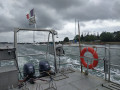
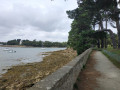
(S/E) From the car park, head for the pine forest that covers the northern part of the peninsula, then walk along its eastern shore. You will have a view of the entire landscape you will be exploring. Walk to the end of the point, skirting the villas built there, some of which are right on the water's edge, then return to the slipway where the ferry operator is based. If he is not there, simply wait for him to leave the opposite shore to come and meet you.
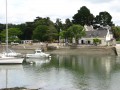
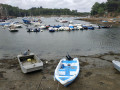
(1) In less time than it takes to say, you will be able to disembark on the Langle peninsula in Séné. As you leave the slipway, take the path on the right. It climbs above the cliff overlooking the Port Anna channel, where numerous boats are moored, including the colourful fleet of sinagots (old sailing ships with black hulls and red sails).
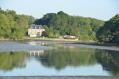
(2) Pass Anse de Port Anna, then after the Ty Anna café-restaurant, go up to the left along the street that leads to the port. After 100 metres, turn right into the narrow passageway that has been created in the high stone wall and continue along this path until you return to the sea. You will then have bypassed the photogenic pink house in Port Anna, which cannot be seen from this side of the channel. Continue left along the coastal path, bypassing a development of more or less identical opulent villas. To starboard, the horizon opens up onto the Gulf, partly hidden by the nearby Île de Boédic.
(3) Below the village of Langle, leave the slipway on your right, which seems to stretch all the way to the neighbouring island, and continue along the coastal path, crossing some oyster farms if necessary. Be careful of moving machinery when it is in operation, as space is limited and must be shared.
(4) At Le Badel, after a possible oyster and Muscadet break, continue along the coastal path to reach Anse de Cadouarn. Here, you will need to cross a small stone dyke, which may be covered by the tide when the tidal range is high. In this case, return to Le Badel and take the road that bypasses this area.
At the end of the cove, which can also be quite wet, follow the coastal path along the shore and turn left into Rue des Hirondelles to go up to Cariel. At the road, turn right and follow this road for about 100 metres.
(5) Turn left onto Rue des Vanneaux, then right after the last houses. Continue along the path to the hamlet of Kerdavid, then join the road that leads to the Langle peninsula.
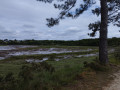
(6) Follow it for about 400 metres until you reach the first roundabout. Take the path that leads left towards the marsh. It quickly leads to a dyke that cuts across the bottom of the cove: on the right, there are old marshes where you can see a multitude of birds, and on the left, an area subject to the tides. At the end of this dyke, you will reach the first houses of the village of Séné.
(7) Turn left to continue along the coastal path, ignoring the path that goes up to Rue des Écoles. Pass just below two colourful buildings where children must have a great time, to go around the whole village of Séné, then go up towards the Cantizac mill.
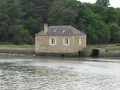
(8) When you reach the road from Séné to Vannes, turn left to pass in front of the old tide mill, whose original appearance is hard to imagine. Follow the edge of the road, first on a well-maintained footpath, which narrows before reaching Kerhuilleux and ends up being shared with cyclists. Two hundred metres after the village, just after passing the town exit sign, turn left onto the small path between two hedges. Here you will find peace and quiet!
(9) Walk along the bottom of Anse de Cantizac again to return to the hamlet of Rosvélec. At the fountain, after going around the farm buildings, turn left onto the path that leads to Pointe de Rosvélec.
(10) Return to the coast and turn right onto the path that follows it to the small Arcal beach. On the way, take a look at the Kerbourdon heritage site, which you will pass by following the coastal path. For swimming, it is best to be in this area at high tide to enjoy the small beaches that dot the route, otherwise you will end up in a mud bath!
(11) Pass Arcal Beach and continue along the water's edge until you reach Kerino slipway. This slipway is unique in that it is the roof of the road tunnel that crosses the Marle at this point.
(12) If the swing bridge is open to traffic, continue on the left to cross the river. Otherwise, turn right onto Avenue René de Kerviller, then turn right and go down the hill to go through the tunnel. It's not very interesting, but it's shorter than going back up towards Vannes to find another crossing.
On the other side, go up the stairs on the right at the tunnel exit and follow the more or less pedestrian path to the right that runs alongside the port facilities. You will pass the boarding pontoons for the islands, then a series of workshops, including Multiplast, where you may be able to see the hulls of some of the latest sea monsters.
After the last workshops, you will reach the park that occupies the entire Pointe des Émigrés.
(13) Continue along this park until you reach the road that leads to the Conleau peninsula and the car park where you started (S/E).



 Visorando Member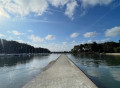
 Easy
Easy