Country:

 City:
City:


Departure from the car park at Place Joliot Curie in Nébian.
(S/E) Turn left onto Rue Anatole France. At the "Sergognes" signpost, turn right with the street and join a junction with a cross street.
(1) Turn left onto the Sentier des Heaths. After 300 metres, the concrete track veers off to cross the Combe stream.
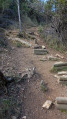
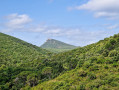
(2) Cross the stream and stay on the track until you reach the end of the olive grove. Then turn right and follow a well-marked goat path to the bottom of the field, which will take you to a row of log steps that start to climb the hill. The path first runs alongside the stream below, then a steeper path climbs up to the left (slippery in wet weather). Take this path and climb through the kermes oak trees and heather to the top of the plateau, the Pioche de Navis. A sign presenting the ancient Oppidum of Nébian provides information about the occupation of this vast area.
Cross it easily by following the path to the south-west to reach an area with picnic tables where the path joins the markedPR® along the Roc du Cayla.
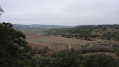
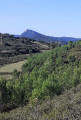
(3) Follow thePR® trail to the right along the cliffs of Roc du Cayla. The edge of the cliff offers beautiful views of the plain towards Lieuran-Cabrières and Le Vissou, but do not get too close when the Mistral wind is blowing. Unfortunately, fire has burned the vegetation on part of the rock from the top of the cliffs down to the heath below. To the right, the view stretches far towards the hills of La Ramasse. The trail descends to the end of the plateau and joins a trail protected by a wooden chicane with a signpost marked "Travers de Nébian" indicating the start of a variant called the "Sentier Bleu" (Blue Trail).
(4) Follow the "Sentier Bleu" to the left, which descends via wooden steps and goes around the Roc du Cayla at the bottom, allowing you to admire the cliffs you have just passed. The view is simplified by the fire that struck mainly the western part of the rock. Between the kermes oaks, the path emerges on the other side of Roc du Cayla onto a wider track (farm below).
(5) Descend immediately to the right via a few wooden steps onto a small path that leads to thePR® marked "de la Tourelle aux Meules" laid out by the municipality.
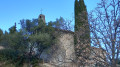
The marked trail descends to the right towards the drystone shelter site (see long version), while to the left it heads towards the stony site of La Tourelle, which rises slightly above the stony ground, a meagre ruin remaining from the "castrum" of Nébian (see information panel). Going around La Tourelle, the path descends the hill, but the markings become difficult to see among the trees. Keep to the left-hand path to come out onto a well-marked track 40 metres below, some 200 metres from La Tourelle. Take this track on the right, which leads to the next bend at the Chapel of Saint Jean-Baptiste de Restinglière. After visiting the chapel, continue down the well-marked path to cross the stream via a wooden footbridge alongside a large restored house on a concrete track.
(6) Follow the markings for this connecting route, which will take you to the south-east of the village to another historic site. The road first descends towards a three-way junction marked by a signpost for "Les Traversières". Ignore the left fork, which leads back to the village (La Combe), and follow the right fork (Gué de la Dourbie). This will take you to the D128E10 departmental road. Continue to the left, taking care with the traffic, and join the D128. Cross it and take the small road opposite (2nd turning on the right). The signposts guide us along a quieter little road. Pass the hamlet of Taille-Fer with its few houses, including an old farmhouse with a stone arched porch. Ignore the road on the left and reach the three-way junction that follows.
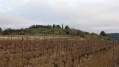
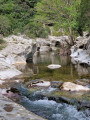
(7) Turn right, cross the Dourbie river when the water is low and the ford is easy to cross, then follow the concrete track which becomes a stony path, sometimes a bridle path, which climbs quite steeply up the hill then turns left and runs along the plain towards the Baumes site among the kermes oak trees. The views over the plain are very pleasant.
The signpost for "Les Baumes" leads straight to the old quarry. You can still see abandoned millstones at the foot of the quarry face in a sandstone conglomerate cliff riddled with cavities. Here again, an information panel provides details about the medieval period and the technique used to cut these millstones, which were intended to equip the many mills in the region.
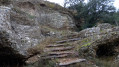
As you walk along the terraces of the quarry, the path begins to descend steeply. With the help of log steps ( be careful on rainy days), the yellow markers guide you to the vineyard at the bottom of the slope. Cross the yellow gas trail, go around the vineyard on the right and follow the path that leads to the second ford. Pass through an electric fence (for horses) using the insulated handle and taking care to close it behind you. Reach the Dourbie.
(8) Cross the ford and continue north until you reach a junction of marked tracks.
The path on the left is the alternative route in case of flooding of the Dourbie.
First turn right then left, walk alongside the equestrian centre and, about 50 metres after its entrance on the right, you will find the start of a path on the left.
(9) Take this stony path, which climbs steeply up the Pichaures hill. On this hill, there is a wild botanical garden with cypress trees bordering collapsed mazets (traditional stone houses), stone terraces bordering olive groves and, above all, a 360-degree view of the surrounding countryside.
After the belt of cypress trees, the path descends towards a concrete track, which you should follow, paying close attention to the markings at the beginning, as the path turns sharply left and right and then heads north-west towards Nébian. Reach the D128.
(10) Cross and continue opposite on a botanical trail along the Ruisseau de la Combe. The "Chemin aux Mille Plantes" joins, after a bridge, at the crossroads of Rue de Sergognes and Rue Anatole France.
Turn left until you reach the crossroads.
(1) Turn right and continue straight ahead until you reach a side street. Turn right onto this street, which is a one-way street, and continue to Place de la Liberté (with its gate, passageways and fountain).
(11) Pass under the medieval gate, walk along Place Gambetta, then turn right onto Rue Jules Ferry. Walk down this street, ignore Place Gambetta on your right, and take the first small street on your right at the small roundabout marked by a central lamppost, Rue Saint-Saëns. At the end of this street, you will reach Place Joliot Curie (S/E).



 Visorando Member
 Easy
Easy 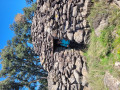
 Difficult