The Parmelan plateau via the Chalet des Espagnols and the Plan de l'Aigle

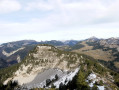
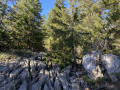
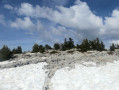
From the Vallée de la Fillière, I suggest you visit a little-frequented area of the Plateau du Parmelan, located to its north-east. This route, which is rather "wild" in places, winds its way through pretty landscapes with some beautiful views towards the Montagne de Sous-Dine and the Plateau des Glières. Along the way, there are three caves that are worth checking out.

Please note that this route presents some difficulties: rough terrain, steep slopes and orientation issues.
For more details, see below and, in particular, the Practical Information section.

Details

55843093
Creation:
Last update:
Last review:
  • Walking
    Activity: Walking
  • ↔
    Distance: 17.02 km
  • ◔
    Average duration: 7h 50 
  • ▲
    Difficulty: Very difficult

  • ⚐
    Back to start: Yes
  • ↗
    Ascent: + 1,047 m
  • ↘
    Descent: - 1,050 m

  • ▲
    Highest point: 1,679 m
  • ▼
    Lowest point: 705 m

Photos

Description of the walk

Small correction by the author on 23/11/2025: in the introductory paragraph, the name of the path was incorrect (de l'Aidiau instead of l'Adiau).

Please note: since 17/10/2025, access to the Verrerie bridge has been prohibited to motor vehicles until further notice while diagnostics and consolidation work are carried out. The starting point of the hike must be from the Verrerie at point (1).

The route starts from the car park at the Moliets footbridge in the commune of Thorens-Glières. Access via the RD55 road towards the Plateau des Glières, then the Route de la Verrerie after the village of Nant Sec, then the Chemin de l'Adiau to its end point: the last 500 m are unpaved.

(S/E) Head north on Chemin de l'Adiau. Ignore the access roads on the right to La Guingettte and Chez Isard.

(1) At the hamlet of La Verrerie, turn left onto the small road. About 200 metres further on, cross the hamlet of Le Jourdil, then continue right on a path along the edge of pastures to reach an intersection: signpost in the opposite direction.

(2) Turn right onto a path leading downhill. When you reach a bridge on the right-hand side, do not cross it, but continue straight ahead in a north-westerly direction.

(3) Just before another bridge, follow a path on the left uphill (no sign): the slope is moderate at first, then gradually becomes a little steeper. You will reach an intersection where you can choose between two routes: they meet further on.

(4) The first route continues straight ahead on a clearly visible path, but with steeper slopes than before: this is the route I chose. The second route branches off to the right on less difficult slopes, but is slightly longer: when I walked it, the path was moderately passable with dense vegetation. The route follows the one marked by IGN: click here to view it. Further up, the two paths join at a point where four paths meet.

(5) Take the right-hand path uphill. At a bend in the path, continue straight ahead on a trail (marked with a blue arrow). Be careful, as the trail is not very wide and runs along the edge of steep slopes.

(6) Approach a wooden platform, which acts as a footbridge, then continue straight ahead. A little further on, be careful to turn left: the access opposite marked with a blue cross is a dead end.

(7) Just after a bend in the path, continue to the right at this intersection, which is easy to spot (orange markings). Reach the Bunant stream and wade across its rocky, uneven bed. Crossing the stream itself should not normally pose any problems. Reach the hut called Chalet des Espagnols.

(8) From here, follow a path for a long climb with numerous bends, all on slopes that are fairly gradual overall. After a while, you will reach a small valley in a wooded area where visibility of the path ahead is poor in places: continue straight ahead without attempting to climb. You will come to a fork marked by a signpost at an unnamed pass.

(9) Take the left-hand path uphill. Higher up, you will reach another pass. Continue straight ahead on the path, which soon leads to an area of mountain pastures.

(10) Off the trail, enter a small valley visible on your left (south-east) and continue for about 100 metres; orientation should not be a problem. Join a path on the left and follow it for about 50 metres.

(11) Look for a slightly marked intersection and follow a discreet path to the left (east). For a short while, the path will take you to the right and left over terrain that is a little uneven in places, guided by fairly regular yellow markings. You will reach a beautiful viewpoint on the edge of a cliff: marked "belvédère" on IGN maps.

(12) Continue along the path, which veers further away, avoiding the summit of Plan de l'Aigle marked on the IGN map at an elevation of 1,673 metres. This will take you to a fairly open area offering another beautiful viewpoint.

(13) The path then becomes a little less clear, and orientation is therefore difficult in this area: head south-east, keeping an eye on the yellow markings. After about 100 metres, head left off the trail, first eastwards, then southwards, to reach the end of the cliff edge marked by a rough cross.

(14) Then retrace your steps and continue along the path on the left: as the route is not necessarily obvious, using a GPS device may help. You will soon find a visible path and follow it for a short while, heading west. Along the way, you will pass by a cave that is not visible from the path. Optionally, you can make a round trip, as indicated on the map: see § Practical information for more details. Continue on to reach the Grande Glacière site, marked just before by a signpost. This is a fairly deep chasm with ice at the bottom; I recommend that you exercise extreme caution when approaching it.

(15) There are two possible routes that meet at point (16). The direct route is about 170 m long and more difficult (route choice): head left of the chasm towards the south-west, then follow a moderately visible path (a few orange markers). Not far away, you will reach an area of sharp limestone pavement: this is not an easy section to navigate, so keep an eye out for the slightly faded orange markings. Once you reach the path, take it to the left. The easier but slightly longer route (approximately 530 m): see the description via the following link : alternative route.

(16) Follow the path southwards, where a few yellow arrow markers help you find your way on some sections where the path is less clear. You will come to a fork (Montagne de Laud).

(17) Turn left. At first, the route consists of a series of ascents and descents, then only descents, on a few steep slopes.

(18) Further down, there are three successive difficult sections on steep, uneven slopes; cables are provided for safety. A minimum of caution is required in these areas, particularly on the third section, which is the most difficult. The path that follows is much easier and leads to an intersection.

(19) Take the path on the left.

(20) Shortly after a sharp bend to the right, take a path leading to a hut, about a 5-minute walk away (no sign): continue straight ahead and, along the way, you will encounter a slightly rough section on steep slopes. You will reach an intersection.

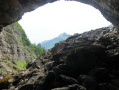
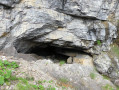
(21) Continue left to quickly reach the Grotte de la Diau, which is surrounded by beautiful scenery. If you wish, you can take a short detour to the large entrance of the cave and even continue inside: be careful as the ground can be slippery in the maze of rocks. See § Practical information for further details.

(22) Retrace your steps back to the intersection.

(21) Continue diagonally to the left. After a few hairpin bends downhill, the path leads to another intersection.

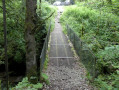
(23) Continue to the left, cross the footbridge, then return to the starting point (S/E).

Waypoints

  1. S/E : km 0 - alt. 807 m - Molliets footbridge - Car park
  2. 1 : km 1 - alt. 753 m - La Verrerie
  3. 2 : km 1.96 - alt. 752 m - La Pierre
  4. 3 : km 2.35 - alt. 720 m - Intersection before the bridge
  5. 4 : km 2.67 - alt. 808 m - Three-way junction, choice of route
  6. 5 : km 2.83 - alt. 868 m - Four-way intersection
  7. 6 : km 3.26 - alt. 928 m - Footbridge
  8. 7 : km 3.9 - alt. 1,020 m - Chalet des Espagnols fork
  9. 8 : km 4.4 - alt. 1,071 m - Chalet des Epagnols
  10. 9 : km 6.72 - alt. 1,471 m - Unnamed pass
  11. 10 : km 7.48 - alt. 1,517 m - Small valley on the left
  12. 11 : km 7.65 - alt. 1,540 m - Fork
  13. 12 : km 8.72 - alt. 1,656 m - Belvedere
  14. 13 : km 9.32 - alt. 1,674 m - Foot of the Plan de l'Aigle
  15. 14 : km 9.57 - alt. 1,666 m - Map of L'Aigle
  16. 15 : km 11.05 - alt. 1,609 m - La Grande Glacière
  17. 16 : km 11.21 - alt. 1,611 m - Intersection
  18. 17 : km 11.65 - alt. 1,609 m - Laud Mountain
  19. 18 : km 12.74 - alt. 1,454 m - Cabled passages
  20. 19 : km 13.63 - alt. 1,267 m - Fork in the path, to the left - Fontaine de Geai
  21. 20 : km 14.42 - alt. 1,209 m - Cabane des Pics Noirs
  22. 21 : km 15.75 - alt. 961 m - Les Gevrans
  23. 22 : km 15.93 - alt. 958 m - Diau Cave
  24. 23 : km 16.93 - alt. 821 m - L'Essert Barty
  25. S/E : km 17.02 - alt. 807 m - Molliets footbridge - Car park

Notes

The starting point can be viewed on Google Maps: click here.
Good hiking boots and walking sticks are recommended.

Take your rubbish with you; nature will thank you.

Below is a difficulty rating for each section (the route is not uniform):
- Green: fairly easy route with no significant elevation changes or difficulties.
- Blue: steeper slopes and/or elevation changes on a well-marked trail.
- Orange: route presenting some technical difficulties and/or poor route viability (markings or visibility of the path).
- Red: difficult route due to significant elevation changes that may require some climbing, in an environment with some hazards.
- Black: fairly difficult route and/or involving contiguous dangers.
- White: route in very difficult technical environments requiring certain equipment.

From (S/E) to (2): green difficulty
The section is easy to complete on roads and paths with short ascents and descents.
No markings.

From (2) to (3): blue difficulty
Follow a downhill path to the bridge with a few steep slopes, then continue without difficulty on a slightly uphill path.
No markings.

From (3) to (4): blue difficulty
The trail follows a moderate incline, gradually becoming steeper.
No markings.

From (4) to (5): Orange difficulty
On this section, the route is on terrain that is not technically difficult but has fairly steep slopes.
No markings.

From (5) to (6): Blue difficulty

  • First, follow a path on slopes that are a little steep but not excessively so.
  • Then you continue on a narrow path along the edge of steep slopes (take care).

Blue markings after accessing the trail.

From (6) to (7): Blue difficulty
After crossing a relatively wide footbridge, follow the same type of path. After crossing asecond deforested area (with dense vegetation), turn left onto another path as you approach the stream (there is a blue cross on the access point opposite). Further up, follow the start of a path on the right just after a hairpin bend (orange markings) and be careful not to miss it.
Blue and orange markings.

From (7) to (8): Blue difficulty
The start of this section is relatively easy, but then you will encounter some difficulty crossing the Ruisseau du Bunant, which is a little rough in its fairly stony bed. You then need to make a short climb to continue opposite on the path.
Orange + yellow markings.
You will reach the Chalet des Espagnols, which is open to all passers-by for shelter or simply for a short break. It is basic (in a good way) and fairly clean. It is maintained by the ONF (French National Forestry Office) of Thoire-Glière: a big thank you to them.

From (8) to (9): Blue difficulty.
The route continues along a long path with numerous hairpin bends on a fairly gradual slope, which becomes steeper towards the top. It should be noted that the path is not very wide in places and there are some short sections where the terrain is difficult. In the vicinity of the valley, the orientation is average and it is advisable to stay on the valley floor, heading slightly to the right, then a little further on, slightly to the left.
Spontaneous green markings.

From (9) to (10): Blue difficulty
Follow a gently ascending path to the second pass. The route then continues through pleasant alpine pastures.
NB: from the pass, it is possible to take an off-trail route via the Tête de Bunant. Click here to view the route
No markings. There is a signpost at the start of the section. Orientation is not a problem.

From (10) to (11): Blue difficulty
The route follows a path at the bottom of a valley off the beaten track in azimuth mode. There are no orientation difficulties.
Note: it is also possible to follow the slightly longer route shown on the IGN and OMS maps, but the orientation will not be any better (as the trail tends to disappear shortly afterwards).
No markings.

From (11) to (13): Blue difficulty
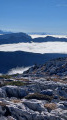
For a short distance, follow a fairly clear path. The difficulty lies in finding the path to take on the left (all I can say is that it is located just after a sign about water conservation): the path is moderately visible for the first few metres, then quickly becomes much more obvious. The route then continues upwards for a while on a non-linear path. At the top of the route, it becomes more chaotic with a series of ascents and descents. Along the way, you will come across a beautiful viewpoint (mainly towards the Montagne de Sous-Dine) and I recommend taking a short break.
Yellow markings. These are fairly regular and quite useful for finding your way at times.

From (13) to (14): orange difficulty
You will reach a beautiful viewpoint (Montagne de Sous-Dine and Plateau des Glières) at the edge of the slopes. Further on, you may encounter some difficulty in finding your way as the path almost disappears with the yellow markings spaced far apart. Access to the summit is off-trail on a downhill slope, heading towards the cliff tops, and a few tracks can help you find your way. From the edge of the cliffs, the view is clearer (including the Aravis mountain range); be careful on the edge.
Yellow markings (rather discontinuous) then none until the edge of the cliff.

From (14) to (15): orange difficulty in the Plan de l'Aigle sector, then blue for the rest of the route.
On the way back, the slight difficulty is finding the path to follow once you have retraced your steps (you can use a GPS to help you). You will quickly find a path and the rest of the route is easier: the route is initially downhill only, then a series of ascents and descents.
Optionally, you can make a short round trip to a cave that is not visible from the path, starting from GPS point 45.960853", 6.2643163": a path on the right leads you there and as soon as you enter, you can feel a very slight draught due to the temperature contrast. The cave is not very deep, but be careful of a hole near the bottom.
Yellow markings after accessing the trail.

From (15) to (16): orange difficulty
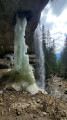
You will reach the Grande Glacière area: this is actually a fairly deep chasm with a cave at the bottom where ice remains year-round. On the south side, a path leads down to it, and if you take it, I recommend that you do not go beyond the balcony and do not descend to the bottom (if you wish to go further and in particular access the cave, you do so at your own risk). Be careful in these areas!
There are other chasms nearby, close to the path continuing northwards.
The route continues along a short (approximately 170 m) and attractive trail that is somewhat wild but presents difficulties that require caution:

  • First, head to the left of the chasm on its southern side, then you will quickly reach a wooded area via a discreet path, following the slightly faded orange markings as best you can.
  • Next, cross a rugged sharp limestone pavement area where it is not very easy to find your way: head west, keeping an eye on the orange markings, which are still somewhat faded.

Orange markings (moderately visible).

From (16) to (17): Blue difficulty
The route follows a path with no significant elevation changes and no major difficulties. At most, the path disappears in a few places, but orientation should not be a problem.
Yellow arrow markings

From (17) to (18): Blue difficulty
A pleasant, varied trail is easy to follow, with a rollercoaster-like descent for a short while. The rest of the route is downhill, with the slope becoming steeper as you go.
Yellow arrow markings.

From (18) to (19): Orange difficulty
There are three difficult sections in quick succession on steep, uneven terrain, with cables for safety:

  • thefirst, over a short distance, is the least difficult,
  • the next two, and especially thethird, are more challenging.

Proceed slowly and carefully in this area!
After this, following a section along the edge of ravines, the rest of the route is relatively easy.
Yellow arrow markings.

From (19) to (20): Blue difficulty
This section is one of the least difficult on the route, with no significant elevation changes and relatively flat terrain. At most, you may find that the area around the start (Fontaine de Geai) can be quite wet.
At the intersection, you can take a short detour to the Cabane des Pics Noirs for a break.
Yellow arrow markings.

From (20) to (22): Blue difficulty
The slopes become steeper atfirst, particularly on a short exposed section at the edge of a small cliff. The rest of the route is easier, with a few hairpin bends.
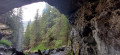
Located in a small cirque, the Diau cave is quite beautiful. If you wish to access its entrance, continue straight ahead, keeping to the left, along a path over stony and somewhat uneven ground; beware of the potential risk of falling rocks from above. You can also enter the cave, but be aware that the terrain is even more uneven and you will need to proceed with caution among the large eroded boulders, especially if the ground is wet and slippery.
Yellow arrow markings. Access to the cave is not marked.

From (22) to (S/E): Blue difficulty
The rest of the route is not very complicated: follow a path with a few hairpin bends on moderate slopes, which will take you back to the starting point after crossing a footbridge.
Marked with yellow arrows.

Worth a visit

  • La Grande Glacière: this is a chasm with a cave at the bottom, inside which there is permanent ice. For more information, read the article on the Camptocamp website: click here.
  • Grotte de Diau: located at the foot of cliffs, this is the "exit" of a long and complex underground network known to speleologists (25 km of galleries spread over a 700 m drop) and is one of the largest caves in France (source: Wikipedia).

Read the comprehensive article on the Persée website: click here.

Other walks in the area

For more walks, use our search engine .

The GPS track and description are the property of this route's author. Please do not copy them without permission.