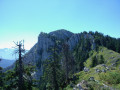
This circular path is strongly discouraged for people who are afraid of heights or who are unsure of themselves on steep terrain. It is therefore not suitable for children either.


 Country:

 City:
City:


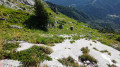
By car, from Saint-Pierre or Col du Cucheron, park in the small car park (maximum 2/3 cars) at the entrance to the Piste Forestière de la Coche, near Champ Massot. If it is full, don't worry, you can park a little higher up, at Les Perriches, and walk down to the entrance to the forest (see map).
(S/E) From the car park, follow the wide forest track for about 2 km in a south-westerly direction. The climb, although not particularly exciting, is a useful warm-up for what lies ahead. Arrive at the end of the third hairpin bend.
(1) Follow a path on the left, which is signposted for Col du Frenay (1 hour), Pas de la Suiffière (1 hour 50 minutes) and Grand Som (3 hours). It climbs very steeply through the forest but is pleasant underfoot and very well marked. The coolness of the forest is welcome. This will take you to Col du Frenay
(This is the only part of the circular loop where walking poles come in handy: I put mine away when I reached the pass and never took them out again.)
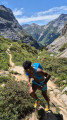
(2) Now the serious stuff begins. Head towards Pas de la Suiffière and begin the gentle ascent along the scree slope, in the shade of the beautiful and impressive rock face. The path tends to be a little uneven in places, so caution is advised. The yellow markings are clear and easy to follow. Next, the path becomes rocky and the first climbing steps appear. They are easy, but as with any climbing step, caution and precision are required. After a good 45 minutes of effort, you will reach Pas de la Suiffière.
(3) Here, you have two options.
1) If you are afraid of heights, or if you are weighed down by a trekking rucksack, or too tired or unsure of yourself, take the path that plunges down in front of you towards the north-east and joins the Sentier Racapé a few hundred metres further on, which you follow downhill. It is longer, but safer.
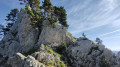
2) If everything is fine and you are sure-footed, opt for the themed route and head straight for the ridge by climbing the gap in the large rock on your left. A half-faded red arrow invites you to do so.
You will then encounter a series of ledges and flat sections that can be traversed without any particular difficulty, except for the fact that you must not take the wrong route, as this can quickly become dangerous. You can feel a lot of wind, especially on the west-facing ledges. A good sense of direction and a little intuition are useful, even though the red arrows, although not very visible, provide useful guidance. In the end, it's perfectly doable, as long as you don't stray from the path and remain focused and alert at all times. I found it very refreshing and fun to progress as if on rocky "waves" without ever knowing what lay ahead. And the little extra adrenaline more than compensates for the accumulated fatigue.
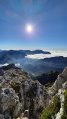
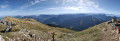
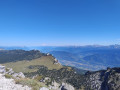
(4) The summit and its imposing iron cross have been visible for quite some time now, but are slow to materialise. As we begin the last few metres of the final dirt track, we turn around and feel that we have made a beautiful journey. The view is breathtaking, wonderful and soothing. You can see the whole of the Chartreuse, Mont Blanc beyond the Rochers de l'Alpe, and also the Bauges, the Belledonne ridges, those of the Écrins further away, the Taillefer massif, the Dévoluy, the Vercors in the south, etc. Even the Isère plain to the west is pleasant to contemplate. The imposing monastery of the Grande Chartreuse below looks very small. The two 3D cement orientation tables are relatively illegible. It is better to have some basic knowledge of alpine geography or a dedicated app installed on your smartphone.
(4) Take the Sentier Racapé, which immediately heads east, leaving the Sentier des Moutons on your left. The slope is steep from the outset, and the route follows a dirt track that has been carved into the meadow by countless passages, to the point that numerous shortcuts can be seen in the grass from time to time. The path then becomes stony, then very quickly rocky, and finally the cable passages appear, which are quite impressive although not very difficult. You need to remain alert, focused and place each foot carefully without rushing. You will arrive at the Col des Aures safe and sound, of course, but a little worn out. Someone has written "Liberté" on the yellow sign at the pass.
(5) From there, you can enjoy a peaceful descent to the right on a wonderfully marked, easy trail, delightfully shaded by the forest. It's a bit long, and you'll be tired, but it's very pleasant. You'll come to a fork (altitude 1,300 m).
(6) Keep to the right on the path until you reach the forest track, which you follow downhill to the left for 200 m to the car park (S/E).
Be careful when leaving the car park and on the way back. Fatigue can sometimes play tricks on you on mountain roads.



 Association / Club / Walk leader
 Difficult
 Visorando Member
 Moderate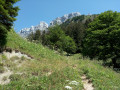
 Tourist office