The Pic Charvet Fort
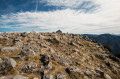
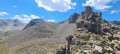
Characteristic of the military architecture of Séré de Rivières, the Pic Charvet fort protects the city of Nice. It helps control the strategic route through the Var valley. The building, constructed between 1883 and 1890, occupies a rocky promontory that controls the confluence of the Tinée and Var rivers, north of Nice.
The 1860 treaty annexed Nice and Savoy to France and forced the French General Staff to redefine the defence plans for the south-eastern border with Italy. The young Italian state, unified by the House of Savoy, sought to assert its authority by controlling its territory, fortifying the Col de Tende and waging a trade and customs war. This policy of systematic opposition to France led Italy to join the Triple Alliance in 1882.
Séré de Rivières, tasked with developing a line of defence for the north-eastern border, extended his plans to the Italian border, aware of the threat: "Since, through a series of annexations favoured by French policy, the King of Piedmont has become King of all Italy and, instead of a neighbour incapable of inspiring the slightest concern, we are now in contact with a first-rate power, the Alpine border has acquired great importance."
The first step was to seal off the approaches to Nice, transforming the city into a position of resistance. Nice then served as the nucleus around which a line of defence was built, consisting of forts positioned on natural promontories, within firing range of each other. It quickly became necessary to move the line of defence closer to the border.
A second fortified line was established, completing the strategic road network begun in 1877. It should be noted that his predecessor, General Frossard, had planned as early as 1862 to defend Nice and control the Var and Tinée gorges with two chuise and four forts.
The "torpedo shell crisis" rendered the "first generation" forts of Séré de Rivières largely useless.
The Pic Charvet, or Picciarvet, fort is a typical example of this system. It is part of a vast defensive system comprising 158 forts and 254 batteries responsible for securing the border.
The Pic Charvet fort is a protective fort. The structure is surrounded by a moat that protects the western side, which is the most vulnerable. Caponiers ensure its defence. There is no large visible façade. Only a few walls and a cannon ramp are visible. The heavy equipment consists of four 120 mm cannons, heavy armament in keeping with the role of this fort.
General Baron Berge created the "alpine batteries" by law on 22 December 1889, each of which was to be twinned with a battalion of Alpine Hunters from the nearest fort. These batteries were equipped with the 80 mm Bange "mountain" cannon, a rifled weapon that could be broken down into three loads of about 100 kg each, which could be carried by mules using a pack saddle: the carriage, the extension of the gun barrel and the wheels. This cannon had a range of 4,100 metres. It was eventually replaced by the 65 mm mountain gun. This was a rapid-fire weapon with an articulated carriage. It weighed 400 kilos and consisted of four packs for transport by mule: the gun, the brake, the gun carriage and the wheels. Its maximum range was 5,500 metres and it could fire 10 to 15 rounds per minute. The fort was occupied until the Second World War by the 18th Battalion of Alpine Hunters.
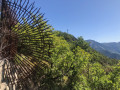
View of the Var and Tinée valleys
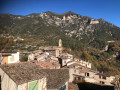
Ruins of the old village of Tournefort
Tournefort is a village that once belonged to the Knights Templar. Unfortunately, it was destroyed by an earthquake in 1887 and abandoned.
Since then, Tournefort has been rebuilt, but in a scattered manner across its territory. From the recent development, you can access the remains of the old village via a wide staircase.
Incidentally, it seems that the village owes its name to the many windmills that existed before the earthquake... which leads us to believe that the wind must blow hard there from time to time!
Shortly before arriving at the Saint-Antoine Chapel (8), you can take the stairs on the right to reach a summit orientation table.



 Country:

 City:
City:





 Visorando Member
 Difficult
 Very difficult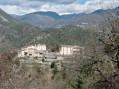
 Easy
Easy