Country:

 City:
City:


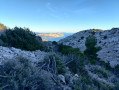
Start from Col de la Gineste at the barrier opposite the car park.
(S/E) Follow the red/green marked trail that climbs up Pain de Sucre. After the long bend to the left (east), the trail flattens out and descends towards Col Ricard. Leave the green marked trail heading east and continue on the red marked trail to Col Ricard, recognisable by its crossroads.
(1) At Col Ricard, continue right (west) towards Chemin du Centaure, a wide track marked with red dots that winds below the Luminy cliffs. Follow the track for about 700 m until you see Aiguille Guillemin on your left around a bend. Look for a path (the Sentier Frager) that climbs up to the left and passes behind the peak.
(2) Take the path, which climbs gently at first, then becomes steeper near the peak.
Some sections require the use of your hands to climb over a few ledges, but these are not particularly difficult for hikers who are comfortable with this type of steep terrain. The climb ends on the plateau just above Vallon Mestrallet and below Mont Puget. Continue along the path on the right and head towards Mont Puget, the highest point of the hike.
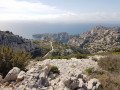
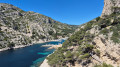
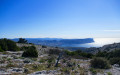
(3) From here, there is a clear view: to the west over the city of Marseille, to the south over the Riou archipelago and Cap Morgiou, to the east over Cap Canaille and Sainte-Baume, and to the north over Mont Carpiagne.
Descend eastwards along the path (green dotted line) and then continue along the yellow-marked Crête de l'Estret trail.
(4) Follow the trail for about 300 metres until you reach a fork (return).
(5) Continue along the track for another 1.2 km until you reach the Cirque des Pételins, visible on the right, to the south, near elevation 440.
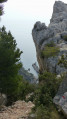
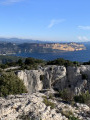
(6) Take the path on the right (south), which descends into the Cirque des Pételins, along the western face of a north-south facing cliff. From here, you enter one of the most remote and mineral-rich areas of the calanques. Inexperienced hikers rarely venture here, so you should only encounter a few more experienced hikers. An easy downclimb requires the use of your hands. The vertiginous cliffs of the cirque are visible on the right.
(7). After about 1 km, the path makes a 90° turn to the left (east). Continue and pass a few bends.
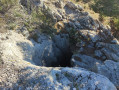
(8) When you reach the eastern side of the bottom of a small valley visible on the right, leave the path continuing north and turn right, heading south, walking above the valley. The path is no longer very visible, but several cairns will help you find the karstic cave des Marseillais (173 m deep), also known as the Gouffre des Quatre Trous, on the slope of the valley. Above the vertical fault of the cave, there are several holes that can be seen by climbing the embankment above the cave.
(9) Caution: there is no protection around the chasm. Do not approach its vertical fault and take great care around the holes above. Keep an eye on children and animals, as it is very easy to fall at this point.
Then descend into the valley and continue to the left (south) on the path until you reach the wide track of the Vallon des Rampes.
(10) Take the track on the right and follow it for about 300 m until you reach a U-turn.
There you will find a small path that branches off to the right (west) and enters the Vallon de la Fenêtre. This valley is undoubtedly one of the wildest in the massif, and again you are unlikely to encounter many people here.
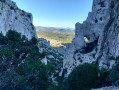
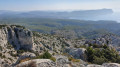
(11) Here begins the very long, wild climb up the Vallon de la Fenêtre, first through a small forest and then through a more limestone landscape. The climb becomes steeper and steeper as you progress through the valley. The path passes under the famous window carved into the rock visible on the left, then climbs up to the plateau below Mont Puget.
(12) On the plateau, head right (north) on the red/blue trail to reach the fork you passed on the way there.
(5) Cross the Yellow trail of Crête de l'Estret. Look for the Red/Blue trail on the edge of the rocky ridge, which leads down the north side into Vallon de l'Herbe. The beginning of the trail consists of several switchbacks that cross small rocky ridges, where it may be necessary to use your hands at times. There are no technical difficulties, but people who are prone to vertigo may find it challenging. Leave a path on the left. The descent continues to the Puits du Cancel, visible on the right (covered with a protective plate) at an altitude of 300 metres.
(13) At the well, leave the green trail that branches off to the left and continue to the right on the red trail. A hundred metres further on, leave the trail that enters the Vallon de Chalabran on your right and continue on the red trail. Further on, turn right and rejoin the initial fork.
(1) After crossing the Col Ricard, the red trail climbs up the Pain de Sucre and leads back to the Col de la Gineste (S/E).




 Visorando Member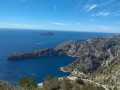
 Moderate
 Very difficult