Basilica of Saint Maurice: built on the foundations of an earlier 10th-century church. Extensions carried out between the 11th and 13th centuries reveal a variety of architectural styles (Romanesque nave and Gothic choir). The belfry tower in front of you, featuring a parapet walkway at the top, is one of the oldest parts of the church. Fitted into this tower in the 19th century, the western portal depicts Christ in Majesty. Enter the basilica through this portal if it is open; otherwise, walk along the left side of the building and enter through the Bourgeois Portal. Inside, discover some beautiful sculptures: the Entombment (15th century), the Virgin with the Rose (14th century), the paintings of the Mysteries of the Rosary (17th century) and the Altar of Relics, which houses the bones of Saint Goëry and Saint Maurice, once venerated during pilgrimages and religious festivals.
Portail des Bourgeois
Place des Vosges: once the city’s economic and political centre, this square remains today a meeting place, ideal for cultural events. It bears witness to the city’s different eras with a wealth of architecture dating from the 13th to the 20th century.
Renaissance Arcades (Place des Vosges): the arcades at No. 20, dating from the 14th and 16th centuries, are adorned with floral motifs and human faces. The first is topped by a representation of Bacchus.
Place des Vosges plaque: on the arcade bordering the building, there is a plaque recalling the origin of the name of the Place des Vosges in Paris.
Maison du Bailly: it was built between 1603 and 1605 by Amé Geninet, the master papermaker of the Grand Moulin d’Épinal. In an elegant Renaissance style, the façade of the house is adorned with a balcony. Between the mullioned windows on the first floor, a rectangular cartouche is carved in bas-relief depicting a cherub holding a coat of arms bearing the owner’s initials: AG.
Pharmacy: dating from 1903/1904, it was built by François Clasquin in the Art Nouveau style. Note the numerous floral motifs on the façade (chestnut leaves, poppies, anemones…) and the female faces carved around the central window on the second floor.
(1) Town Hall
Law Faculty
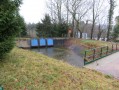
Washing house and Saint-Goëry spring: Originally, laundry was washed at the water’s edge. To limit pollution and epidemics, the construction of wash basins became widespread in the 18th century. The washing houses consisted of several basins, a washstone and a drying rack for the laundry.
This one was built in the 19th century near the Saint-Goëry Spring, which supplied the town with water and was renowned for its miraculous and healing properties in the Middle Ages.
Castle site: built on a rocky outcrop at an altitude of 387 m by the bishops of Metz in the 13th century, Epinal Castle overlooks the town and commands a view of the Moselle valley. Its layout forms a polygonal enclosure featuring a mighty residential keep and a large cistern. This castle, destroyed by the troops of Louis XIV in 1670, was converted into a 26-hectare English-style park in the 19th century. From this period, ‘fabriques’ (fancy structures used to adorn a garden) remain: a farmhouse and a reception pavilion. The remains of the seigneurial residence and other buildings were uncovered during excavations of the castle in the 1980s. These ruins are accessible all year round and adjoin a wildlife park. This medieval fortified complex is listed as a Historic Monument.
Chinese Tower: This tower, inspired by Asian art which was very much in vogue in the 19th century, was built on the initiative of Christophe Doublat from 1805 onwards. After acquiring plots of land on the castle site, this wealthy citizen of Épinal commissioned this ‘fabrique’, which served to link his residence to his private gardens.
Listed as a Historic Monument in 1992 and restored by the City of Épinal in 2011, this tower contains a staircase of 72 steps providing access to the castle site from the town centre.
Former Treasury
City walls: a rampart built of pink Vosges sandstone protected the town from the 13th century until 1670, when it was demolished by the troops of Louis XIV. From 1978 onwards, excavations uncovered 36 metres of ramparts and the bases of three towers. These are the only remaining vestiges of the town’s fortifications.
Musée du Chapitre: spread over three floors, the museum recounts the town’s history through a wealth of illustrations and numerous archaeological finds. On the ground floor, an impressive model shows the town as it was in 1626. On the second floor, a section is dedicated to the history of the Canonesses.
Chapitre District: The communityin Épinal comprised around twenty ladies under the authority of the Abbess. They were required to attend daily services but did not take vows. Plaques and coats of arms preserve the memory of the last owners before the dissolution of the Chapter at the time of the French Revolution.
Former Cloister: A cloister adjoined the church and led to this narrow street lined with beautiful residences belonging to the residents of the Saint-Goëry Chapter. Its location is now marked by a garden.
Place de l'Âtre: Place de l'Âtre refers to the cemetery that surrounded the church in the Middle Ages. Surrounded by the former residences of the canonesses, this square was the site of a wine market, then a vegetable market in the 18th century. Recent excavations (2018) confirm human presence in the city dating back to before the 10th century.
Courthouse.



 Country:
 City:
City:



 Tourist office
 Moderate
 Visorando Member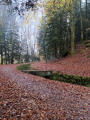
 Difficult