Country:

 City:
City:


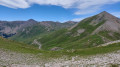
The Col de Raspaillon on the M64 motorway is equidistant (4 km) from Camp des Fourches coming from Nice and from the Cime de la Bonette coming from Jausiers. It is marked only by a small yellow sign for the Mercantour National Park downstream from the large car park overlooking the Ravin des Granges Communes. It is protected by a small embankment.
(S/E) The starting point is on the embankment about 50 m to the left of the yellow sign. The path, which is in good condition, descends rapidly in switchbacks into the ravine, heading north. It then becomes flatter and slopes to the left until it reaches the Torrent des Granges Communes.
(1) Cross the torrent on almost flat stones and continue to the left into the meadow. The path is then lined with large stones. It then runs alongside the torrent. Follow it to the shepherd's hut, which can be seen from quite a distance.
(2) Go around the hut on the right and follow the path. Avoid a steep shortcut that leads to a scree slope that has washed away the path. You will then see asecond shepherd's hut on the other side of the stream. Stay on the left bank in the meadow, pass a memorial stone to a fallen soldier and join the track.
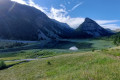
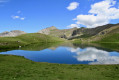
(3) Follow this track to Lac des Sagnes, then walk along the lake to the car park barrier.
(4) To the right of the spillway, there is a terrace with a number of information panels explaining the environment and its history. Make a return trip to the viewpoint.
(5) Enjoy the view from above of this former peat bog. Return the way you came.
(4) Take the footbridge on the left towards "Tour du Lac des Sagnes", pass close to the Cascade du Pisson waterfall and follow the lake to the undergrowth. At the start of the tourist season, the vegetation is not very trampled, so it is impossible to miss the fork where you turn left towards the Vallon de Pelouse, which is not signposted. A simple cross on a tree indicates that this is no longer the path around the lake. The climb through the larch forest is easy. When you come out onto the meadow, continue south. The valley gradually widens, and rows of widely spaced, parallel cairns can be misleading. Keep left until you come to a fork marked by a cairn.
(6) Option: if you turn right, the trail will cross the stream before climbing directly to the Col de Pelouse. This is Plan B for those who are unsure about continuing off-trail beyond the lake.
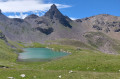
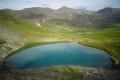
Turn left, keeping the small waterfall and the pointed Bonnet Carré mountain in sight, and continue across the meadow until the final climb to Lac de Pelouse.
(7) For those who are uncomfortable off-trail or prone to vertigo, retrace your steps (6), turn left and rejoin the Col de Pelouse.
Otherwise, go around the lake on the right to the foot of the scree, cross the streams that feed it and turn left onto the grassy slope until you find the trail that leads to the Pas de la Petite Cavale.
(8) Turn right. The path is narrow, stony, sometimes sandy, hilly, always on a ledge and, in places, degraded and slippery if wet. Take great care and stop to admire the view over the Vallon de Pelouse. Follow it to a nameless pass where there are always ibex.
(9) This is a crossroads: the path on the left climbs up to the Cime de Pelousette and its old fort, which can also be reached from the Camp des Fourches. Continue straight ahead on the path overlooking the access road to the Cime de la Bonette. A short sandy section, which is damaged in winter, requires caution before descending to the Col de Pelouse.
(10) Continue straight ahead. The trail, which is almost flat until the end, crosses the lawn on the side of the Cime de Voga. Caution: the last hundred metres to the Col de Raspaillon (S/E) are on tarmac and the road is very busy in summer.
It is possible to reach the military structure above the car park.

 Visorando Member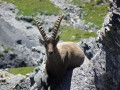
 Very difficult
 Moderate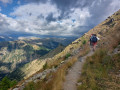
 Easy
Easy