


Refine your search for walks in Lac d'Aydat
Lac d'Aydat walks


 Tour of Lake Aydat
 Visorando Member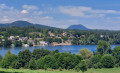
 3.55 mi
 +269 ft
 -246 ft
 1h 50
1h 50
 Easy
Easy
 Departure from Aydat (Puy-de-Dôme)
A charming walk around the lake with beautiful views of the lake and surrounding hills and modern buildings that blend in perfectly with the setting.
Solidified lava flow and Lake Aydat
8.56 mi
+758 ft
-751 ft
4h 35
 Moderate
Departure from Aydat (Puy-de-Dôme)
Moderate
Departure from Aydat (Puy-de-Dôme)
Go back 8,600 years, to the day when two young volcanoes were born, the Puys de la Vache and Lassolas. Their two lava flows joined together as they flowed eastwards and met the River Veyre. After a battle that was lost before it even began, the bubbling river was diverted eastwards, creating two lakes, Aydat and Cassière.
Lake Aydat and its heights via La Pierre Longue
6.02 mi
+479 ft
-469 ft
3h 10
Easy
Departure from Aydat (Puy-de-Dôme)
A circular trail to discover different aspects (leisure activities, wild spots, landscaped marshes) of Lake Aydat, with a passage along its heights for beautiful views of the Chaîne des Puys and the Sancy massif, and passing by a menhir, the Pierre Longue. On the way back, the route takes you to the beautiful 13th-century church of Aydat.
The lakes of Aydat and La Cassière
12.22 mi
+1,165 ft
-1,191 ft
6h 40
Moderate
Departure from Aydat (Puy-de-Dôme)
A circular route around these two lakes formed by lava flows from the Puys de la Vache and Lassolas. You will walk along the shores of the lakes but also explore the heights, where you will have beautiful views of the surrounding puys.
The Fohet plateau at the start of Lac d'Aydat
8.31 mi
+827 ft
-823 ft
4h 30
Moderate
Departure from Aydat (Puy-de-Dôme)
Circular route around the heights of Lake Aydat, in the middle of pastures, to enjoy beautiful views of the Chaîne des Puys and the Massif du Sancy.
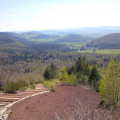
Circular route through the heart of the Chaîne des Puys
 35.90 mi
+4,902 ft
-4,898 ft
4 days
Moderate
Departure from Saulzet-le-Froid (Puy-de-Dôme)
35.90 mi
+4,902 ft
-4,898 ft
4 days
Moderate
Departure from Saulzet-le-Froid (Puy-de-Dôme)
A four-day hike (or three – see the practical information) staying in stopover lodges, so you can sleep in the warmth every night.
The route will take you along the GR®30 and GR®441 trails into the heart of the Chaîne des Puys, between the Puy de Sancy and the Puy de Dôme, to explore the volcanoes and lakes of Auvergne as well as the Romanesque basilica of Notre-Dame d’Orcival.
Lake Aydat and its heights via Mont Amant and Pierre Longue
6.45 mi
+591 ft
-600 ft
3h 30
Moderate
Departure from Aydat (Puy-de-Dôme)
Circular route starting from the edge of Lake Aydat, climbing slightly to enjoy views of the Chaîne des Puys and the Sancy massif. Pass through hamlets with a few traditional houses and the Pierre Longue. This menhir owes its "original" name, compared to the multitude of other "standing stones", to the fact that it was lying down before being raised by merciful locals. That said, "menhir" in Breton means "long stone"!