Country:
 City:
City:


Park in front of the ruins of the Auberge Saint-Jean to the left of the entrance to the military site.
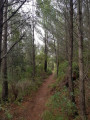
(S/E) Take the forest road to the north-west and follow the turquoise blue markings to a place called Le Goudron, where caulking for boats was made from pine resin.
Please note that this road is very dangerous as many semi-trailers travel very fast back and forth to the active quarry in Le Revest. Cross carefully to reach the entrance to the Château de Tourris.
(1) Go through the gate, join the path and follow the blue markings.
(2) Take the forest road on the left, continuing to follow the blue markings. At the crossroads, turn north-west and you will come to a fork.
(3) Turn right at a right angle, rejoin the forest road further on and continue to the left. Follow the track and the blue markings to reach the sand quarry that supplies the Tourris glassworks.
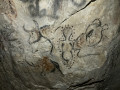
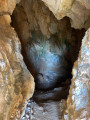
(4) 20 metres on the left, the first entrance does not go very far. A little further up, you will see a second entrance. The visit is very interesting but requires lighting and caution, especially with children: deep galleries and holes, so be careful. You will be rewarded with engravings and cave paintings.
Continue along the track towards the west for about 100 metres and leave the path on the left.
Continue for 50 metres and look out for a path on the right marked by two blue dots.
(5) Go down the path on the right. From this point, follow the turquoise blue dots. Follow them carefully as there are many paths. Take the path on the right that goes down northwards, then follow the tracks westwards and you will arrive at a well-preserved well that supplies the abandoned hamlet of Les Olivières, which is where we are heading. Take the path on the left and follow the blue markers to go around the hamlet: feel free to explore it.
(6) Wherever you are, return to the markings and go back to the forest track. Turn left and continue to the abandoned marble quarry at Le Revest.
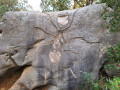
(7) Some of the blocks have been polished. Others have been engraved with a multitude of animals, including many ants, a few bees, butterflies, wild boars and a wolf. Finding them requires detective skills. There is even an engraving of ants in front of the chimneys of a nuclear power plant: can you find it?
Return to the track and continue along it until you reach a path on the right.
(8) Leave the track and take this path on the right to rejoin the track you took on the way there.
(2) Continue to the hamlet of Le Goudron.
(1) Do not cross, but take the path marked "Verrerie" which runs along the road to the west. Pass through a small wood before reaching the road. Follow it for a few dozen metres to reach the Verrerie, unfortunately now a rubbish tip, dating from 1827. Nevertheless, the building is of historical interest. If you scratch the ground a little, you will find glass processing residues. Refer to the section "Things to see during the hike" for all the useful links to the sites on this hike.
(9) Cross the road with great caution to reach the car park where you started (S/E).




 Visorando Member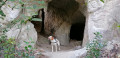

 Difficult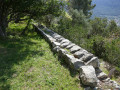
 Moderate