Country:
 City:
City:


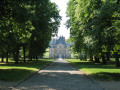
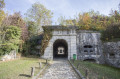
The walk begins at the main entrance to the Château d’Ormesson, located at the end of Avenue du Général de Gaulle, where you can enjoy the finest view of the building from the gates.
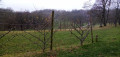
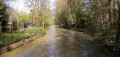
(S/E) Turn right onto Avenue Olivier d’Ormesson towards Créteil, then take the first left at the traffic lights, towards Sucy-en-Brie, onto Avenue Maurice Schumann. Walk along the estate’s boundary wall through the meadow, then, at the bend, take the tree-lined footpath of the Chemin d’Ormesson to Noiseau. Follow this down to the river and walk up the Morbras valley for 650 metres, enjoying the almost wild setting of this natural area.
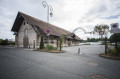
(1) At the end of the path, turn left onto Rue du Général de Gaulle, noting as you pass the wall and old buildings of a working farm. Continue straight on to the end of Rue Alexandre Milard, and after a bend, you’ll reach the heart of Noiseau’s small historic centre. The old town hall faces the Church of Saint-Jacques-le-Mineur-et-Saint-Philippe. Built inthe 13th century , the church was used as a barn during the Revolution and was rebuilt in the19th century with its current square bell tower.
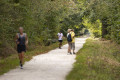
(2) Continue straight on Rue Léon Bresset until the traffic-light junction, then turn right onto Avenue Pierre Mendès for 250 metres. After the Place de la Mairie, located opposite the car garage, take the Chemin de Brie on your left until you reach the Maison de la Petite Enfance, then continue straight on along the pedestrianised section and then the road section of the Allée René Dessert/Chemin de Brie until you reach the junction with Rue Denis Diderot and Rue Berthelot. Continue straight on along Rue Raymond Paulvaiche, then along its extension, the forest path Chemin de Brie-sur-Yerres. Nestled within the Arc Boisé forest, the Notre-Dame State Forest belonged to Notre-Dame Cathedral in Paris during the Middle Ages. Use the attached map or the Visorando app to help you follow the route.
(3) After 350 metres, at the junction of several paths known as Carrefour de la Croix, take Chemin de la Gueule Noire, the second on the left. After 200 metres, turn left at the first junction onto Allée Blanche.
(4) After 900 metres, turn right onto Allée des Soupirs.
(5) After 1.5 km, when you reach the star-shaped junction known as Carrefour des Huit Routes, take the third lane on your left, the Route Royale, towards the Pavillon des Friches. Continue for 1 km until the second junction and turn left onto the Chemin Noir, then onto the Chemin des Marmouzets. Enter the Domaine des Marmouzets.
(6) Continuing straight ahead along the main avenue of the Chemin des Marmouzets, 500 metres past the château on the left, opposite the car park, you will find yourself in front of the Centre départemental de modélisme.It offers model aircraft enthusiasts, whether competitors or amateurs, the chance to fly their models in complete safety (provided you hold a federal licence and have your own equipment, access to the site is permitted under certain conditions).
(7) Continue along Chemin des Marmouzets until, after 850 metres, you reach Rue du Général de Gaulle. At the traffic lights, cross the junction at the pedestrian crossing and head left. Take the first street on the right, Chemin de la Pompe, then turn left onto Rue Renard. Continuing along this road, head straight on along Rue Jean Jaurès, the main thoroughfare leading to the old town centre of La Queue-en-Brie. After the bend, stop off at the Parc des Impressionnistes, formerly owned by Henri Rouart, a painter and patron of the arts. He used to host many prominent figures of the time there, including Edgar Degas, who stayed in the house at the entrance.
(8) Continue down Rue Jean Jaurès, and as you pass, look out for a19th-century wash house at No. 34 on your left. Consisting of two huts with sloping roofs situated on either side of the River Morbras, it was restored in 1969. On the other side of the street, a gentle slope was used for watering livestock.
(9) Continue along the path. At the end of this street, at No. 46, discover Saint Nicolas Church. Built inthe 13th century from millstone and limestone, this Romanesque-style building retains the appearance of a fortified structure. At the far end of the car park opposite the church, on Place de la Tour, discover the remains of the medieval tower, of which only the base of the walls, standing 6 metres high, remains. Probably built in the early12th century and measuring nearly 33 metres at the time, it played a major role in the defence of Paris.
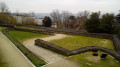
(10) Continue up Rue Jean Jaurès and take the first street on the left, Route du Pont Banneret. Follow it for 600 metres until you reach the junction with Avenue Charles Péguy. Carry on straight ahead, crossing the pedestrian crossing so you can use the pavement on the right. After 300 metres, at the traffic lights at the junction with Rue Louis Aragon, take a moment to admire the view unfolding to your left from an orientation table, featuring the rolling fields of the Morbras basin. Across 123 hectares, orchards, market gardens and cereal crops stretch out before you.
(11) Continue straight on for 600 metres towards Chennevières/Ormesson along the footpath running parallel to Avenue Georges Pompidou. Turn into the second street on the left, Allée des Clématites. After 250 metres, just before the Pauline Kergomard nursery school, turn into the cul-de-sac on the right, then continue along the footpath through a wooded area to the roundabout. Turn left onto Avenue de l’Hippodrome towards Ormesson-sur-Marne.
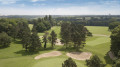
(12) Go straight ahead at the roundabout and, at the second roundabout, continue straight on along Avenue de Pince Vent for 750 metres. Turn left at the next traffic-light junction onto Rue Chemin du Belvédère and head towards the Ormesson Golf Club. Built by Count Wladimir d’Ormesson in 1925, it is one of the very first courses in France. With 18 holes, it covers 54 hectares within a hilly, wooded area (suitable for all levels, the course is ideal for beginners as well as more experienced players).
(13) Retrace your steps to the traffic-light junction at the entrance to Chemin du Belvédère, and turn left onto Avenue Wladimir d’Ormesson. 250 metres on, No. 12 marked the entrance to a former sanatorium established in 1888 and later converted into a specialist care home. Near the gate, a small wooden pavilion dating from the 1889 World’s Fair served for many years as the gardener’s cottage.
(14) In the background, the silhouette of the institution’s former chapel can be seen. Continuing along the avenue for 250 metres, after the Ormesson-sur-Marn Town Hall, turn left into Rue de l’Église. At the entrance to the street, take a look at the Church of Notre-Dame-de-l’Assomption, a building partly constructed inthe 18th century and housing numerous ancient tombstones. Staying on Avenue Wladimir d’Ormesson, you will reach the main entrance to the Château d’Ormesson 50 metres further on (S/E).
 Local authority

 Visorando Member
 Easy
Easy