The Baume Cave

Discovering the natural and heritage treasures of the Vallon de Sancey. After passing the Basilica of Sainte-Jeanne-Antide Thouret, the route winds its way up the peaceful Vallon de la Baume to its impressive cave, nestled at the far end of a deep ravine. The route continues through forests, past streams and hamlets before offering magnificent views of the medieval Belvoir Castle. A varied walk, alternating between the cool shade of the woodland and the discovery of historical heritage.

Details

100917284
Creation:
Last update:
Last review:
  • Walking
    Activity: Walking
  • ↔
    Distance: 4.98 mi
  • ◔
    Average duration: 2h 50 
  • ▲
    Difficulty: Moderate

  • ⚐
    Back to start: Yes
  • ↗
    Ascent: + 663 ft
  • ↘
    Descent: - 663 ft

  • ▲
    Highest point: 2,103 ft
  • ▼
    Lowest point: 1,657 ft

Photos

Description of the walk

Car park on Rue de la Basilique (to the right of the building). The basilica car park is private and reserved for visitors.

Yellow-red and yellow-blue signposting

(S/E) Head towards the basilica and continue along the narrow lane that runs alongside the Ruisseau de la Baume. On leaving the village, turn right onto the dead-end Rue de la Baume (towards Moulin Neuf).

(1) Turn right after the sawmill towards Moulin Neuf and its two beautiful buildings. Leave the small road leading to La Cude on your left, continuing straight on along this path, which starts as a gravel track and then becomes a stony track. You’ll reach the village of Les Nains and, at the fork, turn left.

(2) Continue left after Les Nains along a lovely forest track. When it begins to descend and is flanked by rocks on your right, ignore the path on the left that leads back down to the stream, and carry on straight ahead.

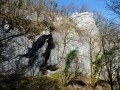
(3) You’ll soon cross the stream via a footbridge and reach a fork in the path. Head up to the right towards the bottom of the ravine to discover the Baume cave at the foot of the cliff. Make the most of the cool surroundings for a snack break.

(4) Return to just before the footbridge.

(3) Turn right onto the path that runs alongside the stream, winding through the tall grass, until, after a small footbridge, you reach a stony track near a house tucked away in the woods.

(5) Carry on to the right, quickly leaving a stony path leading uphill to the right, and climb leftwards to the hamlet of Acanthe, where you’ll join the D464.

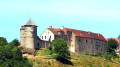
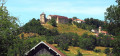
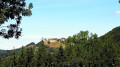
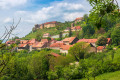
(6) Carefully head down the D464 on the left, keeping to the safety barrier, for about 400 metres. This is the slightly tricky part of the walk, but it will reward you with a lovely view of Belvoir Castle. Just before the road begins to curve to the left and descends towards the village, look out for the ‘Cycle Motoculture’ sign on the right and a path that climbs up into the pasture on the other side of the road. Cross carefully.

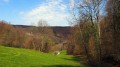
(7) Head up towards the edge of the forest along the meadow path that runs alongside a hedge on your left. You’ll come across the signposting again and a lovely path that climbs the wooded hillside. Always ignore the paths that climb steeply to your right, continuing along this peaceful path, which stays fairly close to the edge of the woods. You’ll reach an X-shaped crossroads and a signpost.

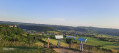
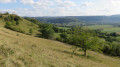
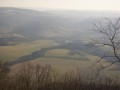
(8) Head down to the left (towards the Basilica), taking in the lovely view of the Val de Sancey hills. When you reach the village, do remember to look back for a superb final view of Belvoir Castle. Head down towards the village. At the stop sign, carry on straight ahead, pass the fountain and rejoin Rue de la Basilique; the car park is on your left. (S/E)

Waypoints

  1. S/E : mi 0 - alt. 1,657 ft - Basilique Sainte-Jeanne-Antide Thouret (Sancey-le-Long)
  2. 1 : mi 0.34 - alt. 1,683 ft - Sawmill
  3. 2 : mi 0.91 - alt. 1,857 ft - Village of the Dwarves
  4. 3 : mi 1.9 - alt. 1,841 ft - Footbridge
  5. 4 : mi 2.16 - alt. 2,103 ft - Grotte de la Baume (Sancey-le-Long)
  6. 5 : mi 2.9 - alt. 1,772 ft - Gravel path
  7. 6 : mi 3.54 - alt. 1,811 ft - D464 road
  8. 7 : mi 3.9 - alt. 1,716 ft - Bois des Épesses
  9. 8 : mi 4.51 - alt. 1,841 ft - Crossroads
  10. S/E : mi 4.98 - alt. 1,657 ft - Basilique Sainte-Jeanne-Antide Thouret (Sancey-le-Long)

Notes

(4) WARNING! You can walk a few steps into the cave, but do not be reckless enough to climb the metal ladders at the back. The interior of the cave is reserved for experienced cavers.

Do remember to bring a pair of binoculars to get a better view of Belvoir Castle, or ‘Bévoi’, as it was once known in the local dialect.

Worth a visit

(S/E) Built between 1926 and 1934, the Basilica of Sainte-Jeanne-Antide Thou ret pays tribute to Jeanne-Antide Thouret, who was born in Sancey in 1765. As the founder of the Congregation of the Sisters of Charity, she devoted her life to the education of children and to helping the most destitute. Exhausted by years of devotion and work amongst the poorest of the poor, she passed away on 24 August 1826 in Naples, aged 61. Canonised in 1934, she is now recognised as a great figure of Christian charity. Built near her birthplace, the basilica is distinguished by its Neo-Romanesque architecture, its white marble high altar, its granite columns and its remarkable stained-glass windows.

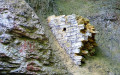
(4)The Baume Cave: its vast entrance, situated at the foot of the cliffs of the Baume Gorge, provides access to an underground network of nearly 1.5 km of galleries carved into the Jura limestone. Known for centuries, it served as a refuge for the region’s inhabitants during periods of war and invasion. In the 4th century BC, the Gauls had fitted out the cave, and in 800 BC, the Celts buried their dead there. The remains of an ancient fortified wall, still visible above the entrance, bear witness to its defensive use in the Middle Ages. The cave is also the subject of numerous local legends, notably that of the ‘Fairy Cave’.

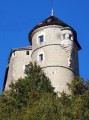
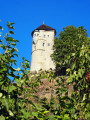
Belvoir Castle is one of the most important medieval fortresses in Franche-Comté. Built from the 12th century onwards by the Lords of Belvoir, it occupied a strategic position from which the routes between the plateau and the Doubs valley could be monitored. Enlarged and remodelled over the centuries, it has retained much of its ramparts, towers and vast inner courtyard, offering a fine insight into medieval military architecture. Carefully restored, the castle now welcomes visitors and hosts a variety of cultural events. From its terraces, the view stretches across the hills and landscapes of the Doubs, making this a must-see stop for history and walking enthusiasts.

Other walks in the area

For more walks, use our search engine .

The GPS track and description are the property of this route's author. Please do not copy them without permission.