The Cotepatière Cave, starting from Saint-André-de-Cruzières

An unusual walk and nothing too complicated if you’re not claustrophobic.

Details

38542862
Creation:
Last update:
Last review:
  • Walking
    Activity: Walking
  • ↔
    Distance: 9.04 km
  • ◔
    Average duration: 3h 05 
  • ▲
    Difficulty: Moderate

  • ⚐
    Back to start: Yes
  • ↗
    Ascent: + 181 m
  • ↘
    Descent: - 177 m

  • ▲
    Highest point: 254 m
  • ▼
    Lowest point: 163 m

Photos

Description of the walk

Park at Place du Planet in the small village of Chadouillet, 15 km from Barjac, in the commune of Saint-André-de-Cruzières.

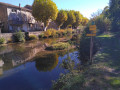
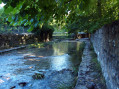
(S/E) Head to the crossroads, then turn left to go down towards the bottom of the village and look for Chemin du Peyrol on the right, marked with yellow signposts. Head to the banks of the Claysse, a stream that dries up in summer, at the Peyrejal or Chadouillet resurgence.

(1) Take a short detour to the right to see it, then rejoin the route along the Claysse riverbed.

(2) Turn left to find the Peyreval vent a little to the right, then the Cotepatière cave. Towards the end, the path through the Claysse riverbed is a bit of a struggle.

(3) Head south to reach the Aven de Cocalhère. You exit the cave to better enter the narrow passage at the other end of the karstic cave: see the description in the ‘During’ section.

(4) Turn back.

(3) After this visit, continue by heading up to the left to reach the plateau, following the marked path. You will reach a T-junction.

(5) Turn right, reach the D901, take it to the left and you will soon reach the Goule de Sauvas junction. Take the small bridge on the left to make a return trip to the Goule de Sauvas.

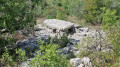
(6) Return to the D901, follow it to the left for about a hundred metres, then turn right onto the marked path “Les Dolmens”. Walk past several ruined dolmens along this path. You’ll reach a lovely path at the ruined sheepfold of Les Conchettes.

(7) Turn right onto it and continue through the woods to reach the junction with the D901.

(8) Cross it carefully, continue straight ahead and stay in the woods, keeping the same direction. You’ll come out onto Chemin de Caressoule; follow it straight on to return to the Chadouillet car park (S/E).

Waypoints

  1. S/E : km 0 - alt. 178 m - Chadouillet car park
  2. 1 : km 0.78 - alt. 167 m - Peyrejal resurgence junction
  3. 2 : km 1.16 - alt. 171 m - Turn left
  4. 3 : km 1.49 - alt. 179 m - Cotepatière Cave
  5. 4 : km 1.79 - alt. 210 m - Karstic cave of the Cocalhère
  6. 5 : km 3.89 - alt. 238 m - T-junction
  7. 6 : km 4.82 - alt. 224 m - Goule de Sauvas
  8. 7 : km 6.24 - alt. 235 m - Les Conchettes
  9. 8 : km 7.55 - alt. 215 m - D901
  10. S/E : km 9.04 - alt. 179 m - Chadouillet car park

Notes

Bring torches; helmets are strongly recommended.
The distance of the route varies depending on how far you venture into the caverns; as there are no underground connections, GPS devices stop working at the entrances. Thethird karstic cave before the sinkhole can extend up to 8 km of tunnel leading to an underground lake.

Worth a visit

Peyraou de Chadouillet resurgence: there is indeed a passage where you would need to crawl to explore the interior, but it is not at all inviting.

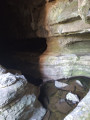
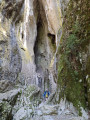
(3) Grotte de la Cotepatière: the cave entrance is fitted with metal bars set into the rock. The first part of the cave is very pleasant, but further in you’ll need to proceed crouching to reach the Aven de Coucalhère, a karstic cave.

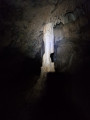
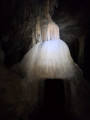
After (3) Karstic cave of Cocalhère: a beautiful tubular gallery with very pretty and imposing concretions. It is a long journey through a wide gallery where progress is fairly easy, apart from a few passages where you have to crouch. The main gallery splits into two. The right-hand branch leads towards the Peyrejal vent. This gallery, which I haven’t explored, begins with a passage where you have to crawl through a rat-hole for about thirty metres. The left-hand gallery, however, continues for quite some time before ending at the edge of a small lake (very little water at the moment), but to go further you have to pass the siphon, so you have to turn back to the Coucalhère karstic cave. The more intrepid can climb straight up to the right after a few steps of scrambling.

(6) Goule de Sauvas: entering it is impressive, but the journey ends quite quickly because, once again, it ends at a siphon.

Reviews and comments

4.4 / 5
Based on 6 reviews

Reliability of the description
4.2 / 5
Ease of following the route
4 / 5
Route interest
5 / 5
OCCITAN1907
OCCITAN1907
• Edited:

We didn't do this hike, as it was too vague inside the caves... we didn't have a breadcrumb trail to find our way back, mobile phones don't work there and the description is quite stressful... maybe another time with helmets, ropes and a caving guide: we don't want to have to call the fire brigade to rescue us from the bottom of a hole.
Thanks anyway to whoever posted it!

Machine-translated

Justine.catala1
Justine.catala1

Overall rating : 5 / 5

Date of your route : Jul 23, 2025
Reliability of the description : ★★★★★ Very good
Ease of following the route : ★★★★★ Very good
Route interest : ★★★★★ Very good
Very busy route : No

A really enjoyable hike, mainly centred around visiting the four caves: the first one at point 1 isn’t particularly interesting, and you soon find yourself blocked by a lake at the back. The second, at point 2, involves entering the cave from below and climbing a 5-metre ladder (but it’s doable): make sure to take the route veering to the right, and follow the riverbed (if you take the route to the left from point 2, it goes uphill and you’ll reach the cave but from above). It’s a lovely karstic cave to walk through; you can’t get lost as there’s only one path. At point 3, you emerge into the heart of the karstic cave, and there’s another cave directly opposite (to reach point 4). It looks very deep; we didn’t go all the way to the end. We turned back to return to the karstic cave, and the path on the right looked difficult to climb (a 10m climb, it’s steep…), so we turned back, passing through the first cave again, climbed down the 5-metre ladder, then returned to point 2 to take the path on the left this time; the rest of the hike is in full sun, along wide paths. At point 6, there’s another cave, quite spectacular due to the dense vegetation; the path wasn’t easy to find because of the tall grass
, so we followed the narrow path that was still just visible, just after the bridge. The cave is on the left; we couldn’t go all the way to the end as there were pools of stagnant water. But it’s well worth a detour. After the return to point 6, we continued the hike, which is fairly straightforward.

We loved this hike. It’s quite impressive, but really accessible to everyone. You’ll need head torches, as you can’t see daylight when crossing through the caves. Inside the caves, you can stand upright most of the time; you just need to duck in a few places (especially near the exits).

Machine-translated

diabloqueur
diabloqueur

Overall rating : 4.3 / 5

Date of your route : Jun 27, 2025
Reliability of the description : ★★★★☆ Good
Ease of following the route : ★★★★☆ Good
Route interest : ★★★★★ Very good
Very busy route : No

A fabulous hike that feels more like caving if you’re up for going as far as possible into the karstic cave – which we didn’t do – but simply walking through the cave is already a great experience and well worth a visit for its stalactites and stalagmites and other rock formations. You’ll definitely need to bring a helmet and a head torch. And for those prone to vertigo, I strongly advise against it; the cave entrance requires a 5-metre climb up rock using via ferrata-style rungs.
Make sure you stay in the riverbed at the start so as not to miss the cave entrance (we climbed up too quickly and consequently discovered the karstic cave from above, so we had to turn back and retrace our steps). We hadn’t actually realised that the cave crossing led to the karstic cave!
As for exiting directly to the right via the karstic cave as suggested by the author, I strongly advise against it because, even if you’re an experienced climber, you’re likely to end up 10 metres below (and injured, or worse...) if you’re not properly secured with the right equipment (rope, harness, etc.). By the way, there are two new quickdraws up for grabs if anyone’s interested
The rest of the hike is very pleasant, but be careful in hot weather as some sections are very exposed to the sun and offer little shade, except for the final stretch on the way back to the car park (a very pretty path through the woodland).
If, like us, you’re planning to do this hike in hot weather, set off early in the morning and take at least 1.5–2 litres of water per person (even with 1.5 litres, we were completely out of water by the time we reached the car).
Thanks to the author in any case for this discovery!

Machine-translated

Kevengwen
Kevengwen

Overall rating : 4.3 / 5

Date of your route : Feb 08, 2024
Reliability of the description : ★★★★☆ Good
Ease of following the route : ★★★★☆ Good
Route interest : ★★★★★ Very good
Very busy route : No

A tour of the first section of the karstic cave, leading up to the fascinating sinkhole.
Passage where the Claysse disappears into the bowels of the earth, then on past the dolmens.
A lovely, short and very interesting walk.
Thanks for this guide!

Machine-translated

boukin51
boukin51

Overall rating : 4.3 / 5

Date of your route : Jan 15, 2024
Reliability of the description : ★★★★☆ Good
Ease of following the route : ★★★★☆ Good
Route interest : ★★★★★ Very good
Very busy route : Yes

Once I’d found the start, marked by a Yellow Cross, I was a bit thrown off track, but the tour of the cave – which is absolutely stunning – went very smoothly

Machine-translated

Christian F.
Christian F.
• Edited:

Overall rating : 4.7 / 5

Date of your route : Jul 18, 2023
Reliability of the description : ★★★★☆ Good
Ease of following the route : ★★★★★ Very good
Route interest : ★★★★★ Very good
Very busy route : Yes

I visited the Cotepatière Cave three times (between July and September 2023), mainly to take photos of the stalactites and stalagmites (access: follow the Claysse stream to the resurgence). I always stopped before the lake, which I never saw. Depending on the day and my availability, I stayed inside for between 4 and 11 hours, such is the site’s wealth of diverse concretions; it’s a real pleasure to be able to linger as long as you like in a cave with free entry. Depending on the day, I’ve come across between 30 and 10 people there (families, groups of children on caving taster sessions, etc., and only cavers in September). I’ve encountered three passages that were more or less difficult to get through due to my weight – but because of a lack of flexibility when climbing over rocks, not because of narrow passages. In summer, there is practically no water on the ground and you can walk upright almost the whole way (often on a bed of pebbles, otherwise on sand or rock), at worst on all fours in a few sections (slight risk of bumping your head against ceiling formations). Note that some of the draperies are so thin that they are translucent in the flash (which is powerful, mind you).

Machine-translated

IgOr07
IgOr07

Overall rating : 3.7 / 5

Date of your route : Sep 29, 2023
Reliability of the description : ★★★★☆ Good
Ease of following the route : ★★☆☆☆ Disappointing
Route interest : ★★★★★ Very good
Very busy route : No

Hello, very poorly signposted – GPS essential. When you arrive in front of the cave, there’s a cross on the rock indicating you should climb higher, but this path leads to trail no. 8, so we turned back; we didn’t go into the cave as there was a group of schoolchildren visiting, but it was a very beautiful walk – we got very hot as much of it isn’t shaded. Do make sure to visit the Goule de Sauvás – it’s lovely. We’ll do this route again when the weather’s cooler and visit the cave.

Machine-translated

Other walks in the area

For more walks, use our search engine .

The GPS track and description are the property of this route's author. Please do not copy them without permission.