Country:

 City:
City:


Access:
From Cilaos: Head towards Îlet-à-Cordes via the D241. After the first ravine, look out for the start of the trail on the left, marked by a sign. Park here on the hard shoulder of the road.
From Îlet-à-Cordes: Head towards Cilaos via the D241. After about 10 kilometres, look out for the start of the trail on the right, marked by a sign. Park here at the side of the road.
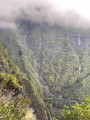
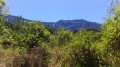
(S/E) Set off along the path, first through a forest of filaos and then out into the open. You’ll be treated to a view of a jagged section of the plateau on which the town of Cilaos stands.
(1) After an initial series of hairpin bends, you’ll cross the old route of the Waterfall du Bras Rouge trail. This trail used to start at the old thermal baths of Cilaos, which are now off-limits.
At this junction, follow the direction indicated by the sign to reach the Bras Rouge waterfall by turning right. The path, which varies in width, then levels out and heads due west. Here, for the first time, you’ll catch sight of the Corne du Rhinocéros and the Pain de Sucre, at the foot of which stands the chapel. Although the path runs along the edge of the cliff, it is rarely vertiginous as it is well shielded from the drop by the vegetation.
To the left, you look out over the Bras des Étangs, which you can hear but will see little of and will never cross. To the left, you can also see the very jagged slopes of the Bras des Étangs area, where one can’t help but imagine that rockfalls are very common in this part of the cirque. The path occasionally crosses ravines before entering a grove of filaos once more.
A few bends further on, you can finally get a full view of the Rhinocéros, as well as the Grand Bénard and the Château Fort – a large rock outcrop similar to the Roche Verre Bouteille, which is very popular with rock climbers.
(2) After a fifteen-minute descent, you’ll reach a second series of hairpin bends, which are easier and less steep than the first. You can take the shortcuts, which shorten the distance by a few metres but involve a steeper slope. After this second series of hairpin bends, a few clearings offer glimpses of the Bras des Étangs, which is very rarely seen. The narrow path becomes a little more vertiginous after passing this second series of hairpin bends. The path then passes beneath an enormous rock wedged between two rock faces. Passing under this natural arch signals that you are nearing the Ravine Ferrière.
Thereafter, the path occasionally runs alongside areas that were undoubtedly once used by humans, as evidenced by the presence of low stone walls. About a hundred metres after passing these walls, you can see the Bras Rouge on the left, which is not far away. A few more bends and the Waterfall Ferrière comes into view (dry on that particular day).
(3) A few hundred metres further on, the path crosses the Ravine Ferrière, passing very close to a pool and its small waterfall. Unfortunately, the ravine is dry, so we’ll only get to see the pool. Then begins a third series of hairpin bends: this is the final descent to the Cascade du Bras Rouge. The path is completely exposed and the slope is slightly steeper.
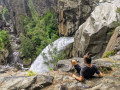
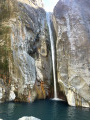
(4) You’ll soon come to a sign warning of the danger in the area. Turn left at the sign to see the Bras Rouge waterfall and then head to the viewpoint at the end of the path.
(5) The view of this iconic waterfall in the Cirque de Cilaos is impressive and well worth the detour!
Take a few minutes to admire this incredible waterfall, then return to the starting point via the same route (out and back).


 Visorando Member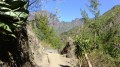
 Easy
Easy 
 Difficult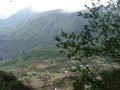
 Very difficult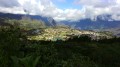
 Association / Club / Walk leader