Country:

 City:
City:


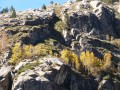
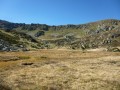
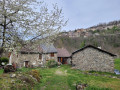
Once in Savignac-les-Ormeaux, leave the N2020, pass between the police station and the school, and cross the very narrow bridge (take care) over the Ariège. Continue along the small tarmac road that passes under the Ax-les-Thermes bypass and then begins a series of tight hairpin bends as it climbs up the Ruisseau du Najar valley. Park on a grassy area at the side of the road near the few restored barns that mark the end of the tarmac road.
Excellent yellowPR® signposting
(S/E) Continue along the road, which immediately gives way to a wide track suitable for vehicles at a sign reading “No entry for all vehicles – Customs”. Cross an electric fence, taking care to close it properly behind you, and continue along the shaded track with the murmur of the Najar on your left.
The track leads to a small turning area with a sign reminding hikers of the correct behaviour to adopt in the mountain pastures. It then gives way to a wide, non-vehicular path that enters a magnificent beech and spruce wood. After crossing a second electric fence and several muddy sections where the stones on the ground prove very useful, you reach the Jasse des Esquers de Dessous and its hut.
(1) Cross this beautiful meadow by following the wooden posts bearing the yellowPR® markings, which prevent you from getting lost in very wet areas. After a few more muddy sections where you really have to navigate around the rocks on the ground, you’ll reach the Jasse des Esquers de Dessus (hut).
(2) No wooden posts this time, but the route is obvious if you head towards the valley floor. At the end of the meadow, rejoin the path that winds through the ferns. After crossing a few small rocky outcrops, you’ll reach a barely marked junction, indicated however by aPR® marker inviting you to head left towards the Pont du Ressec, which you can see a little further on.
Rare cairns
(3) Leave thePR® path, which continues south into the valley, and turn right onto a faint track that quickly becomes very difficult to spot on the leaf-covered ground. Climb straight up the slope, heading west, taking care not to stray from the Ruisseau des Pradels, which serves as a guide on your left.
Emerge from the woods to reach the Jasse des Pradels. Continue climbing for about fifty metres and veer left to get closer to the stream. Look out for a relatively small cairn on the opposite bank, which marks the spot where you need to cross.
(4) Cross the stream and follow a faint track that veers to the right, running alongside a small tributary of the Ruisseau des Pradels. After a few cairns over the first hundred metres, the track disappears and you must navigate the terrain as best you can between large boulders and clumps of rhododendrons, taking care to stay close to the stream on the right.
(5) Where the stream turns south-west, a clearer path reappears. Follow it, keeping the same direction. The magnificent Pic du Paillé towers above us on the right at 2,182m. Go round a small rocky outcrop on the left. The track splits into several paths due to livestock, so keep heading south-south-west, aiming for a saddle between two large rocks. Cross this to rejoin a well-marked path.
Cairns are much more numerous
(6) The route continues over gispet (a rock type characteristic of the siliceous high Pyrenees), which conceals numerous holes (some filled with water) that are treacherous for your ankles: proceed with caution! The slope steepens sharply and becomes challenging as you cross a succession of small rocky outcrops before easing off at the start of a grassy section.
(7) The trail becomes more or less lost again. Head for a small pass in the centre of the valley. The path, which you’ll find again a hundred metres further on, steepens once more before reaching the rocky cirque covered in scree that marks the valley floor (a small lake in the process of disappearing).
(8) Turn right to tackle the final ascent, first diagonally then straight up the slope, following a small stream flowing to the left at varying distances. Navigate this very steep slope as best you can to reach the pass that opens onto a vast grassy plateau housing a small, shallow lake overgrown with weeds. On the left, you can see the Embizon hut perched on a rocky outcrop (not shown on the IGN map).
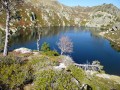
(9) Follow a track through the grass on the right, heading north, which soon leads out above the Étang d’Embizon, nestled in its rocky cirque. Take in the beauty of the site and enjoy a well-deserved rest after all the effort of the climb, as the descent will be tough.
(10) The return journey follows the same route back to the barns where you started (S/E).


 Visorando Member
 Easy
Easy 
 Moderate