L'Étale

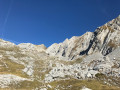
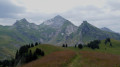
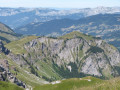
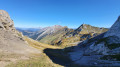
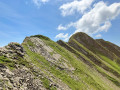
L'Étale (altitude 2,483 m) is a complex mountain in the Bornes-Aravis massif, renowned for its aerial ridge route. The normal route (with a few variations) allows you to climb up a relatively austere combe on the western slope, but the final stretch is well worth the effort for the purity of the ridge and the expansive view.

Details

1702128
Creation:
Last update:
Last review:
  • Walking
    Activity: Walking
  • ↔
    Distance: 7.76 km
  • ◔
    Duration according to the author: 7 hrs 
  • ▲
    Difficulty: Very difficult

  • ⚐
    Back to start: Yes
  • ↗
    Ascent: + 1,358 m
  • ↘
    Descent: - 1,358 m

  • ▲
    Highest point: 2,470 m
  • ▼
    Lowest point: 1,187 m

Photos

Description of the walk

From Thônes, climb to Manigot and in the village take the small road to Comburce: park in the car park after passing the hamlet.

(S/E) Cross the Nant de la Blonnière on a footbridge and immediately climb to the left on a marked path that leads to some chalets. After crossing to the south-east, climb up to the left in front of a chalet to reach La Turte. Here, join a pastoral road.

(1) Cross it and climb straight up to the east into the forest (several paths are possible, follow the marked one) then the path heads south-east across the slope, which becomes less steep until you reach the flat grassy area of La Rouelle.

(2) Just before a right-hand bend to cross a stream, climb straight up to the left on a path over a ridge that is half grassy, half scree, which remains on the right bank of an often dry stream. Do not be tempted by the grassy slopes opposite and stay on this ridge, which curves to the left until it reaches a rocky outcrop where the stream becomes a narrow, steep-sided ravine.

(3) Turn sharply right (red arrow) to climb the steep grassy couloir towards the east. The path is less visible but still there: towards the top of a grassy climb, a red mark indicates a ledge with a tree that allows you to escape easily to the right. You will find yourself back on grassy or rocky slopes, which you should climb, avoiding the slabs. These slopes gradually become less steep as you climb higher. You will then see the normal route path coming up higher on the right through the scree.

(4) When you reach a limestone barrier, go around it either on the left (paths in the scree) or on the right (less marked path but grassier slopes: this is the marked route) to climb up to the centre of the valley and join the normal route.

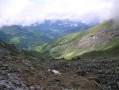
(5) This valley does not open out at its summit (overhangs) and the route consists of climbing its right bank along a path on the side of the valley above a clearly visible limestone stratum running across this slope.
Reach this path by climbing up the left side to the point where you can best cross this small layer: there are several tracks, take the one that looks best.
Climb up this slope to the corridors closing off the valley: climb up the schistose faults on the right to the breach overlooking the Combaz Corridor.
Be careful here: before reaching the summit, the route is rocky and relatively exposed. You need to be sure-footed, but the reward at the summit is worth the effort.
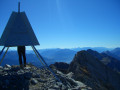
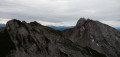
From this pass, take the trail on the right through the rocks: a first delicate step leads to a system of small couloirs. Climb them, staying on the western side of the ridge, which is slightly less exposed. Reach a secondary summit and then easily reach the summit, which is easily recognisable with its newly renovated geodetic signal.

(6) Descend via the same route in the rocky summit area: towards the end, you can descend a little lower to avoid the tricky step and gain a foothold more easily in the schistose couloir.
Descend this couloir, keeping to the right to rejoin the hillside path. At the most obvious point, head left to reach the bottom of the valley in the scree.

(5) Descend this valley, gradually veering left to cross, sometimes over scree, sometimes over grassy areas, to the Col du Passet (2032 m). Here you will find a proper marked trail.

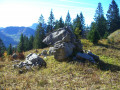
(7) Turn right to descend the steep valley. The path winds and fixed ropes help in some rocky passages. Arrive at La Creuse (chalet and distinctive rock).

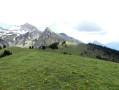
(8) Turn right heading north into the forest, then across meadows to descend to La Rouelle.

(2) Take the path on the left, which is the reverse of the one you took on the way up, to La Turte.

(1) There are two options here:
- either descend, in the opposite direction, along the path you took on the way up through the meadows and chalets (option shown on the map),
- or, for a more leisurely stroll, take the pastoral road on the right, which crosses the forest to the north-east, then descends to cross the stream de la Bonnière (water intake) and returns westwards to the car park where you started (S/E).

Waypoints

  1. S/E : km 0 - alt. 1,187 m - Comburce
  2. 1 : km 0.69 - alt. 1,365 m - La Turte
  3. 2 : km 1.52 - alt. 1,574 m - La Rouelle. Crossroads of the circular
  4. 3 : km 1.78 - alt. 1,698 m - Direct ascent start
  5. 4 : km 2.41 - alt. 2,027 m - Foot of the limestone barrier
  6. 5 : km 2.71 - alt. 2,150 m - Centre of the valley
  7. 6 : km 3.42 - alt. 2,447 m - Summit of Étale
  8. 7 : km 5.03 - alt. 2,000 m - Col du Passet
  9. 8 : km 5.8 - alt. 1,669 m - La Creuse
  10. S/E : km 7.76 - alt. 1,187 m - Comburce

Notes

There are water sources at the chalets. Higher up, there are no resources: it is quite desert-like.
Caution.
The route does not require any special equipment. However, it does present some difficulties below the summit and below:
- between (2) and (5) there is a more direct but off-trail access, with steep slopes from (3). This requires a good sense of direction and good visibility to avoid the limestone bars and slabs between which you have to squeeze through.
In case of fog or apprehension, the ascent should be made via the route described for the descent, passing through (8) and (7), as it is more regular and, above all, well marked.

Beware of rockfalls on part of the route, particularly in the couloirs below the pass and, of course, on the ascent to (6).

Worth a visit

The view from the summit is particularly extensive: Mont Blanc, Vanoise, Ecrins... and of course closer to home, Aravis, Bargy, Charvin, Tournette...

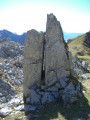
The structure of this sector of the Aravis features numerous peaks and ridges, but also a number of characteristic rocks forged by erosion and rockfalls.

Reviews and comments

4.7 / 5
Based on 2 reviews

Reliability of the description
4.5 / 5
Ease of following the route
4.5 / 5
Route interest
5 / 5
Steph29510
Steph29510

Overall rating : 5 / 5

Date of your route : Nov 11, 2025
Reliability of the description : ★★★★★ Very good
Ease of following the route : ★★★★★ Very good
Route interest : ★★★★★ Very good
Very busy route : No

Hello,

And thank you for moderating, because having done this hike three days ago (09/11/2025), access to the arrival point at point 5 and towards point 6 was really difficult, to the point that without equipment and with quite a lot of snow that had hardened slightly, my son and I turned back.
In addition, snow covers the access path to point 5.
So be careful, and we will do this hike again in May to be on the safe side.
In any case, thank you for the advice on how to approach the hike, which is different from what is given at the start of the hike.

Stéphane

Machine-translated

grandin
grandin ★

Thank you, Chamoun.

I have increased the difficulty level of this hike. Even though some may feel that the rating is exaggerated, it is better for hikers to be fully aware of the difficulty.

Machine-translated

Chamoun
Chamoun

Overall rating : 4.3 / 5

Date of your route : Aug 11, 2019
Reliability of the description : ★★★★☆ Good
Ease of following the route : ★★★★☆ Good
Route interest : ★★★★★ Very good

Hello,

I live in the GBO and am familiar with Etale from hiking there in winter (twice) and summer (three times).

I climbed it again on Sunday 11 August, following the Visorando guidebook.

I would recommend taking the route in the opposite direction to that indicated, as the climb between bars 2-3 and up to mid-4 is exhausting and it is easy to get lost between the bars.

The direction 1, 2, 8, 7, 5, 6 then 5, 4, 3, 2, 1 is the one used for winter ski touring. The route is natural and the descent can be made without having to search for the passage.

However, I have reservations about climbing the final ridge from the pass at point 6.

It is extremely exposed with a 1,000-metre drop below you towards La Giettaz.

Even for an experienced hiker, a cable or fixed rope would be needed for safety. This free passage is more like mountaineering, it is grade 3 but the risk of falling is high.

The guidebook is not explicit enough; the final passage should be mentioned as extremely difficult due to the commitment required.

Best regards

Jean-Christophe Hamm
Le Grand Bornand
jchhamm@aol.com

Machine-translated

Other walks in the area

For more walks, use our search engine .

The GPS track and description are the property of this route's author. Please do not copy them without permission.