
Kitadake, Japan’s second-highest peak

Superb views of Mount Fuji and the whole of the Southern Alps. My best hike in Japan. Whilst not technically difficult, it does require a bit of effort, but every step counts. Unlike other hikes that are a bit of a rollercoaster, here you just keep climbing. You therefore pass through all the vegetation zones fairly quickly: classic mixed forests, birch forests, then shrubby areas before reaching the final zone of rocks and low-growing plants.

Details

1543596
Creation:
Last update:
Last review:
  • Walking
    Activity: Walking
  • ↔
    Distance: 10.65 km
  • ◔
    Average duration: 7h 50 
  • ▲
    Difficulty: Difficult

  • ⚐
    Back to start: Yes
  • ↗
    Ascent: + 1,682 m
  • ↘
    Descent: - 1,682 m

  • ▲
    Highest point: 3,169 m
  • ▼
    Lowest point: 1,523 m

Photos

Description of the walk

Take the Chūō Line (中央線) from Tokyo or Shinjuku to Kōfu Station (甲府).
Then take a bus from platform 1 to Hirogawara (広河原).

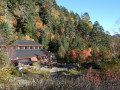
(S/E) The path starts directly behind the mountain hut: on leaving, facing the river, turn right, then immediately right again; the path is well signposted. You then follow (at some distance, and much higher up) a torrent which is a tributary of the main valley.
After crossing two footbridges over small secondary tributaries, you reach a junction of paths (signpost).

(1) The path on the left continues to follow the tributary along its left bank (west), whilst the one on the right climbs the ridge separating this tributary from the secondary tributary you crossed about 100m earlier. All that remains is to climb, rather steeply, up this ridge with the sound of the two torrents to your right and left. The higher you climb, the further you move away from the torrents and their song. You will pass two benches to catch your breath, and numerous ladder-steps installed in the steepest or most eroded sections.
The entire ascent follows a series of switchbacks heading west-south-west, until the path turns left to head generally south. This final section allows you to catch your breath as the average gradient is very gentle all the way to the refuge.

(2) The refuge offers a well-deserved break. Tables and benches. Unlimited water. Toilets (a small box allows you to leave a ‘tip’: no set price, but a small gesture is appreciated). You can also top up your supplies of food and drink. A friendly welcome at this very well-maintained refuge.
We then continue southwards, passing a pretty little pond on the left before immediately coming to a fork. We take the path on the right, which climbs through a wide strip of open ground between wooded areas. Here again it is quite steep, winding its way south-west.
After a fair bit of effort, you reach a rather surprising fence in these parts: a sign explains that it is to protect an area of vegetation from the damage caused by fallow deer. The path turns left along the fence and soon reaches a fork (signpost). We turn right to continue climbing, initially along the fence which soon veers off to the right, and we quickly reach the ridge at a junction.

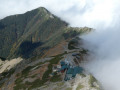
(3) The path on the right descends along the ridge heading north. Take the path on the left along the ridge, following the ascending trail. All that remains is to follow the ridge: magnificent panoramic views of almost 360° (weather permitting!) all the way to the refuge.

(4) A slightly older and more rustic refuge than the previous one. But it offers the same facilities. After a break, take the path on the left between the refuge wall and a low wall, and follow the path that begins the climb up the rocks behind the refuge for the remaining 200m of elevation gain to the summit.

(5) We retrace our steps (but see Note 3 below in the ‘Practical Information’ section) to return to the start (S/E).


Waypoints

  1. S/E : km 0 - alt. 1,523 m - Hirogawara-sanchô Mountain Hut (広河原山挑)
  2. 1 : km 0.62 - alt. 1,674 m - Junction: West route – East route
  3. 2 : km 2.52 - alt. 2,238 m - Shirané-o-iké Hut (白根御生け小屋)
  4. 3 : km 3.77 - alt. 2,837 m - Mount Kotoroyama Junction
  5. 4 : km 4.57 - alt. 3,010 m - Kitadake-Katano-Koya Mountain Hut (北岳肩の小屋)
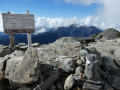
  6. 5 : km 5.24 - alt. 3,166 m - Kita-Daké
  7. S/E : km 10.65 - alt. 1,523 m - Hirogawara-sanchô Mountain Hut (広河原山挑)

Notes

Note 1: The route is very easy to follow, as it is very well marked by the passage of thousands of hikers. There are no misleading branches, and the few junctions are clearly marked by signposts. In areas where the path is a bit unclear, particularly on the rocks, there are red paint markings.

Note 2: Visorando’s smoothing or sampling of the data yields figures significantly lower than those given by my GPS, which must already be smoothing out the hundreds of waypoints along this route. I recorded a distance of 9.5 km and 1,750 m of elevation gain. Similarly, Visorando’s estimated time of 5 hours 30 minutes (“average walker with reasonable breaks”) seems to me to be exceptionally underestimated. Allow for 7 hours instead, and without dawdling along the way. The descent is, of course, quicker: from point (4), I reached point (S/E) in 3 hours.

Note 3 for the return journey: it actually takes two days in total (except for very fit walkers), which can be organised in various ways.
I had planned to descend via the eastern road, which drops rapidly into the valley and joins this route at point (1). However, it had been damaged by recent typhoons and was strongly advised against.
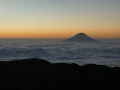
I chose to spend thefirst night at (S/E) and thesecond at (4) after descending from the summit. Other options are possible, such as spending the night at (2), which seems much more comfortable and cuts the ascent in half. But it is important to be at the summit or near the summit to enjoy the sunrise and/or sunset. From the Kitadake-Katano-Koya mountain hut, I fully enjoyed the sunrise over Mount Fuji and the Alps (see photos) without having to climb back up to the summit.
It might be worth pushing on to the hut beyond the Kitadake-Sansô-Koya summit (北岳山荘小屋) at 2,900m to spend the night there. It is perhaps more comfortable than (4) and offers a more open view of Mount Fuji.

Access:
Take the Chūō Line (中央線) from Tokyo or Shinjuku to Kōfu Station (甲府).
Then take a bus from platform 1 to Hirogawara (広河原). Cost: 2,100 yen; journey time: approximately 2 hours. Please note: there are only a few buses on weekdays, and timetables vary at weekends and depending on the season.
Website in Japanese

At the bus stop: an information office (useful for checking trail conditions), toilets, and drinks vending machines. To reach the mountain hut and the start of the hike: take the road running alongside the river downstream, pass the barrier restricting vehicle access, then take the path on the left leading to the suspension bridge crossing the river. Follow the river upstream on the right to reach the mountain hut or the start of the trail.

It is advisable to book accommodation and meals at the mountain huts in advance (average price 8,000 to 9,000 yen for full board):
Hirogawara-sanchô Mountain Hut (広河原山挑): 090-2677-0828
Shirané-o-iké Mountain Hut (白根御生け小屋): 090-3201-7683
Kitadake-Katano-Koya Mountain Hut (北岳肩の小屋): 090-4606-0068
Kitadake Sansô-Koya Mountain Hut (北岳山荘小屋): 090-4529-4947

Note: the meals at Hirogawara-sanchô were quite enjoyable, but I didn’t like those at Kitadake-Katano-Koya nearly as much. If I were to do it again, I’d bring some food with me for the day spent at altitude...

Worth a visit

Don’t miss the sunrise and/or sunset from the heights (either the summit or one of the huts near the summit).

For more walks, use our search engine .

The GPS track and description are the property of this route's author. Please do not copy them without permission.