


Refine your search for walks in île Saint-Louis
île Saint-Louis walks


 The Village Saint-Paul, Île Saint-Louis and Île de la Cité
 Visorando Member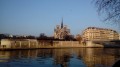
 3.13 mi
 +26 ft
 -26 ft
 1h 30
1h 30
 Easy
Easy
 Departure from Paris
The last stage of this journey takes us to the historic heart of Paris, where we discover a rich heritage. The labyrinthine streets of the Village Saint-Paul are followed by the Île Saint-Louis and its 17th-century mansions. The Île de la Cité is a delight in itself, with Notre-Dame as its highlight. And the Seine is always in the background...
The route and description take into account areas closed to the public following the Notre Dame fire in April 2019.
The main monuments of Paris along the Seine
 5.12 mi
+26 ft
-30 ft
2h 25
Easy
Departure from Paris
5.12 mi
+26 ft
-30 ft
2h 25
Easy
Departure from Paris
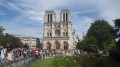
This urban but relatively open route allows you to discover the main monuments of Paris on foot. You will see the Eiffel Tower, the Louvre and Notre-Dame Cathedral, among others. The start and finish points are accessible by underground.
Saint-Germain-des-Prés and Montagne Sainte-Geneviève
 3.84 mi
+79 ft
-105 ft
1h 50
Easy
Departure from Paris
3.84 mi
+79 ft
-105 ft
1h 50
Easy
Departure from Paris
A journey into the medieval and even Gallo-Roman past of Paris, following in the footsteps of Sainte-Geneviève, whose namesake hill we climb, whose ancient sarcophagus can be seen in the church of Saint-Étienne-du-Mont, and whose statue can be seen in the Jardin du Luxembourg and on the Pont de la Tournelle. Among other sights, the itinerary follows a section of the old city wall built by Philippe Auguste and crosses the Arènes de Lutèce.
A route through the heart of Paris
 22.13 mi
+312 ft
-312 ft
5 days
Easy
Departure from Paris
22.13 mi
+312 ft
-312 ft
5 days
Easy
Departure from Paris
This route, comprising just five stages, all accessible by public transport, offers an exploration of the capital’s city centre and a journey back in time to the city’s Gallo-Roman foundations.
From the Basilica of Saint-Denis to Notre-Dame de Paris
 17.04 mi
+554 ft
-528 ft
5 days
Easy
Departure from Saint-Denis (Seine-Saint-Denis) (Seine-Saint-Denis)
17.04 mi
+554 ft
-528 ft
5 days
Easy
Departure from Saint-Denis (Seine-Saint-Denis) (Seine-Saint-Denis)
This urban itinerary, comprising five short stages, links two masterpieces of Gothic art in the Île-de-France region. It offers an opportunity to discover a rich and diverse heritage: medieval remains, 17th-century mansions, industrial and modern architecture, street art, and more. The purely urban sections are interspersed with a walk along the Canal Saint-Denis and a stroll through several parks and gardens, including those of La Villette and the Buttes Chaumont.
Walks near île Saint-Louis
The Philippe Auguste enclosure and the covered passages of the Sentier
 4.71 mi
+26 ft
-23 ft
2h 10
Easy
Departure from Paris
4.71 mi
+26 ft
-23 ft
2h 10
Easy
Departure from Paris
This route on the right bank of the Seine takes us on a journey from medieval times to Art Nouveau. First, we discover the most important remains of Philippe Auguste's city walls and former mansions. We then wind our way through the Sentier district to explore several of its covered passages.
This walk is best done during the week, as the covered passages are closed on certain days.
The Passages of Paris
7.51 mi
+75 ft
-16 ft
3h 30
 Moderate
Departure from Paris
Moderate
Departure from Paris
In Paris, the term ‘passages’ refers to covered walkways through which one goes from one street to another by passing through one or more buildings, and which are intended solely for pedestrians. The shops there are splendid, well-stocked, but somewhat expensive. In bad weather, like the Palais-Royal, they serve as promenades and meeting places. They are generally lit by gas.
Women's march of 5 October 1789: from Paris City Hall to Sèvres
 8.88 mi
+89 ft
-82 ft
4h 10
Moderate
Departure from Paris
8.88 mi
+89 ft
-82 ft
4h 10
Moderate
Departure from Paris
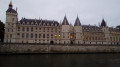
The first section of this women's march of 5 October 1789 follows fairly closely what we know today about the route taken at the time. Starting from the centre of Paris, we follow the course of the Seine and then cross the districts of Auteuil and Billancourt. We cross the Ile Seguin, where the Vieux Pont de Sèvres bridge used to be, and end up in Sèvres, where the 1789 procession made a stop. All along the way, there is a rich heritage to discover.
In the footsteps of the French Revolution
 21.14 mi
+1,020 ft
-712 ft
4 days
Moderate
Departure from Paris
21.14 mi
+1,020 ft
-712 ft
4 days
Moderate
Departure from Paris
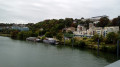
Here are four hikes that take in iconic locations from the French Revolution. One of them takes place in Versailles, where it all began in May 1789. Another takes place in Paris, which was the scene of many events, including the storming of the Bastille on 14 July 1789. The other two connect Paris to Versailles, attempting to reproduce the women's march of 5 October 1789.
Green spaces in Paris’s 5th arrondissement
 4.70 mi
+177 ft
-157 ft
2h 20
Easy
Departure from Paris
4.70 mi
+177 ft
-157 ft
2h 20
Easy
Departure from Paris
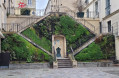
Just like Paris’s oldest arrondissement, the gardens of the fifth evoke the past: the Cluny Medieval Garden, Square Viviani, where the capital’s oldest tree, the famous black locust, has watched Paris transform for over 400 years; the Arènes de Lutèce or the Jardin des Plantes, the Royal Garden of Medicinal Plants. A tour through bustling neighbourhoods, blending bookshops, student cafés and ancient alleyways in an authentic, timeless atmosphere that embodies the intellectual soul of Paris.
Green spaces in the 1st and 2nd arrondissements of Paris
 2.54 mi
+157 ft
-115 ft
1h 20
Easy
Departure from Paris
2.54 mi
+157 ft
-115 ft
1h 20
Easy
Departure from Paris
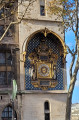
The1st arrondissement, modest in size, represents the historic and geographical heart of Paris; today, it is a district of museums and luxury boutiques. The Tuileries and Louvre Gardens, as well as the Palais Royal, managed by the State, make up for the limited number of municipal squares.
The 2nd arrondissement, the smallest in Paris, is livelier and more commercial. Formerly a financial district, it is now bustling with covered arcades, restaurants and businesses. The atmosphere is dynamic, friendly and very urban. It has only two municipal squares.
From the Île de la Cité to the Porte de Versailles
 3.65 mi
+43 ft
-30 ft
1h 45
Easy
Departure from Paris
3.65 mi
+43 ft
-30 ft
1h 45
Easy
Departure from Paris
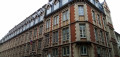
From the heart of the capital to its outskirts, this urban walk takes you through the Latin Quarter before following the entire length of Paris’s longest street, Rue de Vaugirard. Along the way, you’ll come across Notre-Dame Cathedral (currently undergoing restoration), the Palais du Luxembourg and several churches dating from various periods.
From Île de la Cité to Porte de Montreuil
 5.38 mi
+118 ft
-39 ft
2h 35
Easy
Departure from Paris
5.38 mi
+118 ft
-39 ft
2h 35
Easy
Departure from Paris
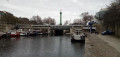
From the heart to the outskirts of the capital, this urban route starts on the banks of the Seine and then follows the Port de l'Arsenal on the Canal Saint-Martin. It then crosses the Roquette and Charonne districts and takes a few narrow streets and passages bordering the Père Lachaise Cemetery.
From Île de la Cité to Porte de Charenton
 4.51 mi
+69 ft
-33 ft
2h 10
Easy
Departure from Paris
4.51 mi
+69 ft
-33 ft
2h 10
Easy
Departure from Paris
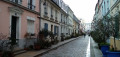
From the heart to the outskirts of the capital, an urban route that first crosses the Île de la Cité and the Île Saint-Louis. It continues along the banks of the Seine and then the Port de l'Arsenal. After passing by the Gare de Lyon, the route briefly follows the Coulée verte René Dumont. The walk ends via Square Saint-Éloi, the former Gare de Reuilly and Place Félix Éboué with its lion fountain.
From Île de la Cité to Porte de Pantin
 6.26 mi
+79 ft
-23 ft
2h 55
Moderate
Departure from Paris
6.26 mi
+79 ft
-23 ft
2h 55
Moderate
Departure from Paris
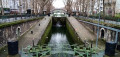
From the heart to the outskirts of the capital, this urban route first takes you through the Marais district, dotted with mansions. Then, under the sign of water, you walk along the Canal Saint-Martin and then the Bassin de la Villette. The route ends at the entrance to the Parc de La Villette.