
Haapsalu: from the medieval castle to the seafront and the railway museum

On Estonia’s west coast, Haapsalu’s wooden houses and promenades stretch along the edge of a shallow bay; this former seaside resort was once prized for its therapeutic mud. This circular walk takes in the main sights. You’ll first reach the medieval bishop’s castle and its cathedral, then head to the seafront and its wooden viewing platforms overlooking the bay. You then walk along vast coastal meadows where, in spring, huge flocks of migratory geese gather, before skirting the bay along its tranquil shores, from where the picture-postcard view of the castle rising above the water comes into view. The return journey takes you past the historic railway station and its railway museum, renowned for its very long covered wooden platform. An ideal getaway combining heritage, the seaside and birdwatching.

Details

101602184
Creation:
Last update:
Last review:
  • Walking
    Activity: Walking
  • ↔
    Distance: 4.54 mi
  • ◔
    Average duration: 2h 05 
  • ▲
    Difficulty: Easy

  • ⚐
    Back to start: Yes
  • ↗
    Ascent: + 33 ft
  • ↘
    Descent: - 39 ft

  • ▲
    Highest point: 46 ft
  • ▼
    Lowest point: -3 ft

Photos

Description of the walk

Park in the shopping centre car park along Posti Street.

(S/E) From the car park, cross Nurme Street at the pedestrian crossing and walk up Posti Street, keeping to the right-hand pavement. Cross a further three pedestrian crossings, continue straight on along Karja Street and turn right into the passage between numbers 19 and 21 on Karja Street. Climb the steps leading to the castle grounds (lossipark) and enter the grounds.

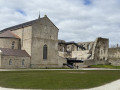
(1) In the courtyard of the Episcopal Castle, walk round the Dome Cathedral on the right and exit the grounds on the other side. In the wooded park, turn left, walk along the ramparts and head for the Lossiplats car park. Continue via the old Swedish market square (Rootsituru plats) and its central wooded island, where you should veer slightly to the right to follow Ehte Street to the edge of the bay. Turn right and start the footpath.

(2) At the wooden observation hut on stilts, enjoy the view of Väike viik Bay, its reed-covered islet and the town opposite, then continue your walk, passing Viigi Square and the Väinameri Victims’ Memorial. When the pavement moves away from the shore, stay on the coastal path, cross a small stream and then join the pavement on Uus-Sadama Street.

(3) At the junction with Lahe Street, carry straight on along Uus-Sadama Street to the tip of the peninsula. You’ll reach the wooden viewing platform, facing the lagoon, with the tall radio mast visible in the distance.

(4) Then retrace your steps along Uus-Sadama Street back to the junction, with Lahe Street on your right.

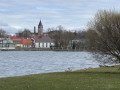
(3) Once back, turn right onto Lahe Street. A little further on, continue your walk around the bay by leaving the pavement and taking the coastal path that branches off to the left. Follow the shore as closely as possible: the old town and its castle come into view across the bay. Continue along Vaikne Kallas Street and pass thefirst junction.

(5) Leave the shore by taking the small, partly pedestrianised Rue Väike-Lossi on the right, between the houses, and rejoin Rue Lahe.

(6) Take thesecond right onto Õhtu kallas. Walk past Wiedemanni Square and its information board, then leave the street and continue straight ahead along the greenway. Carry on facing the open sea, alongside the white benches.

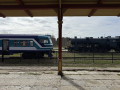
(7) At the end of the cycle path, carefully cross Kiltsi tee – a busy road – at the pedestrian crossing and walk past the historic Haapsalu railway station and its open-air railway museum. Walk through the old station building to emerge onto Raudtee Street. With your back to the station, head towards the footpath at 10 o’clock, on the other side of the coach station. Carefully cross Kiltsi tee Street again and continue to the right. Cross the pedestrian crossing on Kalda Street, follow Jaama Street, then cross Posti Street at the traffic lights to return to the car park (S/E).


Waypoints

  1. S/E : mi 0 - alt. 36 ft - Car park by the shops along Posti Street
  2. 1 : mi 0.46 - alt. 43 ft - Château épiscopal de Haapsalu (Piiskopilinnus) et cathédrale du Dôme (Toomkirik)
  3. 2 : mi 1.18 - alt. 7 ft - Observation hut on stilts - Baie Väike viik
  4. 3 : mi 1.66 - alt. 7 ft - Junction of Uus-Sadama and Lahe
  5. 4 : mi 2.17 - alt. 7 ft - Viewing platform
  6. 5 : mi 3.21 - alt. 7 ft - Väike-Lossi Street
  7. 6 : mi 3.4 - alt. 20 ft - Ohtu kallas
  8. 7 : mi 3.93 - alt. 10 ft - Gare et musée ferroviaire de Haapsalu
  9. S/E : mi 4.54 - alt. 30 ft - Car park by the shops along Posti Street

Notes

Parking is available in the car park by the shops along Posti Street; free for two hours.

The promenade is open to the public all year round. The seafront is open-air and can be windy, and the promenades may be icy or snow-covered in winter.

The railway museum, housed in the historic station, is only open during the tourist season and has reduced opening hours outside the summer months. Please check before visiting.

Cafés, restaurants and shops can be found in the old town. Haapsalu is connected to Tallinn by coach.

Worth a visit

(1) Haapsalu Bishop’s Castle (Piiskopilinnus), founded in the 13th century by the Bishopric of Ösel-Wiek, is one of the largest medieval fortresses in Estonia. Its stone walls surround the Cathedral (Toomkirik). The legend of the White Lady, who is said to appear in a window of the cathedral during the August full moon, attracts many curious visitors every summer.

(3) The meadows and reed beds around the bay are a renowned birding spot. In spring, huge flocks of migratory geese – including barnacle geese and greylag geese – stop off here before continuing northwards.

(7) Haapsalu railway station, built in the early 20th century, is famous for its covered wooden platform – one of the longest in Europe – which was constructed to accommodate the Russian imperial train that brought the aristocracy to the seaside resort. It no longer serves passenger trains and is now home to the railway museum, where steam locomotives and railcars are on display.

For more walks, use our search engine .

The GPS track and description are the property of this route's author. Please do not copy them without permission.