Circular route around Hattainville and Les Moitiers-d'Alonne from Carteret

This long circular day-long loop (including breaks) combines the “urban” landscapes of the charming port of Carteret with coastal scenery, beaches and austere moorland, leading to the small village of Hattainville, then to Les Moitiers-d’Alonne, mostly along footpaths.
With a few variations, this is a classic route for regulars at the seaside resort and local walking clubs!
The Visorando app is recommended for the dunes

Details

61920662
Creation:
Last update:
Last review:
  • Walking
    Activity: Walking
  • ↔
    Distance: 15.05 km
  • ◔
    Average duration: 4h 55 
  • ▲
    Difficulty: Moderate

  • ⚐
    Back to start: Yes
  • ↗
    Ascent: + 210 m
  • ↘
    Descent: - 202 m

  • ▲
    Highest point: 90 m
  • ▼
    Lowest point: 4 m

Photos

Description of the walk

Parking is available at Place du Terminus (or Place Flandres-Dunkerque), opposite the old station.
Start in front of the old station, now Restaurant Le Terminus.
The entire first section is in the town centre, on pavements and roads.

(S/E) Head towards the nearby Restaurant Le Carteret, pass in front of its terrace, keeping it on your right, and continue along Avenue de la République for a few dozen metres, towards Port de Carteret.

(1) At the junction with Rue de Paris, turn right onto this street, which continues as Promenade Abbé Lebouteiller. From there, follow theGR®®223route.
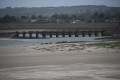
Walk along the quays of the River Gerfleur, which flows out to sea, and take in the sights of the entrance to Carteret Harbour, the tide level, the arrival or departure of fishing or pleasure boats, and the “gate” – a sort of small movable barrier between two buoys designed to retain as much water as possible in the harbour.

(2) At the first junction after the gate, between No. 10 and the bar-restaurant "Le Russel", turn right onto Route de la Corniche and follow it up the winding road. Continue until you reach No. 12 and the start of Rue des Pins (a dirt track) on the right.
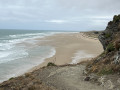
Just before this, 40 m above sea level, there is a lovely view over the beaches of Carteret and Barneville, the sea wall and the open sea.

(3) Cross Route de la Corniche here. Take the steps and the path down to Plage de la Potinière.

(4) Ignore the steps leading up to the right. Walk to and from the former seaside bathing establishment, now a restaurant (La Potinière), and admire the beach and the row of brightly coloured beach huts. Retrace your steps back up.

(4) Then turn left to head back up to the Route de la Corniche. Continue to the right, staying on the pavement on the sea side. Cross the road and turn left at the first Fork in the road onto Rue de Dennemont.
Walk up this street, leaving the impassable path along the large stone wall on your left. Admire the beautiful houses facing the sea.
Reach the first multi-way junction. Turn immediately left onto Chemin de la Falaise. Follow it to the end, opposite No. 11, a large, recently built house (2024).
Turn right onto the path and join Rue de la Roche Biard. Follow the street to the left until you reach some long blue gates, house no. 17.

(5) To make a round trip to the orientation table, take the path on the right opposite, which starts at a former EDF high-voltage/low-voltage substation. A sign points to “Roche Biard”. Climb the steps and then follow the path.
Reach the Roches Biard orientation table. A very pretty viewpoint, with place names marked on the table. Retrace your steps back to Rue des Roches Biard.

(5) Turn right onto the street. Pass Rue des Ecréhoux on your right and continue straight on to the end of the street. You will reach Rue du Cap, the D902.
Go round the properties on the left as you head downhill and, at the first junction (sign prohibiting vehicles over 3.5 tonnes), turn left onto Route des Deux Plages. (You might want to take a break on the bench, generously provided and sensibly placed here (though there’s no remarkable view!).
Walk past the villa “La Colinette”, then its little sister “La Marina”, and finally past a small, sloping stretch of moorland, still untouched by development. Continue downhill to the Potinière car park.

(6) Turn right onto the Sentier des Douaniers. Follow this path roughly westwards, leading south of the Carteret Semaphore. Magnificent scenery!

(7) Reach Cap de Carteret, below the Carteret Semaphore and Lighthouse. The view is even more beautiful (see § During the walk below).
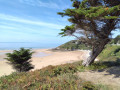
Continue along the Sentier des DouaniersGR®®223, which climbs towards the elevated dunes of Hattainville. Pass the old ruined church. Another remarkable viewpoint overlooking the seafront.

(8) Leave theGR®®223, which heads off onto the road to the right. Pass by the nearby Fontaine Saint-Germain.
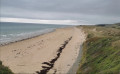
Turn left towards the dunes and the sea. Reach Plage de la Vieille Église. Walk about 200 m along the beach to the right.
Climb up the dune ridge and take a path along the crest of this first dune, without venturing into the dune massif.
Walk another 200 m or so and turn right, heading north-west, onto a clearly visible path. Be careful, however, as there are many misleading tracks in the area (the Visorando app is useful). Head towards a clearly visible strip of conifers. The path crosses this strip.
Behind this strip are three further parallel strips: this is an anti-erosion measure.
The path crosses the second strip, then the third, and joins a path running perpendicular to it.

(9) Take this path to the left to go round the small wood on the left, i.e. to the west, towards the sea.
The path climbs steeply northwards and continues through the wild dune landscape. After about 600 m, the path joins theGR®®223.

(10) Follow theGR®®223to the left, heading due north. About 500 m after this junction, the path runs alongside the first market gardens south of Hattenville (in the commune of Les Moitiers-d’Alonne).
Continue for another 400 m, passing a first pond on the right, then a wash house on the left, then a second pond on the right. Before the first house, the path becomes tarmac for about 50 metres. Reach a crossroads.

(11) Leave theGR®®223and turn left to make a short circular loop towards an orientation table and a Second World War blockhouse.
The path heads roughly westwards, bringing you closer to the sea.

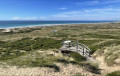
(12) After about 800 m, you’ll reach the Dunes d’Hattainville information board. Magnificent 360° views of the dune system, the coast, the long sandy beaches and the English Channel.
Continue the circular route northwards, without retracing your steps. You’ll reach the Lavoir de Fontenelle.
Turn right onto the circular path that loops back towards the village of Hattainville, turning into a lovely track suitable for vehicles, made of sand and earth. The track meets Rue des Devalous at a right angle, lined with houses in a housing estate. Turn right and follow for 200 m.
Join Rue des Mielles, alsothe GR®®223, just 70 m north of point (11), in front of no. 19. Turn left and head towards the centre of Hattainville, without being distracted by the side streets.
At the main T-junction, theGR®®223continues towards Portbail on the left, heading north.
Turn right onto Rue de la Cohue and follow it for a few dozen metres.

(13) Then, at the crossroads, take Rue de Bas, marked as a dead end. After No. 10 on the right, this street becomes Chemin Rural No. 13, a wide track suitable for vehicles, made of earth, sand and grass. This path runs roughly west-north-west for nearly a kilometre.
The path passes under the “Route touristique”, the D650 county road. After a further 200 metres or so, heading towards one of the two church steeples, you arrive in the centre of the village of Les Moitiers-d’Alonne, at “L’Auberge des Deux Églises” on Rue des Trois Forges.

(14) Take a detour to the left, then immediately to the right through the cemetery and past the village’s two churches.
The reason for these two remarkable, closely situated bell towers lies in the village’s history (see § During the walk below).
Retrace your steps and head down Rue des Trois Forges, the D904e, towards Barneville-Carteret, heading south. Pass the hamlet of Buret, which you’ll leave on your left.
After about 900 m, you’ll reach the “Route touristique”, RD650, at the Caouillette crossroads.

(15) Cross the RD650 with care and take the track, Chemin de la Fouaille, which runs along the fields, roughly west-south-west.
Continue for 360 m. The path then makes a sharp left turn. Continue for a further 350 m or so, heading south. You will reach a junction with the Route du Désert, indicated by a sign.

(16) Cross the road and take another track opposite, the Chemin des Caches, which also continues downhill and is clearly signposted.
You will then reach Rue du Valnotte, a tarmac road, in the heart of the many houses in the hamlet of Toulorge.
Follow the road straight on, continuing the descent towards the centre of Carteret.

(17) Cross the railway line (still in use) and turn right immediately onto a path that is barely visible on the ground but widens as it becomes clearer. Continue to the old station service building.
Reach the Terminus car park. Make the most of your proximity to take a quick detour to the nearby Saint-Louis Chapel.
Walk round the back of the old station buildings, now home to the restaurant “Le Terminus”. In the hedge, find an opening leading to Allée Saint-Louis, which heads right towards the chapel.
Retrace your steps and return to the car park (S/E).


Waypoints

  1. S/E : km 0 - alt. 9 m - Gare de Carteret
  2. 1 : km 0.23 - alt. 7 m - Rue de Paris
  3. 2 : km 0.83 - alt. 8 m - Route de la Corniche
  4. 3 : km 1.35 - alt. 40 m - 12 Rte de la Corniche
  5. 4 : km 1.49 - alt. 26 m - Crossroads
  6. 5 : km 2.35 - alt. 62 m - Crossroads
  7. 6 : km 3.29 - alt. 25 m - Crossroads: Sentier des Douaniers
  8. 7 : km 4.11 - alt. 35 m - Cap de Carteret
  9. 8 : km 4.6 - alt. 19 m - Crossroads at the Old Church
  10. 9 : km 5.87 - alt. 63 m - Wooden crossroads
  11. 10 : km 6.73 - alt. 66 m - Crossroads - GR223
  12. 11 : km 7.65 - alt. 62 m - Crossroads at the end of the GR223
  13. 12 : km 8.51 - alt. 65 m - Orientation map of the Hattainville Dunes
  14. 13 : km 10.14 - alt. 69 m - Rue de Bas
  15. 14 : km 11.6 - alt. 90 m - Notre-Dame Church and the former Saint-Pierre Church (Les Moitiers-d'Alonne)
  16. 15 : km 12.6 - alt. 83 m - Carrefour de la Caouillette - Crossing the RD650
  17. 16 : km 13.31 - alt. 71 m - Crossroads
  18. 17 : km 14.34 - alt. 10 m - Crossing the railway line
  19. S/E : km 15.05 - alt. 10 m - Gare de Carteret

Notes

Use of the Visorando app on a smartphone or iPhone is strongly recommended.

Difficulty
I have rated this walk as "Moderate", because although the route is easy and the elevation gain modest, the distance is considerable and the route is mainly on unmarked paths.
The IBP Index (an automatic route difficulty rating system), a partner of the FFRandonnée, is 45 HKG, which corresponds to an Easy route for a hiker of average fitness.

Time
I completed this route in 6 hours. This is a rather short estimated time, including photo stops and a snack break.
However, allow between 5½ and 7½ hours.

Equipment
Bring proper hiking gear; this is not just a stroll. Hiking boots are essential. Sturdy top and bottom clothing, rainwear, sunglasses, water, food, map, sun cream, lip balm, and possibly a walking stick or two.

Drinking water and shelter
There is no free access to drinking water or shelter on the trails (except for the tunnel under the RD650 between (13) and (14). However, there are shops in Carteret (in the municipality of Barneville-Carteret), in Hattainville (in the municipality of Les Moitiers-d’Alonne) and in the village of Les Moitiers-d’Alonne, and there are numerous shelters in the villages.

Worth a visit

(7) Carteret Lighthouse
The Carteret Lighthouse was built in 1839, shortly after those at Granville and Goury in La Hague, to protect sailors navigating the ‘Passage de la Déroute’. Automated in 1976 and manned until 2012, it is still operational today. The site opened to the public in July 2016.
It is open to visitors from April to October (from €3 per adult). A five-star view of the Channel Islands of Jersey, Sark and Alderney. Its 58 steps will take you to the foot of the lantern, where you can enjoy a breathtaking 180° view of Carteret Point.
There are sometimes events, exhibitions, night-time tours...

Between (8) and (12) Carteret and Hattainville Dunes
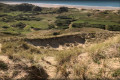
This site is protected from development. The shifting dunes are shaped by the wind. A wide variety of wildflowers and rare amphibians can be found here.
These dunes rest on a fossilised cliff of shale and sandstone; they are known as ‘perched’ dunes. This formation is one of the most spectacular in Europe.
Shifting dunes (whose shapes are not stabilised due to a lack of vegetation), white dunes (almost devoid of vegetation), grey dunes (covered in low vegetation) and heathland follow one another in a varied and ever-changing landscape. The site is managed by the Conservatoire du littoral and benefits from conservation measures.
Source: Alltrails

Between the Cap de Carteret and the Cap du Rozel, the imposing dune massif of Hatainville rises to over 80 metres, covering ancient cliffs dating back more than 70,000 years. From the sea to the summit of the massif, the vegetation is arranged in tiers, forming a mosaic shaped by the tides, sea spray, winds and inflows of fresh water. Numerous rare species thus adorn the dunes with colours that change with the seasons: from the blue of sea rye to the yellow and brown of the spider orchid, via the mauve of wild thyme or the bright pink of the pyramidal orchid.
Source: Attitude Manche

Between (7) and (8) Ruins of the old Saint-Germain church
In an area untouched by development, between the headland and the dunes, stand the ruins of a church dedicated to Saint Germain le Scot, who evangelised the Cotentin in the 5th century. It was Carteret’s first parish church.
The Old Church of Saint Germain le Scot, owned by the municipality of Barneville-Carteret, is situated within the boundaries of the Carteret Lighthouse Conservation Area following the decree of 2 January 1942. The first mention of this church dates from the 12th century in a deed of 1125, under the terms of which the building was donated to the Abbey of Mont-Saint-Michel by Renaud de Carteret. The churchyard was situated to its left, as indicated by the base of a cross still visible within its boundaries. All that remains of this building is a section of wall featuring a Gothic-era oculus.
Source : Barneville-Carteret Town Hall

(14) Les Moitiers-d'Alonne
This name derives from the fact that the two parish churches of the two former villages, now merged, Notre-Dame-d'Alonne and Saint-Pierre-d'Alonne, were situated side by side within the same cemetery.
Moitiers is also a regional variant of the medieval word "moustier" (church).

Near (S/E) Saint-Louis Chapel
The existence of the Saint-Louis Chapel in Carteret has been known since 1332. Situated within the enclosure of the fortified house of the Carteret family, it was the seigneurial chapel.
Donated to the inhabitants by Marie-Françoise de la Luthumière, Lady of Carteret and wife of Henri de Matignon, and extended with a nave, it became Carteret’s second parish church, as the “Old Church” of Saint Germain, situated north of the Cape, was at risk from the sea (1684–1686)
1818–1820 Construction of the bell tower and extension of the nave
1908 Abandonment of Saint Louis Church. Worship services were transferred to the third and current church.
1923–1924 Demolition of the nave (Decision of the Carteret Town Council, 11 February and 12 April 1923)
Since 1969, Protestant services have been held there every Sunday in July and August.
Source: Les Amis de la Chapelle Saint-Louis

(S/E) Barneville-Carteret and Cotentin Tourist Office – Barneville-Carteret Branch
Carteret and Barneville are seaside resorts, united within the same municipality, Barneville-Carteret.
It is a commune steeped in the history of the early days of sea bathing. It is particularly lively during the summer season.

Always be cautious and plan ahead when you're outdoors. Visorando and the author of this route cannot be held responsible for any accidents occurring on this route.

The GR® and PR® markings are the intellectual property of the Fédération Française de Randonnée Pédestre.

Reviews and comments

4.4 / 5
Based on 3 reviews

Reliability of the description
4.7 / 5
Ease of following the route
4 / 5
Route interest
4.7 / 5
User 28800089

Overall rating : 4.3 / 5

Date of your route : Apr 08, 2026
Reliability of the description : ★★★★★ Very good
Ease of following the route : ★★★☆☆ Average
Route interest : ★★★★★ Very good
Very busy route : No

We had trouble finding Leapiste after arriving at the little church; we walked along the beach, but then found it difficult to find our way back or climb up the dune. (Stage 8)

Machine-translated

MCTOUL
MCTOUL

Thank you, 39riviere!
Enjoy your stay in La Manche in the cool air!
Best regards

Machine-translated

39riviere
39riviere

Overall rating : 5 / 5

Date of your route : Jun 22, 2025
Reliability of the description : ★★★★★ Very good
Ease of following the route : ★★★★★ Very good
Route interest : ★★★★★ Very good
Very busy route : No

After point 8, as indicated in the description, the route through the dunes is very difficult: it is hard to find the path and walking in the sand is tough. I regretted leaving the GR. After point 10, the GR has been changed: follow it.

Machine-translated

MCTOUL
MCTOUL

You're welcome, rAoule66!
Have a good week

Machine-translated

rAoule66
rAoule66

Overall rating : 4 / 5

Date of your route : Sep 18, 2024
Reliability of the description : ★★★★☆ Good
Ease of following the route : ★★★★☆ Good
Route interest : ★★★★☆ Good
Very busy route : No

A lovely walk with breathtaking scenery!
My only slight criticism is the difficulty of navigating the barely visible paths through the dunes, but that doesn’t detract in any way from the pleasure of the beautiful scenery.
The section through the Moitiers d’Allones held little interest for me.
But I’m glad I discovered it!😊

Machine-translated

Other walks in the area

For more walks, use our search engine .

The GPS track and description are the property of this route's author. Please do not copy them without permission.