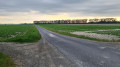
Circular loop to Saint-Georges-de-Gréhaigne via the Couesnon

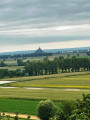
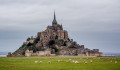
A leisurely stroll through the polders, returning via the plateau overlooking the former coastline. A short stretch along the Couesnon river continues towards the Greenway, offering a fine view of Mont-Saint-Michel. In principle, you’ll get a good breath of fresh air. The route presents only one minor challenge: the hill between Chanel and Haut Chanel, with an elevation gain of 15 to 75 metres. The reward in season is cherries or chestnuts!

Details

97018895
Creation:
Last update:
Last review:
  • Walking
    Activity: Walking
  • ↔
    Distance: 8.15 mi
  • ◔
    Average duration: 4h 00 
  • ▲
    Difficulty: Moderate

  • ⚐
    Back to start: Yes
  • ↗
    Ascent: + 266 ft
  • ↘
    Descent: - 272 ft

  • ▲
    Highest point: 253 ft
  • ▼
    Lowest point: 20 ft

Photos

Description of the walk

(S/E) On leaving the car park, turn right until you reach the small square.

(1) With your back to the church, walk down the street to the crossroads. Take the first left onto the D90 and join the D797. Turn right and follow it parallel to the left after the restaurant.

(2) After the petrol station, turn left, then continue by turning right for 1 km.

(3) Take the path on the left towards Les Verdières. At the canal, follow it to the right to stay on the south side and walk alongside the canal to reach the outlet on the Couesnon and the GR®.

(4) Follow it to the left, and walk alongside the Couesnon to the bridge. Continue on the GR® to the left, then follow it to the right.

(5) The road leads to a grassy path. Take this path and remember to close the gate behind you.

(6) At the farm, continue north-west along the greenway path, going round the farm to the south. Stay on the greenway. Remember to close the gate.

(7) Continue along the Greenway, crossing the road.

(8) Towards La Rue, turn left towards the silos and cross the D797.

(9) After a short climb, take the second street on the left. Continue for 750 metres to reach Chanel.

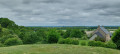
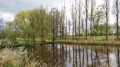
(10) As you leave the hamlet, tackle the climb on the right. As soon as the climb ends, head left (a lovely view of the mountain if the weather permits when you turn round). Join the path that descends from the plateau, through the woodland. The ground may be slippery. Join the road at the pond.

(11) Follow it to the left, then turn right onto the straight road to reach the car park (S/E).

Waypoints

  1. S/E : mi 0 - alt. 75 ft - Car park
  2. 1 : mi 0.06 - alt. 85 ft - Town hall and square
  3. 2 : mi 0.5 - alt. 23 ft - Fork in the road after the petrol station
  4. 3 : mi 1.3 - alt. 26 ft - Crossroads
  5. 4 : mi 2.05 - alt. 26 ft - Outlet - Couesnon (fleuve)
  6. 5 : mi 3 - alt. 26 ft - Marked grassy path
  7. 6 : mi 3.23 - alt. 26 ft - Moidrey Farm
  8. 7 : mi 4.01 - alt. 30 ft - Junction
  9. 8 : mi 5.37 - alt. 26 ft - La Rue Polder
  10. 9 : mi 5.74 - alt. 89 ft - Crossroads
  11. 10 : mi 6.3 - alt. 49 ft - Côte de Chanel
  12. 11 : mi 7.45 - alt. 49 ft - The pond
  13. S/E : mi 8.15 - alt. 79 ft - Car park

Notes

Take care when crossing the road.

The edge of the canal can be crumbly, so do not get too close to the edge.
There are a few parking spaces next to the town hall.
Toilets are available at the village hall (the timber-clad building on the left).

Worth a visit

St George’s Church
A former priory church founded inthe 11th century by the Benedictines of Saint-Georges Abbey in Rennes. The building, rebuilt in two successive phases in the late13th or early14th century, began with the nave and was completed with the chancel. The roof structure dates from the15th century. Some windows were opened or altered in the16th century for the chancel and in the17th century for the nave and chancel. 16th-century stained-glass windows.
Click here for more details.

The Vicarage
The former presbytery, now a private residence, stands out for its remarkable architecture.

The Grotto of Our Lady of Liberation
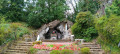
On leaving the car park, head down to the left. It was begun on 1 December 1943 by the local inhabitants to ask the Blessed Virgin to protect the country from the horrors of war. It was inaugurated in 1944 by Cardinal Roques.

The Polders
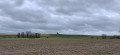
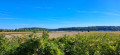
In 1858, the course of the Couesnon was diverted by the construction of the canal that exists today. The drainage of its estuary enabled the gradual reclamation of 2,450 hectares of polders. Unlike the Dutch method, these polders were not reclaimed by building a dam to isolate the land combined with the pumping out of residual salt water. Here, the land was reclaimed from the salt marshes (or salt meadows). When a section of salt marsh has reached maturity—that is, when it is sufficiently colonised and consolidated by vegetation—it is embanked to protect it from the tide. More than 50 highly fertile polders—rich in carbonates and trace elements—were thus successively reclaimed from the sea between 1856 and 1933. This land is used for agriculture.

Always be cautious and plan ahead when you're outdoors. Visorando and the author of this route cannot be held responsible for any accidents occurring on this route.

The GR® and PR® markings are the intellectual property of the Fédération Française de Randonnée Pédestre.

Other walks in the area

For more walks, use our search engine .

The GPS track and description are the property of this route's author. Please do not copy them without permission.