


Refine your search for walks in Gare de Javel
Gare de Javel walks


 The wildlife of Grenelle and Vaugirard
 Visorando Member
 6.07 mi
 +125 ft
 -20 ft
 2h 55
 Easy
 Departure from Paris
This urban route crosses the 15th arrondissement of Paris from west to east and then from north to south, discovering numerous animal representations. The sculptures in Georges Brassens Park recall the past of the Vaugirard slaughterhouses.
Women's march of 5 October 1789: from Paris City Hall to Sèvres
 8.88 mi
+89 ft
-82 ft
4h 10
 Moderate
Departure from Paris
The first section of this women's march of 5 October 1789 follows fairly closely what we know today about the route taken at the time. Starting from the centre of Paris, we follow the course of the Seine and then cross the districts of Auteuil and Billancourt. We cross the Ile Seguin, where the Vieux Pont de Sèvres bridge used to be, and end up in Sèvres, where the 1789 procession made a stop. All along the way, there is a rich heritage to discover.
From Port de Javel to Pont de Saint-Cloud
 6.22 mi
+20 ft
-23 ft
2h 55
Moderate
Departure from Paris
From the Port de Javel, the banks of the Seine are not particularly suitable for a stroll… So you head away from the river to cross three large parks: André Citroën, Suzanne Lenglen and Île Saint-Germain. You then rejoin the towpath with its many moored barges. The walk ends with a brief detour into Saint-Cloud Park before crossing the Seine via the bridge of the same name.
From the Pont d’Austerlitz to the Port de Javel along the banks of the Seine
 5.22 mi
+10 ft
-30 ft
2h 25
Easy
Departure from Paris
An urban route that allows you to enjoy the fully pedestrianised left bank of the Seine in Paris! You walk pleasantly along the river and pass by some of the capital’s most famous landmarks: Île Saint-Louis, Île de la Cité and Notre-Dame Cathedral, Pont Neuf, the Louvre Museum, the Musée d’Orsay, the Grand Palais and the Eiffel Tower.
Adjust your route according to the water levels of the Seine: see the practical information section.
 The banks and quays of the Seine in Paris
 16.83 mi
+66 ft
-69 ft
1.5 hrs
Easy
Departure from Paris
A journey across Paris from east to west and then from west to east along the Seine, almost entirely on cycle paths or lanes. Both banks offer complementary views and numerous vantage points over the capital’s main monuments.
The wildlife of Ranelagh and La Muette
 4.05 mi
+115 ft
-23 ft
2h 00
Easy
Departure from Paris
This urban route crosses the 16th arrondissement of Paris, from south to north and then from west to east, to discover animal representations and a certain architectural diversity specific to this arrondissement.
The Bestiary of Vaugirard and Javel
 3.86 mi
+30 ft
-92 ft
1h 50
Easy
Departure from Paris
An east-west walk through Paris’s 15th arrondissement in search of depictions of animals. Of the various bestiaries in the series, this one is undoubtedly the least extensive, as the façades of early 20th-century buildings tend to be decorated more frequently with plant motifs.
The bestiary of Paris
 146.53 mi
+2,999 ft
-2,625 ft
33 days
Easy
Departure from Paris
This guide brings together around thirty urban routes that allow you to discover representations of animals in the capital: sculptures, building decorations, murals, etc.
The wildlife of Balard, Grenelle and Champ de Mars
 5.32 mi
+13 ft
-13 ft
2h 30
Easy
Departure from Paris
A hike through the 15th and 7th arrondissements of Paris in search of animal representations. We take a few busy streets, such as Rue du Commerce. Crossing the Champ de Mars offers a beautiful view of the Eiffel Tower.
A stroll through Paris’s cemeteries
 25.95 mi
+600 ft
-515 ft
19 days
Easy
Departure from Paris
The term ‘Parisian’ in the title should be taken in the broadest sense. This guide brings together public cemeteries located in two neighbouring but distinct areas:- 16 cemeteries within the city limits of Paris, three of which actually fall under the jurisdiction of neighbouring municipalities.- Several cemeteries in municipalities of the Petite Couronne, six of which are administered by the City of Paris and are therefore officially designated as “Parisian”.Varying in size, these cemeteries are the final resting places of a varying number of notable figures. They also feature a wide variety of monument styles, depending on the simplicity or fame of those buried there and the financial means of their families.
A visit to Grenelle Cemetery
 1.11 mi
+0 ft
-7 ft
0h 30
Easy
Departure from Paris
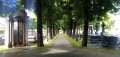
A short stroll to reach and visit one of the smallest cemeteries in Paris, set in unspoilt surroundings. A few notable figures are buried in this cemetery, which also features some unusual monuments.
In the footsteps of the French Revolution
 21.14 mi
+1,020 ft
-712 ft
4 days
Moderate
Departure from Paris
Here are four hikes that take in iconic locations from the French Revolution. One of them takes place in Versailles, where it all began in May 1789. Another takes place in Paris, which was the scene of many events, including the storming of the Bastille on 14 July 1789. The other two connect Paris to Versailles, attempting to reproduce the women's march of 5 October 1789.