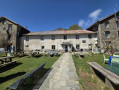
Forti di Genova

The forts of Genoa are a series of military fortifications dating from different periods that the Republic of Genoa built to defend the urban territory of the Ligurian capital throughout its history. The construction projects were also resumed and used during the Napoleonic era, the Risorgimento and during the First and Second World Wars.
This defensive system represents the longest city walls in Europe and the second longest in the world.

Details

12242119
Creation:
Last update:
Last review:
  • Walking
    Activity: Walking
  • ↔
    Distance: 7.66 km
  • ◔
    Average duration: 3h 05 
  • ▲
    Difficulty: Easy

  • ⚐
    Back to start: Yes
  • ↗
    Ascent: + 314 m
  • ↘
    Descent: - 318 m

  • ▲
    Highest point: 643 m
  • ▼
    Lowest point: 430 m
  • ⚐ Country: Italy
  • ⚐ District: Genoa 
  • ⚑
    Start/End: N 44.439493° / E 8.925021°
  • Hour-by-hour weather

Photos

Description of the walk

From the city of Genoa, climb up to the road "Via Al Forte di Begato" via the narrow streets called crose (Via Venezia, Via Bologna, Via San Marino, Via Bartolomeo Bianco, Mura di Granarolo). Park near the north gate of Fort Begato.

(S/E) Leave the road and go through the north gate of Fort Begato.

(1) Turn right immediately (eastbound) to follow the "sentiero dei cani" (dog path).

(2) At the crossroads, go up to the right to Fort Puin (round trip). Then take the "sentiero dei cani" northwards (to the right).

(3) Take the section of the path that branches off to the left towards Fort Fratello Minore.

(4) Do not take the path on the left (Righi) but continue straight on towards Fort Fratello Minore.

(5) Continue left on the "sentiero Fratello Minore".

(6) At the cairn, continue left on the "sentiero Fratello Minore" (route option) or climb straight up the ridge if you want to shorten the hike.

(7) Continue straight ahead towards Fort Fratello Minore. You will then need to return to this point and take the path on the left that climbs up the ridge towards Monte di San Michele (Fratello Maggiore). Once you reach it, continue north until you reach a multi-directional crossroads.

(8) For the more adventurous, continue straight ahead to climb up to Fort Diamante (round trip).

(8) Once back at the crossroads, take the "sentiero dei cani" to return to Fort Puin.

(3) Turn left towards the south in the direction of Fort Puin.

(2) Continue straight ahead, leaving the path you took to reach Fort Puin on your left.

(1) Before reaching Fort Begato, turn left to rejoin the road and pass the gate of Fort Bragato to return to the car park where you started (S/E).

Waypoints

  1. S/E : km 0 - alt. 434 m - Parking at the north gate of Fort Begato - Forte Begato
  2. 1 : km 0.04 - alt. 434 m - Sentiero dei cani - Forte Sperone
  3. 2 : km 1.36 - alt. 481 m - Fort Puin crossroads - Fort Puin
  4. 3 : km 2.01 - alt. 488 m - Crossroads towards Forti Fratelli
  5. 4 : km 2.14 - alt. 512 m - Righi trail junction
  6. 5 : km 2.42 - alt. 544 m - Crossroads towards Fort Fratello Minore
  7. 6 : km 2.82 - alt. 588 m - Fort Fratello Minore crossroads
  8. 7 : km 3.13 - alt. 607 m - Fort Fratello Maggiore crossroads - Fort Fratello Minore
  9. 8 : km 3.82 - alt. 547 m - Fort Diamante crossroads - Fort Diamante
  10. S/E : km 7.66 - alt. 433 m - ärking North gate of Fort Begato

Notes

No guaranteed functional drinking water supply (especially in summer).
Given the altitude, it can be cool, even in the height of summer.

From the city centre, you can take the red Zecca-Righi funicular railway to the upper part of the city. Following an old path that runs alongside ancient 17th-century walls, you will arrive at Forte Sperone.

Worth a visit

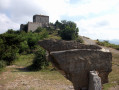
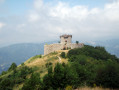
The access roads leading to the military buildings form the fort route and overlook the wooded, panoramic slopes. To visit the forts and ramparts, you have to take paths winding along the hills, ideal for lovers of trekking in the countryside near the city centre of Genoa.

Forte Begato

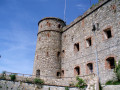
This imposing fort, with angular bastions, a central courtyard and a vast esplanade, was built between 1818 and 1831 by the Military Engineers of the House of Savoy. It could accommodate 840 soldiers and its powder magazine could hold 41,000 kg of ammunition; it also had 1,500 m² of warehouses.
Funding from the European Community enabled its restoration between the end of the 20th century and the beginning of the 21st century.

Forte Sperone

This is the heart of the 19th-century Genoese fortifications and is located at the top of the "New Ramparts" dating from 1630, which still today resemble powerful bastions set on the hills above the town. It is the most imposing fortress.
The main entrance to the fort, surmounted by the coat of arms of the House of Savoy, is protected by a moat and a solid gate, formerly connected to the drawbridge by two chains. Other elements are particularly interesting from an architectural point of view, such as the well-preserved powder magazine located in the lower part of the fort, the central barracks with its spacious rooms, and the pretty little chapel attached to the complex.

Fort Puin

This is one of the best-preserved forts in Genoa's 19th-century defence system.
It occupies a panoramic 360° position overlooking the entire "Parco delle Mura" (Wall Park), which is why the Genoa City Council has been using it for fire surveillance for several years.

Fort Fratello Minore

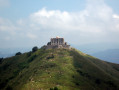
Located on the summit of Mount Spino, at an altitude of about 600 m, in a panoramic and strategically important position.
Begun in 1815, it was completed in 1832. It stands on the route of the paths that lead from the heart of the Ramparts Park to the villages of Begato and Geminiano, two ancient agricultural centres.

Fort Diamante

This is one of the most characteristic forts in the entire Genoese rampart belt. It was built in 1758 on the summit of Mount Diamante, at an altitude of about 667 metres.
Its dominant position over the Polcevera and Bisagno valleys and its distance from the city centre made this fortified castle the city's first line of defence against incursions from the north.

Reviews and comments

4.3 / 5
Based on 1 review

Reliability of the description
4 / 5
Ease of following the route
5 / 5
Route interest
4 / 5
User 24320165

Overall rating : 4.3 / 5

Date of your route : Nov 01, 2025
Reliability of the description : ★★★★☆ Good
Ease of following the route : ★★★★★ Very good
Route interest : ★★★★☆ Good
Very busy route : No

The hike was enjoyable! The route is easy to follow.
However, contrary to what is stated in the description, there are often drinking water taps along the way.

Machine-translated

For more walks, use our search engine .

The GPS track and description are the property of this route's author. Please do not copy them without permission.