Accessible to people with reduced mobility and parents with pushchairs (soft mobility).
(S/E) Place Hardat, which replaces the old town square that was completely demolished to make way for the new canal, dates from the 1980s. For its construction, fine materials such as blue stone (from the region) were preferred to asphalt. Despite these major urban changes, the chestnut tree standing proudly on the esplanade has survived. Fortunately so, as it was planted on 4 October 1930 to commemorate the centenary of Belgium’s independence.
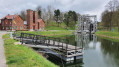
(1) Hydraulic lift no. 4 The four historic lifts are listed as UNESCO World Heritage Sites. They are, in fact, an exceptional testament to the remarkable development of hydraulic engineering in 19th-century Europe. Furthermore, they remain the only ones in the world still in their original working condition. The Thieu lift was completed in 1917. It is the fourth and last in the series. On its own, it covers a height of 16.933 m.
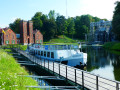
The old canal in the historic centre. Work on its construction began in 1883 and was completed in 1917. From that point onwards, 300-tonne barges could travel from Charleroi to Condé-sur-Escaut, thereby passing from the Meuse basin to the Escaut basin and, from there, into northern France. On the section between Mons and La Louvière, there were no fewer than four hydraulic lifts and six locks to pass through to overcome the 89.457-metre difference in elevation.
(3) Strépy-Thieu funicular lift. It enables boats to overcome the 73.15-metre difference in height in a matter of minutes. Construction began in 1982. It opened to traffic in 2002. It is a concrete colossus, 110 metres high, 130 metres long, 75 metres wide and weighing nearly 200,000 tonnes. Needless to say, with such dimensions and its two gondolas, it is the largest in the world. The Thieu lift is of the funicular type. This means that the platforms carrying the boats are suspended by cables and balanced by counterweights. The ascent itself takes around 7 minutes. However, the total transit time is 38 minutes (including the boats entering and exiting). This single structure now handles the elevation change previously managed by four hydraulic lifts and two locks.
(4) The new Canal du Centre. To avoid having to pass through 6 locks and 4 lifts, which significantly slowed down barge traffic, the excavation of a new wide-gauge waterway (1,350 tonnes) became essential.



 Country:
 City:
City:



 Tourist office
 Visorando Member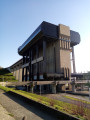
 Moderate
 Difficult