


Refine your search for walks in Église Saint-Eustache (Paris)
Église Saint-Eustache (Paris) walks


 Sundials and astronomical curiosities in Paris
 Visorando Member
 8.94 mi
 +144 ft
 -23 ft
 4h 15
4h 15
 Moderate
 Departure from Paris
A long urban trail on the theme of sundials and sites related to astronomy scattered throughout Paris: the Paris meridian, observatories, gnomons, etc. Best done on a sunny day so you can read the time along the way! The sundials are often high up, sometimes hidden by trees that have grown... you may have to search hard to find them.
The fish route in Paris
 4.43 mi
+108 ft
-144 ft
2h 10
4.43 mi
+108 ft
-144 ft
2h 10
 Easy
Departure from Paris
Easy
Departure from Paris
Until the advent of the railway, fishmongers brought fish to Paris from the ports of the North Sea and the English Channel in horse-drawn convoys. Their route through Paris, as far as Les Halles, has left its mark in the names of a number of lanes that this urban itinerary more or less follows, with a few detours through streets and alleyways that deserve it.
Retrace Bourvil and Gabin’s walk through Paris
6.11 mi
+269 ft
-59 ft
3h 05
Easy
Departure from Paris
Retrace the steps of Bourvil and Jean Gabin in Claude Autant-Lara’s film. Of course, all this remains rather imaginary, as very little of the film was shot on location. But there is still the route from Rue Poliveau to Rue Lepic and the pleasure of strolling through the streets of Paris. There is one more filming location that lies too far off the main route: 158 Boulevard Hausmann, now the Jacquemart-André Museum, where the scenes of the arrival at the Kommandantur were filmed.
The bestiary of Paris
 146.53 mi
+2,999 ft
-2,625 ft
33 days
Easy
Departure from Paris
146.53 mi
+2,999 ft
-2,625 ft
33 days
Easy
Departure from Paris
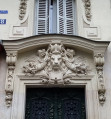
This guide brings together around thirty urban routes that allow you to discover representations of animals in the capital: sculptures, building decorations, murals, etc.
The bestiary of Chaussée d'Antin and the Palais Royal
 4.06 mi
+10 ft
-13 ft
1h 50
Easy
Departure from Paris
4.06 mi
+10 ft
-13 ft
1h 50
Easy
Departure from Paris
From Place de l'Opéra to Les Halles, via the Church of Notre-Dame de Lorette and the Palais Royal Gardens, this urban trail explores the1st,2nd and9th arrondissements of Paris in search of animal representations.
Walks near Église Saint-Eustache (Paris)
Green spaces in Paris’s 6th arrondissement
 5.04 mi
+171 ft
-200 ft
2h 30
Easy
Departure from Paris
5.04 mi
+171 ft
-200 ft
2h 30
Easy
Departure from Paris
The sixth arrondissement of Paris is emblematic of Parisian elegance. A chic neighbourhood with legendary cafés, it has historical links to writers, philosophers and artists. It is as renowned for its intellectual heritage as it is for its architectural heritage, with its museums, art galleries and prestigious cultural institutions.
It boasts a dozen public squares and municipal gardens, including the famous Jardin du Luxembourg, which is managed by the state and will not be discussed here.
From the Louvre to the Bastille via the Tour Saint-Jacques
 4.01 mi
+10 ft
-3 ft
1h 50
Easy
Departure from Paris
4.01 mi
+10 ft
-3 ft
1h 50
Easy
Departure from Paris
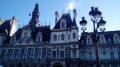
An urban route steeped in history, where 16th- and 17th-century buildings stand alongside modern architecture. This is how you will go from the Palais Royal to the Forum des Halles, from the Church of Saint-Eustache to the Centre Beaubourg, and from the Tour Saint-Jacques to the Opéra Bastille. The itinerary winds its way through streets, alleys, passageways and gardens, offering visitors the chance to discover a rich and diverse heritage.
The wildlife of the Opéra and Europe districts
 3.66 mi
+108 ft
-33 ft
1h 45
Easy
Departure from Paris
3.66 mi
+108 ft
-33 ft
1h 45
Easy
Departure from Paris
From the Louvre Museum to Place de Clichy, via Place de l'Opéra and Saint-Lazare station, this urban route explores the 1st, 2nd and 8th arrondissements of Paris in search of animal representations.
From Châtelet to Austerlitz
 4.21 mi
+138 ft
-135 ft
2h 05
Easy
Departure from Paris
4.21 mi
+138 ft
-135 ft
2h 05
Easy
Departure from Paris
A walk between Châtelet and Austerlitz, along picturesque streets rich in Parisian history with many points of interest: gardens, monuments, building facades, etc. Depending on your pace and curiosity, the route can take between two and four hours.
The Bestiary of the Louvre, the Tuileries and the Orsay
 5.05 mi
+26 ft
-26 ft
2h 20
Easy
Departure from Paris
5.05 mi
+26 ft
-26 ft
2h 20
Easy
Departure from Paris
This urban route focuses on the heart of Paris, in a neighbourhood rich in world-famous museums, exploring depictions of animals. In the Tuileries Garden, these are particularly numerous and offer a conflicting view of the animal world, undoubtedly that of their time.
From Paris to Bry-sur-Marne via the Bois de Vincennes and along the Marne
 Association / Club / Walk leader
 15.57 mi
+177 ft
-154 ft
7h 20
15.57 mi
+177 ft
-154 ft
7h 20
 Difficult
Departure from Paris
Difficult
Departure from Paris
In the eastern suburbs of Paris, along the route taken by Saint Columbanus, we find all the signs of the Columbanian influence that shaped our countryside and landscapes.
The first part of our 26km route through the Île-de-France region is flat, allowing us to take the time to visit the jewels revealed by the churches of Paris, as well as the towns that witnessed the birth of the monasteries that punctuate the route.
Women's march of 5 October 1789: from Paris City Hall to Sèvres
 8.88 mi
+89 ft
-82 ft
4h 10
Moderate
Departure from Paris
8.88 mi
+89 ft
-82 ft
4h 10
Moderate
Departure from Paris
The first section of this women's march of 5 October 1789 follows fairly closely what we know today about the route taken at the time. Starting from the centre of Paris, we follow the course of the Seine and then cross the districts of Auteuil and Billancourt. We cross the Ile Seguin, where the Vieux Pont de Sèvres bridge used to be, and end up in Sèvres, where the 1789 procession made a stop. All along the way, there is a rich heritage to discover.
In the footsteps of the French Revolution
 21.14 mi
+1,020 ft
-712 ft
4 days
Moderate
Departure from Paris
21.14 mi
+1,020 ft
-712 ft
4 days
Moderate
Departure from Paris
Here are four hikes that take in iconic locations from the French Revolution. One of them takes place in Versailles, where it all began in May 1789. Another takes place in Paris, which was the scene of many events, including the storming of the Bastille on 14 July 1789. The other two connect Paris to Versailles, attempting to reproduce the women's march of 5 October 1789.
Green spaces in the 1st and 2nd arrondissements of Paris
 2.54 mi
+157 ft
-115 ft
1h 20
Easy
Departure from Paris
2.54 mi
+157 ft
-115 ft
1h 20
Easy
Departure from Paris
The1st arrondissement, modest in size, represents the historic and geographical heart of Paris; today, it is a district of museums and luxury boutiques. The Tuileries and Louvre Gardens, as well as the Palais Royal, managed by the State, make up for the limited number of municipal squares.
The 2nd arrondissement, the smallest in Paris, is livelier and more commercial. Formerly a financial district, it is now bustling with covered arcades, restaurants and businesses. The atmosphere is dynamic, friendly and very urban. It has only two municipal squares.
From Île de la Cité to Porte de Gentilly
 3.78 mi
+151 ft
-102 ft
1h 50
Easy
Departure from Paris
3.78 mi
+151 ft
-102 ft
1h 50
Easy
Departure from Paris
From the heart to the outskirts of the capital, this urban route crosses the 5th arrondissement, passing through ancient streets and past several churches. It then climbs the Butte aux Cailles and its streets decorated with murals. At the end of the hike, you can stroll through the picturesque Cité Florale.