From the Parc du Biez to the Plateau workers’ housing estate in Mondeville

Discover Mondeville’s architectural heritage, particularly the workers’ housing estate of Le Plateau, starting from the Parc Municipal du Biez.

Details

4187842
Creation:
Last update:
Last review:
  • Walking
    Activity: Walking
  • ↔
    Distance: 3.73 mi
  • ◔
    Average duration: 1h 50 
  • ▲
    Difficulty: Easy

  • ⚐
    Back to start: Yes
  • ↗
    Ascent: + 112 ft
  • ↘
    Descent: - 112 ft

  • ▲
    Highest point: 125 ft
  • ▼
    Lowest point: 10 ft
  • ⚐ Country: France
  • ⚐ City: Mondeville (14120)
  • ⚑
    Start/End: N 49.177857° / W 0.317269°
  • ❏
    IGN map(s): Ref. 1612OT
  • Hour-by-hour weather

Photos

Description of the walk

Parking is available behind the Quai des Mondes, at 4 Rue Calmette in Mondeville.

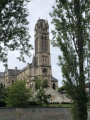
(S/E) With your back to the rear of the Quai des Mondes building, head towards the entrance to Parc du Biez, walk past an old locomotive and cross the bridge over the Biez. Take the path opposite, follow the ring road until you reach a left-hand bend, go round it and continue straight ahead to emerge onto Rue des Roches. Turn right, cross carefully a little further down at the pedestrian crossing (green chequered markings) leading to the side path on the opposite pavement, and head down to the left towards the Church of Notre-Dame-des-Prés.

(1) Before the junction, cross carefully, then head up to the left and take the side lane on the right along Avenue des Érables. Turn right into Allée du Basilic, cross Rue Centrale Prolongée with care and continue along Allée des Capucines. Keep to the left at the Fork in the road, cross Rue des Travailleurs carefully and continue to the Church of Notre-Dame-des-Travailleurs. Turn left at the church gate and cross the esplanade to the road. You are now facing Avenue du Rond-Point.

(2) Turn left until you reach the pedestrian crossing, cross the Grande Rue, then continue left and walk down the street. Cross Rue Centrale with care and turn right into the unusual Rue des Balcons. Turn left onto Rue Traversière, take the left-hand pavement (which is wider than the right-hand one) and continue right onto Rue des Belles Vues. Cross Avenue de la Falaise with extreme caution – as the road curves in a semicircle at the junction, visibility is very limited – then take Allée des Chalets on the left and turn left into Rue du Garage.

(3) Turn left to go round the Rond-point des Villas; after the tennis court, note on the left, at the end of the lane and somewhat hidden from view, the former Director’s House, now occupied by the Ehpad la Feuilleraie care home. Take Rue des Taillis opposite, veer left down Rue de la Conciergerie and turn right at the bottom onto Route de Cabourg (D513).

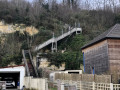
(4) Turn right at the wrought-iron gate, climb the Grands Bureaux steps and turn left to walk past the former Caretaker’s House on your right. Go down the steps, cross Avenue des Écoles with care, climb the steps opposite and walk past the former Hôtellerie building on your right. Cross Rue de l’Hôtellerie with care, take the steps opposite and walk past the former library and La Renaissance on your right. Turn right to cross Place des Tilleuls diagonally, cross Avenue des Écoles with care using the pedestrian crossing, and turn left. Walk past the schools, continue along Avenue des Écoles and turn into the second street on the right, Rue du Garage. Continue straight ahead until you reach the Rond-point des Villas, which you passed earlier.

(3) Cross the Rond-point des Villas, keeping to the left of the tennis court, take the path opposite and turn left at the corner by the villa’s wall. Take the stairs on the right leading down Chemin des Côteaux.

(5) Turn left into Rue Calmette, where you will see a house on your right – formerly owned by Gabriel Moisson de Vaux – with a rounded roof. Turn left before the roundabout to take Rue de Roches uphill; cross carefully using the pedestrian crossing, then, a little further on, take the first grassy path on the right. Turn left at the first junction, walk past the municipal gardens and come out onto Rue de Roches.

(6) Turn right, then, after 50 metres, enter Parc du Biez and take the path opposite. Turn right after the playground to head down to the Biez, turn left to follow the Biez and return to the bridge you used to enter the park at the start. Turn right, cross the bridge and leave the park. Walk past the old locomotive, cross the car park keeping to the left to follow the ring road and reach Rue Calmette. Turn left, go under the ring road and take Rue Chapron towards the town hall and the old town hall. It is worth noting – a rare occurrence – that the two buildings face each other.

(7) Turn round, go under the ring road again, turn right and cross the car park once more to return to the car park (S/E).

Waypoints

  1. S/E : mi 0 - alt. 13 ft - Quai des Mondes car park
  2. 1 : mi 0.51 - alt. 23 ft - Église Notre-Dame-des-Prés (Mondeville)
  3. 2 : mi 1.06 - alt. 108 ft - Église Notre-Dame-des-Travailleurs (Mondeville)
  4. 3 : mi 1.72 - alt. 121 ft - Villas Roundabout
  5. 4 : mi 2.04 - alt. 95 ft - Les Grands Bureaux
  6. 5 : mi 2.57 - alt. 26 ft - Rue Calmette
  7. 6 : mi 3.02 - alt. 23 ft - Rue des Roches
  8. 7 : mi 3.56 - alt. 16 ft - The former Town Hall
  9. S/E : mi 3.73 - alt. 13 ft - Quai des Mondes car park

Worth a visit

Most of the buildings listed below are privately owned and not open to the public. Please do not disturb their owners.

Quai des Mondes – Media Centre / Community Centre
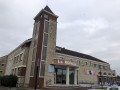
Quai des Mondes is unique in that it is both a media library offering a wide range of resources (books, CDs, DVDs) and a community centre providing support to local residents in their daily lives. Thanks to its spacious interior and areas catering for all members of the public, enhanced by remarkable use of transparency, the architect Jean-Marc Visite (Nord/Sud practice) has fully succeeded in giving this building its intended character of openness to the world. The building was inaugurated on 16 October 2015, in the presence of Fleur Pellerin, the Minister for Culture and Communication.

The Parc du Biez
The city’s green lung, crossed by the River Biez and comprising a marshland area and a municipal garden, it offers a magnificent setting for walks, picnics and family outings. Situated on either side of a ring road that blends seamlessly into the landscape, it is home to well-preserved flora typical of wetlands, and a rich and diverse fauna, forming an ecosystem that is both dense and fragile.

Notre-Dame-Des-Prés Church – Rue des Roches
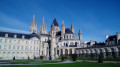
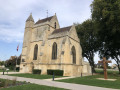
This Romanesque church, dating from the 12th and 13th centuries, is the only building in Mondeville to have been listed as a historic monument in 1913. The exceptional nature of this building lies in a recumbent effigy (funerary sculpture) resting beneath an arcade, carved directly into the thickness of the wall, which can be admired inside.

The Plateau workers’ estate
This former workers’ estate was established in the early 20th century by the Société Métallurgique de Normandie (SMN) to house its employees. It straddles three municipalities: Colombelles, Giberville and Mondeville. Although the factory closed in 1993, the neighbourhood remains strongly marked by its architectural heritage and its spatial layout, which embodies the factory’s social hierarchy. This is particularly true of the garden city section, built according to plans by Jacques Devaux. It illustrates the forms of social organisation characteristic of industrial paternalism:

  • __The villa district, along the wooded hillside near the Route de Cabourg. These are neo-Norman-style residences surrounded by large gardens and enjoying beautiful views of the countryside surrounding Caen. This type of housing includes the director’s house, a spacious residence situated in the heart of a 3-hectare wooded park.
  • The foremen’s houses around Rue Centrale and Grande Rue. Rows of semi-detached houses in pairs, flanked by small gardens. Some also featured balconies, facing the street that bears their names. These houses are built from Caen stone.
  • The workers’ housing proper, situated around Rue du Bois or in the Cité des Roches. Rows of terraced houses with a garden situated not at the back but at the front of the houses.

The Notre-Dame-Des-Travailleurs Chapel – Rue des Travailleurs
This chapel was built in the 1940s at the instigation of the priests of the Mission de France. The SMN supplied the materials needed for its construction, and it was built on a voluntary basis by SMN employees. It symbolises the rebirth of the Plateau district, which was destroyed during the bombings of 1944.

La Conciergerie – Rue de la Conciergerie
This house was home to the caretaker, whose services were for the personal use of the SMN director’s family whilst the factory was in operation.

Les Grands Bureaux – Route de Cabourg
This building was constructed between 1912 and 1913 to designs by Jacques Durville to house the departments necessary for the SMN’s operations. It was converted into an auxiliary military hospital during the First World War. The building was converted into housing in 1999.

The Guard Posts – Route de Cabourg
The guard posts at the former site of the Société Métallurgique de Normandie (SMN) are situated at the entrance to the Plateau and the current Effiscience technology campus in Colombelles.

The Hôtellerie – Rue de l’Hôtellerie
Built in 1913 to house a restaurant reserved for factory managers and a hotel for visiting executives, this Neo-Norman-style building is currently home to the Normandy Regional Orchestra. It performs for a wide range of audiences: schools, secondary schools, the Jules Verne Sixth Form College, care homes, etc.

The Former Library – Rue de l’Hôtellerie
Opened in 1952 as the ‘Bibliothèque de l’Amicale du Personnel’, it moved to its current premises – formerly an annexe of the Hôtellerie – in March 1961. In 1969, it became the SMN Works Council Library. From 1993 onwards, the Town Council managed this cultural facility until 2015, the year the Quai des Mondes media library opened. In September 2016, management of this space was entrusted to the association Vivre Ensemble au Plateau to develop it into a space for community life and remembrance.

La Renaissance – Place des Tilleuls
La Renaissance was built in 1938–1939 by the Société Métallurgique de Normandie (SMN) to provide entertainment for its employees living in the workers’ housing estate. Destroyed during the Battle of Normandy, it was restored in 1949. La Renaissance then became a cinema and theatre until the 1970s. Between 1973 and 2003, it was used for a variety of purposes: meetings, school catering, and rehearsals for the SIVOM music school. Since 2005, a local association has managed this performance venue, which is dedicated to music, theatre, circus arts and dance. A street art festival, ‘Plateaux éphémères’, brings the Place des Tilleuls to life every last weekend in May.

The École des Tilleuls – Rue des Écoles
The SMN’s primary schools for ‘boys and girls’ opened their doors in 1922 for children whose parents lived in the Plateau. At that time, they comprised four classes. The former domestic science school, built in 1929, was converted into a school canteen by the town of Mondeville in 1996–1997.

The SMN Director’s Residence – Rue du Garage
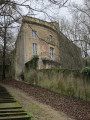
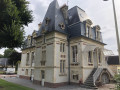
Former home of the SMN’s managing director, built in 1912–1913 to plans by Alexandre Durville in the Neo-Norman style. In 1988, this spacious residence, set within a 3-hectare wooded park, was converted into a care home (“La Feuilleraie”) and subsequently into private and social housing.

The former hamlet of Clopée
Formerly part of Colombelles, this hamlet – situated on the banks of the River Orne at the foot of a hillside and near former stone quarries – has been part of the municipality of Mondeville since 1849. It was from here that, in days gone by, the English and the Normans quarried the stone used to build some of London’s finest buildings and religious monuments. The building on the corner of Rue Calmette and Rue des Roches belonged, in the late 18th century, to Gabriel Moisson de Vaux, a botanist and politician, who created a garden there featuring plants from all over the world, using the excavations as a natural greenhouse.

The Municipal Gardens
Spread across various sites in the town, the 110 municipal allotments are a legacy of Mondeville’s past as a market-gardening centre. They are allocated by the town council to residents of Mondeville who do not own land, enabling families to garden and grow their own vegetables in a natural, peaceful and friendly environment.

The Old Town Hall – Rue Chapron
This town hall, which forms part of a school complex, was built in 1905 during Albert Viel’s term of office. In 1931, a bell tower was added. In 1988, the current Town Hall, situated opposite, was built; however, weddings continue to be held here. The renovated primary school was opened in 2013 by Mr Raymond Aubrac and is named after his wife, the Resistance fighter Lucie Aubrac.

Reviews and comments

4.4 / 5
Based on 3 reviews

Reliability of the description
4 / 5
Ease of following the route
4.3 / 5
Route interest
5 / 5
Mocassin
Mocassin

Overall rating : 5 / 5

Date of your route : Nov 18, 2024
Reliability of the description : ★★★★★ Very good
Ease of following the route : ★★★★★ Very good
Route interest : ★★★★★ Very good
Very busy route : No

Why haven’t the three local councils involved signposted this interesting route? Thank you for this important and very comprehensive description.

Machine-translated

Chris24
Chris24
• Edited:

Overall rating : 4.7 / 5

Date of your route : Dec 09, 2023
Reliability of the description : ★★★★☆ Good
Ease of following the route : ★★★★★ Very good
Route interest : ★★★★★ Very good
Very busy route : No

A lovely walk for anyone interested in the labour history of Mondeville. A real gem.

Machine-translated

le
le

Overall rating : 3.7 / 5

Date of your route : May 07, 2023
Reliability of the description : ★★★☆☆ Average
Ease of following the route : ★★★☆☆ Average
Route interest : ★★★★★ Very good
Very busy route : No

a rather tentative description; in fact, I found myself
doing the route in reverse, but, well, it was just as
interesting

Machine-translated

Other walks in the area

For more walks, use our search engine .

The GPS track and description are the property of this route's author. Please do not copy them without permission.