Country:

 City:
City:


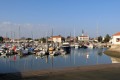
The route starts from the car park located just before the slipway at Port de la Patache, at the very end of the road that crosses the island.
(S/E) Turn right before the slipway leading down to the foreshore and follow the path that runs along the top of the sea wall protecting the houses on the shore. As you pass, note the bench above a fence, which offers a view of the landscape otherwise blocked by the sea wall. Towards the sea, you can make out the ruins of the old jetty that used to protect the anchorage. Walk past all the houses to reach the Trousse-Chemise golf course, which you follow for a few hundred metres.
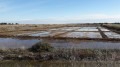
(1) After the golf course, the dyke skirts a somewhat dilapidated oyster farm before heading up a first channel. Turn left to cross it. You will then reach some old salt marshes which, although outside the reserve, are a refuge for many birds.
(2) At the first crossroads, turn left to cross a second channel, then left again to reach the Lilleau des Niges Nature Reserve. Take a moment to read the introductory information on how the area has changed since its reclamation.
(3) From this point, the route runs along the edge of the reserve and is marked by signs introducing the reserve and its inhabitants. Simply follow this path, as access to the reserve is strictly prohibited.
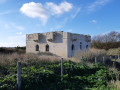
(4) The exit from the reserve is marked by the cycle path onto which you emerge. Turn right and continue walking to the large, dark building bordering the old port of Les Portes. As it stands today, it is hard to believe that large ships could once dock here to load salt.
(5) Pass the old salt storehouse, which now houses the Maison du Fier, and head up the small road linking this spot to the village of Les Portes-en-Ré. A change of scenery: the marsh gives way to flat, rural countryside.
(6) At the houses, cross the RD 101 with care, and continue slightly to the left along Rue de Hurlevent. About 150 m further on, turn right into Rue de la Grenouillère, then pass in front of the town hall to reach the village centre (Place de la Liberté).
(7) Leave the church (of which only the chancel is visible) on your left, and take Rue Jules David, following it up to a three-way junction. At this point, take Rue du Gros Jonc, which branches off slightly to the left. Follow this street straight on until you reach Plage du Gros Jonc.
(8) If the tide allows, head down to the beach and walk along it to the right. Just before reaching the dark mass of the Providence lock wall, head back up the beach to discover the Chapelle de la Redoute and its striking statue perched atop it.
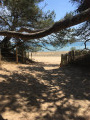
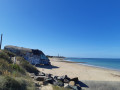
(9) Head back down to the beach to go round a headland and discover the beautiful beach leading up to Banc du Bûcheron. Before reaching this immense sandbar stretching far out to sea, you’ll come across the secluded Anse du Fourneau, nestled at the foot of the first trees of the Trousse-Chemise woods.
(10) Pass this cove, where it must be lovely to sunbathe, and walk along the edge of the forest to reach the Pointe du Fier. To the left, the Banc du Bûcheron stretches on and on.
(11) Beyond the headland, the beautiful, peaceful beaches come to an end: the tidal flow erodes the dune so much that it drops off abruptly into the sea. So be careful not to get too close when you start the climb up the Fier. You’ll soon spot the Jetée de la Patache and its green beacon, a sign that the finish is near (S/E).

 Association / Club / Walk leader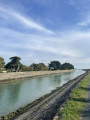
 Moderate
 Visorando Member