Country:
 City:
City:


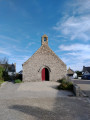
To start this walk from the village of Saint-Sébastien in the commune of Piriac-sur-Mer, begin by heading to the small car park near the chapel, where you’ll find it easy to park.
(S/E) Heading due south, turn right as you leave the car park and take Rue de Praillane. Pass Rue François Nogues on your right—you’ll take this on the way back for the final stretch—and join Route de Brandu, turning left at the end. On the descent, be sure to look back to admire the Moulin de Praillane behind you. At the bottom of the descent, the tarmac gives way and the path becomes a sunken track, veering off to the right beneath the holm oaks that line it. Cross the Ruisseau de Brandu and stay on this path for about 800 m to reach the Croix de Brandu (photo 1).
(1) Take the small road opposite (leaving the Croix de Brandu on your right). About 100 m after the entrance to a former campsite (on your right), turn onto the second path on the left (Chemin des Landes de Brandu). Stay on this pretty path, continuing straight on, which leads you to the Chemin du Raud after crossing two roads.
(2) Turn onto the Chemin du Raud and, shortly afterwards, on your right, you will see the last vineyard in the commune of La Turballe where grapes are harvested annually. After a bend to your right, you will reach a junction where you must turn left towards the Tréméac district.
(3) As you enter the village of Tréméac, at the Stop sign at the top, turn left for a few metres to join the Chemin de Guinguet on your right. This narrow lane takes you through the gardens, provided you keep to the left of a ruined wall (photo 2). You’ll emerge opposite the Fontaine Pusse (photo 3). Turn left and walk for about 200 m until you reach Chemin de l’Esperne on your right; follow this path to reach Rue du Moulin, which you must cross carefully to reach Impasse du Teulin, located about 50 m further on, on the right.
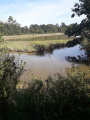
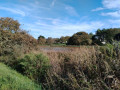
(4) Turn into this cul-de-sac and, at the very end, look for a path hidden to the right of the electricity pole, very close to the entrance to a private property. It is not easy to find; look for the two manhole covers at the foot of the pole; the path is just to the right, after you have crossed these two covers. Take this path, which takes you round the private area to the steps leading down to the bottom of the damp valley on the left (photo 4). Climb the steps in front of you, which lead to Chemin du Presbytère. At the top of the steps, the church of Trescalan (Notre-Dame-de-la-Nativité) stands before you.
(5) Before the cemetery, turn off onto Rue du Chemin des Sources, which branches off to your left, 50 m after the steps, as you walk up the street. Walk down this charming little street to reach the junction with the Route des Grandes Perrières (D333).
(6) Walk along the road on the left before crossing it carefully to rejoin the route, which continues a little further down, behind the electricity substation (look for the ‘chambre d’hôtes’ sign if in doubt). Immediately after this sign, turn right (Allée des Peupliers), then turn left, across the small open space protected by large stones, and follow this road as it climbs gently up to the junction with Chemin de Provenelle , where you can see the Moulin de Kerbroué (Breton for ‘village on the hill’) stretching its wings out towards you through the hedge on the left (photo 5).
(7) Continue straight on. The tarmac quickly gives way to a dirt track as the path leaves the built-up areas, until it reaches a junction with another track, 500 m further on. At this point, turn left to join the road linking La Turballe to Saint Molf (D33).
(8) Where the path meets the main road, you must be very careful. This road is very busy, cars often drive fast and visibility is poor. On your right, you can see the entrance to a track you will need to join, about 30 m off the track you have just left. Choose the right moment to walk along the road for these 30 m, keeping to the right, which will give you the best possible visibility, then cross directly in front of the track without delay.
Follow this path to the right, ignoring the other track on the left. Walk past the entrance to the Model Aircraft Club, then past the sewage treatment plant. Leave this rather unattractive area by continuing straight ahead, ignore the road on the right and, when the path branches off to the left, leave it and continue straight ahead until the next junction with the road, about 800 m further on.
(9) Cross the road to enter the Allée du Bois de Boulle (photo 6). Then, carry straight on to the next junction, about 1.2 km away. As you pass, you’ll be sure to notice the GAEC du Bois de Boulle on your right. This farm has built its reputation on products made from rabbits reared on site, so if a tasty rabbit pâté takes your fancy for a picnic, this is the place to go!
(10) At the end of the lane you have just taken, several roads and paths intersect. The one we are looking for is the narrowest one, which starts at the foot of the tall maritime pines, immediately on the left. Head down this narrow path. After 700 m, cross another path and continue straight ahead for another kilometre or so. The track has given way to tarmac once more and leaves the wooded area to enter farmland. This area suffered the effects of land consolidation carried out in the 1960s. The landscape becomes monotonous and is not the most interesting part of the route, but unfortunately there is no alternative route in this section of our journey.
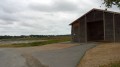
(11) At the junction, at the end of the path, turn left, then left again at the stop sign. After 200 m, turn right onto the long straight road, which you follow for 500 m before leaving it to take the Vélocéan cycle path on the right. At the very end of this new long straight stretch, you’ll come to a roundabout. At this roundabout, turn left and keep to the left-hand side of the road to pass by the old Kervodué farmstead. At the bottom of the descent, turn right, before the sign marking the entrance to the village of Saint-Sébastien (photo 7).
(12) You’ll arrive at the entrance to the Pays Blanc aquatic centre, but it’s not quite time for a swim yet... (At this point in the route, you can shorten the walk by taking the path to the left of the gate, which will lead you directly back to your starting point 200 m away.) Leave the aquatic centre on your left and follow the ditch on the right. Take the path at the far right, wedged between the stream and the campsite bungalows. After two wooden footbridges, you will soon reach the junction with the D333, which you must cross with the utmost care, heading straight ahead.
(13) This is the starting point of the Kervin botanical trail, with a few information boards about the various plants found along the shaded path, which will provide welcome shade on hot days.
(14) At the end of the botanical trail, turn right and head down to the Stop sign. In front of you is a small white wall which you will need to go round to find the narrow path that continues to follow the stream, below the houses. After a few steps down, turn right after the footbridge, under the large willow tree, and continue to the Stop sign, taking the time to admire the pretty houses of the village of Kervin and their vegetable gardens on your right (photo 8).
(15) At the stop sign, facing you, there is a large house which you go round to the right. To do this, cross the pedestrian crossing and head up to the right for a few metres, then turn left behind the house. Pass the entrance to the private property (5bis) on your right and take the path on the left. This path leads you to the rubbish bins at the motorhome site.
(16) Turn right and walk for about 300 metres to rejoin Rue du Vieux Lérat on the left; but before you turn off, you’ll be sure to spot on the right a new vineyard planted on one hectare in 2025 on the initiative of a young winegrower seeking to revive tradition. Follow it down to the first street on the left (Rue de la Sardinerie), which runs alongside an old wall. Cross the road at the pedestrian crossing by the bridge. When you’re facing the harbour at this point, you’ll see buildings along the canal on your right. On the left, about 20 metres away (just after the blue sign for “Port de Lérat”), take the small sandy path that leads up to the right along the fences.
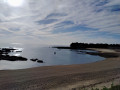
This path takes you to the “Côte des Fréssigné”, so named by the locals after a family of fishermen who used to live on this dune. Take a moment to enjoy the lovely view from the path overlooking the beach below (photo 9).
(17) Follow the low wall that continues the path and, just past the last bench, a flight of steps leads down to the beach.
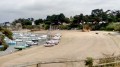
(18) At the bottom of the steps, turn left and walk along the sand and rocks. Go round the small headland before heading back up towards the path. Do not take the first set of steps, which leads to private property, but the second one. Walk along the coast, enjoying the view of Pointe du Croisic, Pointe de Pen Bron and Port de La Turballe in front of you (from right to left). Below lies Anse de Port Nabé, better known locally as Chalet Rouge beach (the house on the left explains the origin of this nickname). After passing the beach car park on your right, cross the D99 road using the pedestrian crossing, just before the sign marking the entrance to La Turballe, and head towards the pond opposite (photo 10). To the left of the picnic tables is the path that will take you along the Étang de Port Nabé for about 500 metres, until it joins Rue de la Fontaine.
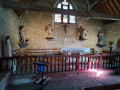
(19) Head up to the left to rejoin Rue François Nogues and return to the starting point at the Chapelle Saint-Sébastien (S/E). And there you have it, now all you have to do is head to the chapel (open daily from 9am to 5.30pm). If everything went well during the walk and you enjoyed it, you can light a candle there as a token of thanks (photos 11 and 12) for a few coins. The volunteer in charge of the chapel will be grateful...

 Visorando Member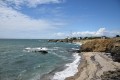
 Easy
Easy