


 Country:
 City:
City:


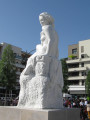
Departure from Place des Victimes du V2 (or Place de l'Église) in Deuil-la-Barre. Please note: there are few parking spaces for cars, but there is a bus stop for line 256 nearby (Église de Deuil stop).
(S/E) Head west on Rue Camelot, then left onto Rue de l'Église and left again onto Rue de la Barre. Enter Winston Churchill Park on the right and walk through it until you reach the Sentier des Coquins exit. Walk up Sentier des Coquins until you reach the street of the same name. Turn left onto it.
At the end of the street, turn right onto Rue des Vergers, then left onto Rue des Mathouzines.
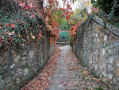
(1) Then cross the street and continue straight ahead along Sentier de la Sablonnière, which is well signposted and lined with trees. It is steep on its final stretch before leading to Rue du Panorama. Turn left onto this street (which borders Montmorency). At the end of the street, climb the embankment on the right to take the pedestrian crossing on Avenue Charles de Gaulle, just in front of the entrance to Parc de Dino.
(2) Go through the gate and walk through the park to the gate known as Porte de Jean-Jacques Rousseau.
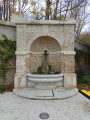
(3) Take the path that gently climbs to the left in the park, near the surrounding wall and along Rue Saint Denis. Once you are back near Avenue Charles de Gaulle, take the wooden ramp on the right to descend into a French garden. At the bottom of the ramp and on the right is the 18th-century Fontaine de la Rocaille fountain. Leave Parc de Dino via the Porte Rouge exit opposite the fountain. After crossing Avenue Charles de Gaulle, take a few steps to the right.
(4) Turn left onto Sentier de la Porte Rouge and cross a densely wooded area. As you emerge from the undergrowth, the path turns slightly to the right and offers an unobstructed view of the capital. At the signpost, turn left onto a path leading to Rue du Beau Site. Take it to the right downhill. Then turn left onto Sentier Trousse Vaches (marked by a sign) and enter a wooded area. At the end of this path, join the Sablonnière path, which you took on the way there. Take it to the right for 100 metres until you reach Rue des Mathouzines, which you passed on the way there.
(1) Go down Rue du Crochet on the left, then take Rue Haute slightly to the left. Then turn right onto Rue de l'Église. Pass in front of the Notre-Dame-et-Saint-Eugène Church, a listed historical monument. Turn left after the church to return to Place des Victimes du V2 (S/E).

 Visorando Member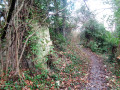

 Moderate
 Difficult
