Country:

 City:
City:


From Perpignan, head towards Prades and bypass it via the N116. At the third roundabout, turn right towards Cattlar and Molitg-les-Bains. Pass Mas Riquer, enter Cattlar and, at the small roundabout, follow the D24 Route d’Eus. Park along this road, which overlooks some lovely gardens on the right-hand side.
(S/E) Head towards the centre of the village, due east. Almost opposite the cul-de-sac Rue des Planes, you will find steps on your right leading down towards the heart of the village. When you reach Rue d’en Haut, turn left, passing two streets on your right and another on your left. At the next fork, continue right, crossing the Còrrec, and head uphill towards the D24 (Rue d’Eus). First turn right then left.
Note: it is possible to continue along Rue d’Eus from (S/E).
(1) Climb the very steep concrete road called Chemin de Saint-Jacques de Calahons. Pass the drainage grates on the ground and the end of the concrete. Cross the small water supply channel, which is still in use. Yellow markings and a signpost.
(2) Climb steeply to the right along the stony path of Les Cabanes, marked as Camí del Llenguadoc on the IGN map. Yellow markings. Steel signpost for the Chapel of Saint-Jacques de Calàhons.
Pass by and visit the numerous huts of varying sizes, all in perfect condition, along this ascending path.
(3) Leave the path leading to the Chapel of Sant Jaume de Calahons and a track running parallel to it on your right. Head left into this open area. Follow the yellow markings.
Note: don’t hesitate to stray a little from the path to visit these huts.
(4) Join a track to follow on the left. Turn left onto this track.
Join another track and follow it to the right for 200 m. Steel signpost. Caution: do not cross the Còrrec de Sant Jaume.
(5) Climb steeply to the left. Pay close attention to the very sparse yellow markings. A few cairns confirm the direction to follow. First turn left then right carefully onto the D619. Continue climbing steeply through the abandoned pastures, heading due north-west. Pass the point at an altitude of 671, with a small electricity pylon.
Note: it is essential to spot and follow the yellow markings. The path becomes very steep with wooden posts painted yellow. A large cairn is the landmark on the ridge.
(6) You’ll reach a megalithic stele. Continue left, taking a gap in the fence. The signpost for the dolmen is hard to spot as it’s overgrown. Continue right along a fence towards a track. There’s an abandoned hut on the left. An old sheepfold is visible in the distance on the left. You’ll reach the track suitable for vehicles.
(8) Pass the Canadian gate on the right. Follow this track to the left for 200 m.
(8) End of yellow markings. Climb steeply to the right. There are usually two cairns at the start of the path heading due north.
Note: it is essential to follow this description and the GPX track as the IGN’s red route no longer exists.
The path is clearly visible and marked on the ground. It may be somewhat overgrown, but it is there and passable. Follow the old IGN route for a few metres to the point with an altitude of 864.
Warning: do not look for the IGN’s red trail, as it no longer exists. The path curves westwards, climbing steeply through this low vegetation.
The path is correct. Further up, you’ll reach an open area that is still grazed. There is a cairn that I placed under a large cedar tree.
Another landmark: there is a large oak tree on the left. Do not continue straight ahead towards the track.
(9) Before this large cedar, follow a wide grassy track to the right for 700 m; it heads due north and climbs. I have placed a small cairn at the start of this track.
But quite soon (alt. 985 m), it curves to the right towards the north-east. Ignore the various dead-end paths you’ll come across. Keep following the grassy, non-vehicular track as it levels out.
(10) Climb steeply to the left along a path clearly marked on the ground. Leave the track just as it levels out. The path exists and is clearly shown on the OSM base map. See practical information.
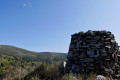
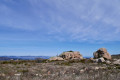
Caution: at around 1080 m, there is a fork not shown on the maps. Continue to the right, climbing towards the ridge, heading mainly north. As the slope levels out, look to your left and go and see a magnificent dolmen in perfect condition. You will need to make your way through the heather and broom. Then look out for a stone hut (orri) leaning against a pile of rocks. The area, which is still grazed, levels out. You will reach the GRP® trail, marked in red and yellow. The 360° view here is perfectly unobstructed. This junction is an ideal spot for a break.
- You can reach Coll del Tribes by turning right for a one-kilometre round trip.
(11) Follow it to the left, north-west; on this side, it is actually a wide, vehicle-accessible DFCI track. Continue along this wide, flat track, enjoying the landscape of pastures dotted here and there with piles of rocks.
(12) End of the GRP®. Yellow markings for 200 m.
Continue left along another wide, vehicle-accessible DFCI track which heads south-west, descending slightly from this point onwards.
(13) Let the track pass on your right. Keep left, still on this wide, passable track as it descends.
Pass an old barrier. The track heads due south.
Note: It is possible to cut across the next bend by heading down towards the Còrrec del Vern, without crossing it.
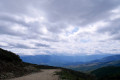
Continue down the track. Make the most of this gentle descent to admire the Pyrenean and Catalan mountains in the distance. Pass above the ruined Cortal Fosset on your right.
You can visit another dolmen on the right, the Pla de l'Arca, but the path is very overgrown.
This spot is also suitable as a rest area. Continue to the next right-hand bend.
(14) Continue left along a path which may, at the start, be overgrown with brambles.
Turn right onto the track taken on the way there towards the cedar and the oak.
If in doubt: simply follow the track. Reach the point with an altitude of 958.
(9) Scattered yellow markings. Turn right onto the grassy track towards the altitude of 958.
At the crossroads of tracks, follow the narrower, non-motorable, grassy and stony track to the left. Scattered yellow markings. Initially, the track heads south.
Pass to the left of the large, ruined Cortal de Mira Conflent. Given the size of the building and its outbuildings, everything suggests that there was once a great deal of agricultural and pastoral activity here. Continue down the track.
(15) Further on, before a wide right-hand bend, you can take a shortcut by following a path that descends steeply at the end of the pasture. Take care, however, as the slope is steep.
If in doubt: simply follow the track and cut across the bend a little further on.
Pass to the right of the ruined Cortal d'en Ponci. Please note: you will need to leave the main track.
(16) End of sporadic yellow markings. Follow a grassy path to the right, clearly marked on the ground. Signpost: Molitg. Sporadic yellow markings. Descend along this wide path towards a grazing area further down.
(17) Turn left onto a grassy path heading due east towards the grazing area.
Signpost: follow Molitg long on the left, leave Molitg court on the right. Take care to spot and follow the yellow markings on small wooden posts. You’ll come to a good path after skirting the forest on your right. The path now heads due south and descends steeply. Leave the Còrrec de les Basses on your left. Simply follow the clear path which descends steeply to the valley floor, marked with yellow markings. You will reach a wide track suitable for vehicles after passing through a gate, which must be closed.
(18) End of all markings. Follow the track to the left, which remains flat. Leave Molitg on your right. The track deteriorates and ends at the edge of the D619. Do not go onto this road; continue straight ahead along a wide path for a few metres. Pass to the right of a semi-buried hut.
From here on, you must look out for and follow the numerous cairns that will guide you. The path is clearly marked on the ground.
Caution: cross the D619. Turn left then right to find the continuation of the path and the cairns, then continue the descent.
Caution: cross the D619 again. Find the continuation of the path and the cairns, and continue the descent. The path, clearly marked on the ground, turns right, heading due south.
(19) Caution: the D619 again. Turn left onto the right-hand verge of the road, climbing slightly for 80 m until you reach a left-hand bend. After a power line, find the continuation of the path and the cairns on the right, and continue the descent, heading due south. Join a tarmac road. At the fork, continue left along the Cami de Mosset, towards the D619, which you should follow to the left for a few metres on the pavement.
(20) At the small roundabout, turn left and cross the D24 (Rue d’Eus) using the pedestrian crossing. Continue along the pavement on the right-hand side of the street and join the (S/E).



 Visorando Member

 Easy
Easy 
 Difficult