Country:

 City:
City:


From Perpignan, take the dual carriageway to Ille-sur-Têt. From there, it’s a two-way road to Prades.
Atthe third roundabout in Prades, turn right towards Cattlar, Molitg and Mosset via the D619, then the D14. Take great care when crossing Mosset, then continue towards the Col de Jau via the D14.
Sparse yellow signposting.
New directional signs have been installed pointing towards Le Madres/Callau.
(S/E) From the car park, cross the road towards the open wooden shelter and head due south. Follow the semi-passable track for 3 km to the old refuge. After the old car park on the left, you can cut across two bends in the track via a good existing path.
Pass through a cattle grid next to a steel barrier.
(1) Leave the abandoned Callau Refuge on your left. At the fork just after the refuge, turn right onto the ascending track.
Look out for two huts in perfect condition on the left, below you. You will need to leave the track very soon.
(2) Head right along the fence, climbing steeply. Return to the track and head right along it.
Pay attention to the signposts to follow a well-marked path that cuts across the bends in the track (altitude 1603).
(3) Turn right, leaving the track. Then cut across the track twice. Look out for and follow the yellow markings and the correct path. The route is accurate but does not quite follow the IGN map.
(4) You will pass through an area with numerous small streams. Follow the yellow markings as shown on the route map.
(5) Head right-hand side via a ford at La Castellane. Continue the ascent on the left bank.
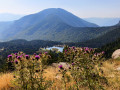
The view opens up. The valley and the peaks come into view.
(6) Cross the Castellane via a fording point to follow the right bank for 300 m. Cross the Castellane again via a fording point and climb to the right, heading due west towards a sort of pass 30 m above. Look out for well-maintained cairns and you’ll reach a flat area where a superb view awaits you.
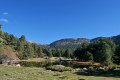
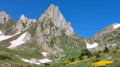
(7) At the Grand Orri de la Balmeta, a magnificent panorama opens up before you, with the Aiguille du Salt del Bourro (2,344 m) as a backdrop. The yellow markings disappear, but the direction is obvious.
Then descend for a few metres. Cross a few streams in this beautiful grazing area and continue south-west; west.
(8) Ford the Castellane. Flat area at the foot of the Salt del Bourro (2,210 m), continue straight ahead.
Be careful to stay above the Castellane, on the right bank. Leave the Salt del Bourro on your left.
In the distance, on the right, you can make out the Pic del Bernat Salvatge.
The gradient becomes much steeper. Head for the valley floor, following the well-marked path.
After the Source de la Castellane, at around 2,280 m, the path levels out a little more and turns due south into the Combe du Madres. The shrill cries of marmots will accompany the climb.
After this steep section, at around 2,400 m, the slope levels off and the summit can be seen opposite to the south.
End of signposting
(9) ==> Those who are not comfortable off the marked trail or in bad weather should turn back from the summit.
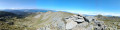
At El Madres (Pic de Madrès), enjoy the 360° panoramic view. In the distance, to the south-west, Lac de Matemale can be glimpsed.
To the east, following the ridge, Rod Nègre is clearly visible. Due north, Bernard Sauvage.
A well-deserved break is definitely in order on this vast summit. The summit hut is in ruins (July 2019).
Head due west on theGRP® Tour du Capcir for a few metres, then turn due north, descending to around 2,390 m. Then climb towards a cluster of large, flat, upright stones and continue north-east to the summit, where a large cairn stands.
(10) At Pic del Bernat Salvatge (Pic du Bernard Sauvage), 360° panoramic view.
You will now need to descend north-east, heading for a metal gate and following the ridge line (1) with the drop-off on your right. There is no danger. The path is clearly marked on the ground. Follow the remains of the old fence on your right. Numerous cairns help guide your way.
(11) It is also possible to follow the fence on your right. The area was clear on 25 June 2020.
- Alternatively, look for a more recent fence on your right (¹). Follow it for about fifty metres and turn right through a passageway fitted with insulated handles in the fence.
Now move away from the fence to the left.
Descend south-east through a grazed area. Caution: the path is poorly marked.
Follow a valley that turns north-east, keeping a good distance from the forest on your right.
(12) In a flat area where salt licks were once placed for livestock, look for and follow a well-marked path on the left that climbs slightly for a few metres, heading north-east.
Caution: leave the valley you have been following to your right.
(13) You will come to the recently erected fence on your left. This will serve as a landmark for quite some time, as it runs along the ridge line (1) which you must follow.
(14) At La Glèbe, look out for a rocky outcrop on the left with naturally standing stones.
Emerge from the forest into a lovely grazing area.
Note: Cross the fence quickly so that it is on your right before re-entering the forest.
The north-easterly route is not straightforward from here for the next 200 m. (2)
Look out for a fairly distinct path on the ground that heads east initially.
Nature has reclaimed its rights and the forest is encroaching. The pastures have been abandoned.
You will follow a path that is there but partly obscured by overgrown rhododendrons. The path then becomes more distinct again, and very old yellow markings, as well as old red and green markings, are also present. You will arrive at a former open grazing area (at around 1,750 m).
(15) Leave the fence and the ridge line behind for good. Turn right at a right angle into the forest.
Be sure to look out for a tree on your right with old paint marks. The path to follow, very clearly marked on the ground, becomes obvious as soon as you enter the forest.
Caution: do not end up at the fence; if you do, turn back and look for the path in the forest.
The path descends steeply through the forest. There is no chance of getting the wrong way round.
(16) Turn right into a grassy, damp area for about twenty metres. You will then very quickly come to a good path that must have been an old logging track.
You’ll come out onto the semi-passable track you took on the way there.
''At this point, if in doubt: the track opposite also leads to the main track below via a right-hand bend.''
(17) Turn left onto this track towards the Col de Jau (S/E).





 Visorando Member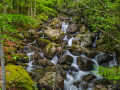
 Easy
Easy 
 Moderate