Country:
 City:
City:


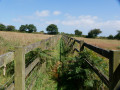
(S/E) From the car park, head up the lane, which is a farm track, to the barn on the right, turn left to the gate. The National Trust does have a route plan for this area; this route did not follow any specific route. Use the GPX on the Visorando app for directions.
(1) From the gate, continue to up the hill and on the track, this is in a southwesterly direction.
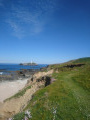
(2) At the treeline, the track splits. Take note of the adjacent National Trust route leading down another path; this is the return route. Using the path with bears more westward and up, follow this track up to the top. At the top of Godolphin Hill, and its a clear day, St Michael's Mount (F) can be seen bearing southwesterly, and on a northwesterly bearing is St Ives Bay. Other points of interest could be highlighted by orienting the app to the two known points. To proceed with the route, a well-used path leads from the top os the hill on a bearing of southeast. Follow it down the hill bearing right, then left, as per the app, ending up at an old gate, and continue to the road; this last section could become wet. At the road, turn right.
(3) Turn left at the entrance to the National Trust Car park for the old mine (Great Work Mine) (G). Walking around the old engine house, following the path at a point where the road is parallel to the path, the path divides; take the left, short path to the road. Vegetation could overgrow the exit route, then return to the car park entrance, turning left. [Option: to shorten the route. At this point, the return route (9) is on the left, leading back to (E) ]. Continuing the route, to the village green, turning right and handrail the road, turning left, a Public Bridleway and Mount Whistle sign, the road surface changes to track.
(4) The route heads up and in a southerly direction. Note: The track appears from the aast (the return path). Heading to the top and the memorial with a Celtic cross.
(5) The Memorial Cross (B) There is a bench to rest and take in the view. Close by is the trig point (C). Continuing along the route. A lot of the path has been overgrown with vegetation. Note: The single trees all over the hill, a majority of which are apple [see 'in the nearby area' (E)]. Passing the seats along the way.
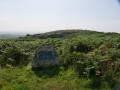
(6) Just prior to this point is a granite memorial plaque (S). This is an open quarry that has overgrown. Do not get too close to the edge. Continue on the track to Tresowehill summit.
(7) The return track could be missed as it switches back on itself; this section is defined but could become overgrown or masked by, for example, dying back bracken. This in itself may not be an issue, but may hide potholes, protruding stones, etc. Be sure-footed; there is a stile along this route, but may change as work in the area diverts around the stile.
(8) Returning to where the route merges at (4), follow the track and road back to road you came from and fork.
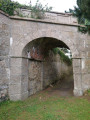
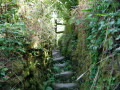
(9) At the fork, take the permitted footpath, (it looks like a drive) handrailing the road bearing left towards the gate of a farm, see two white stones marking the way for the route. The stile is two-fold: step over and step across, with dogs to be on leads at this point. The route cuts across a farm field, which has been fenced for the walkers. Pass another stile. Turn left, then over the wall (granite steps up and over the wall). Turn right, and follow the path back to the intersection with (2) .
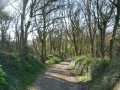
(10) Take the right-hand route down through the trees to another stile, and into a large field, keeping the edge. Continue down the hill to what was, waymark (1), turn left (choice: retrace the route started), turn immediately right past the National Trust office (E), down through the trees. This route is also to the exit, but always has a lot of wildlife - various birds, squirrels, etc. continue on the exit path back to the car park (S/E)
 Visorando Member

 Moderate