Country:

 City:
City:


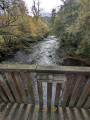
Depart from the car park on the banks of the Sarthe at the southern entrance to Saint-Léonard-des-Bois.
(S/E) Head for the car park exit and turn left. Take the footbridge to the left of the bridge to cross the Sarthe river, then immediately take the stairs to reach the small square below, which continues to the left along a small tarmac road that quickly turns into a stony path. Continue to the hamlet of Les Échameaux.
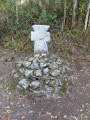
At the old cross, slightly to the right, there is a stony path which quickly becomes steeper for about 500 metres before descending again and joining the Ruisseau du Vieil Étang.
Stay on the right bank, where the winding path at the bottom of the valley climbs upstream.
(1) Please note: fallen trees blocking the path mean you have to cross the stream to continue on the left bank. The path then winds its way along the base of a series of scree slopes, where loose rocks can slow your progress.
Climbing and/or descending is prohibited on these rare, classified and protected sites.
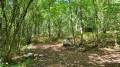
(2) At the crossroads, take the path on the right (photo). It quickly becomes winding and the slope becomes steeper. Continue climbing until you reach a four-way crossroads (a fallen tree forms a barrier).
(3) Turn immediately to the right. The path shared withthe GR® (White and Red) enters an old slate production area that is still clearly visible.
on the left is an old quarry, and on the path is a stone platform with unusable slate residue. A little further on, on the right, a sign tells the story of this activity.
On the left, there are access points to the old extraction sites."
Continue for about 500 m and at the crossroads, continue straight ahead.
At the next crossroads, turn right and head towards the animal park. Several tracks branching off to the left of the path lead to the enclosure fences before rejoining the path.
(4) Continue along this path for about 130 metres. At the three-way junction, keep left on the uphill path. Continue for about 300 metres until you reach a distinctive rock outcrop on the right-hand side of the path.
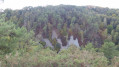
(5) From the viewpoint, there is a bird's eye view of the Misère Valley, with a scree slope visible on the other side. On the left, on the promontory, there is a bench, a view of the animal park enclosures and an information panel about Armorican sandstone/Misère Valley.
Return to the path and continue along this peripheral trail around the plateau.
On the left is the animal park. A path opens up on the left between the enclosures and leads to the heart of the park.
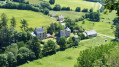
On the right, the panorama opens up onto the Sarthe valley, the Manoir de Lhinte, a little further on the Haut-Fourché site and its cliff hugging the meander of the river, then below the plateau, the village and its bell tower.
(6) Take the path on the left, which offers a better view of the animals. At the next crossroads (hut), turn right. The path descends rapidly to a small tarmac road; follow it to the left.
(7) At the cross, follow the Chemin de Compostelle to the right for about 400 metres, then turn left into Rue de Narbonne.
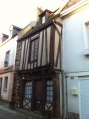
At No. 1, you will see a house with lintels carved from roussard stone.
Continue along this street, turn left onto Rue de Saint-Léonard, then right onto Rue de Vendœuvre.
At the junction with Rue des Alpes Mancelles, a few steps to the left, at No. 23, you will see a beautiful, lovingly restored residence.
Note the date 1806 engraved on the door lintel. Walk down Rue des Alpes Mancelles (D212).
The Church of Saint-Léonard (murals, stained glass windows) is worth a visit. Return to the car park where you started (S/E).



 Visorando Member

 Tourist office
 Moderate
 Difficult