Country:
 City:
City:


Whether you arrive by car from either side of the N83, take the D110 towards Chenecey-Buillon and stop immediately at the car park.
(S) Leave the car park towards the D110, follow the departmental road on the right and take the first road on the right, Chemin des Fourniers. After 100 metres, at the first fork, take the tarmac road on the left. As you descend, you will pass some ruins, probably old winegrowers' shelters. Pass the pumping station.
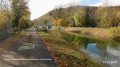
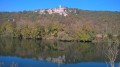
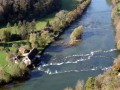
(1) On the left, join Chemin des Prés, which runs alongside the river. Follow the VTT57 cycle route. As you pass, you will see the old renovated mill with its water wheel on the other side of the Loue. At the sign for Chemin du Bas des Combes, leave the cycle route and turn right onto the small path that runs alongside the river. Along the way, you will see a beautiful old house with a turret and dovecote on your left, which probably dates back to the time of the feudal castle that dominated Chenecey. Take the time to walk around the church.
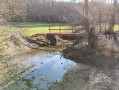
(2) At the bridge, turn right and cross the Loue. Opposite the bridge is the oratory dedicated to Notre-Dame-de-la-Salette. Turn right into the dead-end road.
(3) Three hundred metres further on, climb the hill via the path on the left. Halfway up, continue along the small path that passes under the fallen tree.
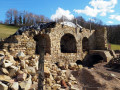
(4) You will come to a crossroads in the shape of an X. Take the path uphill on the right. You will leave the signposts. Soon on the right, there is an unsecured viewpoint overlooking an old house with a turret, the church and the old bridge at Chenecey. Pass the first walls, where the path turns sharply to the left (signpost for mountain bike trail VTT.85).
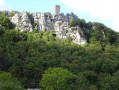
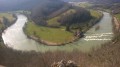
On the other side of the rubble, through a gap, a path passes under ancient postern gates and leads to the old ruins and a viewpoint over Chenecey and the Grand Méandre de La Loue. However, exploring the ruins is not part of the route as the site is not secure (falling rocks, old wells, precipice). If you decide to go in, you do so at your own risk. A sign indicates "private property, no trespassing". If, despite everything, you decide to go in, stay on the path.
You will rejoin the marked path at a sign for mountain bikes crossed out with a red cross and descend the hillside on the right.
(5) At a "Private property" sign, take the path downhill to the right. You will soon reach a small road, which you will take to the right to reach Chenecey, crossing the Loue again (2). Continue along the village's Grande Rue and, at the crossroads, take the small road that climbs at a 45° angle, Rue de l'Ancienne Fontaine.
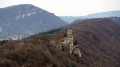
(6) Take the small alleyway that squeezes between two houses (yellow-blue markings almost faded at the bottom of a wall), which should take you uphill to Rue de la Parouse. Catch your breath as you gaze at the ruins of the old feudal castle silhouetted against the sky.
(7) About a hundred metres after the last house in the village, leave the tarmac road and take a small path on the left marked by the Quingey Canton Community (yellow sign indicating Belvédère and the old fountains). Halfway along, you will come to the old fountain and walk alongside numerous piles of stones gathered from fields (known locally as murgets), dry stone walls built by farmers in days gone by when they ploughed their fields, which were richer in large stones than good soil, and deposited them at the edge of their properties. In spring, you will be accompanied by the scent of violets!
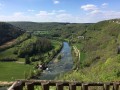
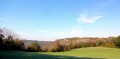
(8) When you reach the ridge, take the path on the left that climbs a few more metres to reach the Grand Méandre viewpoint (yellow sign). To reach it, take a small path on the left just as the main path begins to descend. After stopping to admire the view of the Loue, descend the path that runs alongside and leads to a clearing, where in the morning you may be lucky enough to spot a deer or some chamois. Climb over a small pile of stones gathered from the fields to enter the pasture. Keep to the edge of the clearing, turning right and ignoring the tempting but deceptive gaps on the other side, which would lead you into the neighbouring pastures. This walk is safe, but remember that you are close to the cliffs of Roche Gauthier! Follow the edge for 200 metres, which will lead you to a stone path that is hidden in a recess.
(9) Then head back into the woods. There are no more signposts to guide you. After a few minutes, the path splits. Take the left fork. A little further on, you will come to another fork in the path forming a Z. Take the left path again and from then on, do not go into the woods on the right, but always take the path that branches off to the left, skirting the clearings less than a hundred metres away, without entering them. This path is more or less stony at first, then becomes a trail, but is always clearly marked. Remember to take a discreet look into the clearings, as I had the pleasure of encountering a deer there again today!
(10) Not far from the end, the wet path is rutted, so take care to avoid them by taking a small path on the left that goes around the muddy area. Unfortunately, you will then hear the noise of the main road, which signals your return to civilisation. The path leads to the D110 about a hundred metres from the car park. Turn right.
 The route includes ledges and unsecured viewpoints. The paths are rocky and slippery in places. Good walking shoes are essential and walking sticks are recommended.


 Visorando Member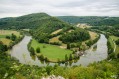
 Easy
Easy