Country:

 City:
City:


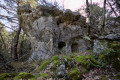
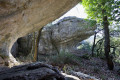
To reach the start point coming from Méounes-lès-Montrieux via the D5, which bypasses the centre of La Roquebrussanne, drive past the petrol station on the left. Turn left onto Chemin de la Foux; on Google Maps, this is incorrectly listed as Chemin de Fioussac. About 100 metres further on, turn right at the signs for ‘Services techniques’ and ‘Courrier’.
Park near the cemetery.
(S/E) Take the tarmac road known as Chemin de la Foux heading south, following the yellow and yellow-red markings. Then turn right onto the Vallon de Valescure cul-de-sac, indicated by a sign at the junction against a hedge (yellow markings only).
At the end of the tarmac road, turn left at the corner of the last house onto the track signposted: Piste d'Agnis - U8; leave the yellow markings here, which head off to the right towards Valescure. Go past the barrier and then the pumping station on the right.
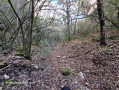
(1) Leave the track and turn left onto the path at the barely visible junction marked by a cairn.
Take care here: this path, which does not appear on any map, is marked by a tin can, red and white stripes, cairns, dots and orange arrows.
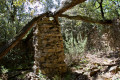
Pass an abandoned trailer on the right, then the remains of a charcoal burner’s hut.
(2) Turn left onto another, wider path which crosses a logging area.
Note: if the route is taken in the opposite direction, this junction, although signposted, is not very visible.
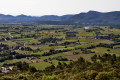
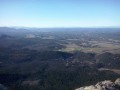
You will reach an open area on the edge of the plateau offering a beautiful view of the plain.
Continue along the path southwards, following the orange or red dots and arrows painted on the stones on the ground.
Pass a Y-junction marked by a cairn, continue straight on, heading south-east.
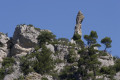
Pass a paragliding launch site marked by a cairn topped with a rudimentary mast.
You will reach a junction of several paths and a track.
(3) At the junction, pass the two paths on the left (sign: Fromagerie), ignore the path straight ahead and turn onto the track on the right which initially heads north-west, following the signs for Bergerie.
Pass a barely visible path on the right, pass a first track junction, continue roughly westwards, then at a Y-junction take the track on the right, heading north-west, and reach Le Jas d’Agnis where there is a restored sheepfold with its cistern.
Leave Le Jas d’Agnis via the track heading south-west for about fifty metres, until you reach a ruin on the right.
Continue along the track (yellow markings). A second ruin is located about fifty metres to the right of the previous one. The entrance is marked by a rock with a yellow mark and a cut tree trunk
(this ruin does not appear on any maps).
Continue south-west to the start of a bend forming an arc which then turns north-north-west.
(4) At the start of the bend, on the left, leave the track heading roughly south along a barely visible path marked by a few cairns to reach two small arches amidst the oak trees.
Return to the track, cross it, and opposite, at a small rock, climb up a barely visible path following a few cairns.
After about a hundred metres, you’ll reach Richard’s large ruined sheepfold.
Cut westwards to rejoin the track, then continue along it towards the west-north-west, following the yellow markings, until you reach a large pond on the right.
(5) Opposite the pond, near a V-shaped oak tree, head into the undergrowth, initially off the visible track.
Note: during the ‘feather’ hunting season, this circular path frequented by hunters can be avoided by continuing along the track until the next path to take, which will then be on the right. Time saved: 1 km.
A few cairns lead first to a hunting post, which you pass to reach a path that then crosses a meadow.
To the north of the meadow, pass a well-maintained country cottage on the right, against a large rock (Private property).
Pass another hunting post wedged between two trees. At this point, to the left towards the south, are the remains of a small dry-stone shelter (known as an ‘agachon’).
The path veers northwards. Ignore the paths on the left and head towards a junction of tracks (yellow markings), until you reach another perfectly maintained country cottage, but be careful as this is private property.
(6) From the track running alongside this country house, head eastwards towards the pond, following the yellow markings.
Turn left before the pond onto an unmarked grassy path that climbs northwards.
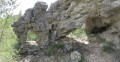
You’ll reach a sheepfold and its cistern, set against a large rock supported by two pillars forming three arches.
Take the path that goes round the sheepfold to the west, marked by a few cairns, to a pine tree on the right, with a cairn at its base and a stone in a branch.
Caution here: from this point onwards, the path—which does not appear on any map—is barely visible and requires constant attention to follow.
(7) From the pine tree with the cairn, head right into a shallow gully and then pass a half-buried arch.
Walk past a few piles of stones to a higher rock on the left, somewhat hidden by vegetation.
A return trip to the rock offers a wide view of the copse concealing the enclosure you are heading for, some thirty metres away.
The enclosure is built around a mushroom-shaped rock, and opposite it stands a magnificent shepherd’s shelter.
Pass the shelter via a path that is clearly visible at the start, heading roughly eastwards; pass a cairn next to a small dolomite outcrop; descend through the undergrowth along the trail, which becomes faint, to reach a drinking trough at the foot of a large rock and a dead tree.
Head north-east to a Y-shaped junction of tracks at the start of a logging area.
(8) Continue along the track opposite (cairn), which is circular, then turn left (cairn) north-east onto a poorly maintained path.
At the end of the path, turn left onto another one, heading roughly north, passing a small field on the right and then another on the left.
At the next junction, continue straight on for about a hundred metres (this path is visible on OSM but not on IGN) and look out for two small, clearly visible dolomites.
(9) Turn left at the two dolomites.
The trail on the ground has been disrupted by logging, so you’ll need to continue ‘by sight’, following a few cairns at the start to go round a group of fairly low rocks to the west, which you’ll then try to get closer to.
Don’t miss a fault on the right, under the trees, which allows you to make a round trip to a rock to enjoy a beautiful 360° view facing La Loube mountain.
Go round the rocks to the right, pass in front of the Del Dado cave hidden by branches (to explore it, see: Practical Information), then go round another rock to the left to reach an arch.
(10) Pass under the arch, cross a track, then join another track heading roughly south, which you follow.
Cross a small meadow to a rock topped by a cairn.
(11) From the cairned rock, follow the cairns along a barely visible path to a track, which you cross.
Continue straight ahead, following the cairns, south-south-west, to a new track where there is a small dolomite rock with numerous openings.
(12) From the dolomite, turn left onto the track, heading roughly east for about fifty metres. Pass a rock on the right and, 30 metres further on, leave the track to the right, heading south-east.
Pass a rock topped by a cairn, then join another track where you turn left.
Continue along this track north-eastwards to a junction, then descend opposite onto a stony path.
Pass a path and a water reservoir, both on the left, to reach the first meadow.
Immediately to the left is Lion’s sheepfold, hidden by the vegetation.
(13) Here you have two options:
- turn left heading due north along the cairn-marked path to reach the crossroads at the rocky outcrop,
- follow the second meadow south-eastwards; this is the route shown on the map, leading to a drinking trough at the foot of a rock.
Go past the trough, follow the cairns, then through the undergrowth go round a fallen boulder on your right.
From there, the path heads mainly east/north-east.
At a barely visible junction, go past a wild boar wallow on your left.
Follow a combination of cairns, stones in the trees and red and white ribbons.
Pass a V-shaped pine tree next to a split rock, then, about thirty metres further on, look out for a pine tree at a 90° angle to the left, in which there is a stone, as well as a cairn on the ground.
At the pine tree, turn left onto a barely visible track that descends to a rock topped with a few trees.
Go over this rock by turning right, roughly eastwards, then continue towards another rock on the hillside, which you go round to the west, on its left, to reach a small shelter (an ‘agachon’).
Optional: from this shelter, you can retrace your steps along the path to climb up the rock off-trail and enjoy a view towards the north-east. Further east, amongst the rocks beneath dense vegetation, you will find what appear to be two small, enclosed enclaves. The second is difficult to access.
(14) From the small shelter, join the Vallon de Valescure path (yellow markings), follow it roughly westwards then reach a water reservoir on the right, crossing a clearly visible gap in the vegetation.
(15) From the water reservoir, start at the base of a large karst slab and climb up off-trail, ‘by sight’, until you reach an enclosure on the right in the north, hidden by vegetation.
(16) From the enclosure, continue north-east, crossing an area of twisted deadwood.
Pass a tree on the left with a yellow mark on a white square: there, turn south-south-west into the undergrowth, guided by the cairns.
Pass a yellow mark just before a natural rock shelter, approach the foot of the large karst slab, roughly due south, and discover some unusual rocks.
Cross an area of terraced fields in the undergrowth, then head for a rock topped by a cairn a few metres from the foot of a small rocky outcrop.
(17) From the rock, follow the cairns, go round the small rocky outcrop and then climb it, veering to the left.
Reach the Jagnisette 1 karstic cave nestled beneath the oak trees. Go round the karstic cave to the left to pass between the two very low trunks of an oak tree. Join the track and turn right onto it, heading north.
At the next track junction, turn right onto the track that descends steeply towards the north-east.
Pass a large rock on the right, beneath the canopy, notable for its marbling caused by runoff.
About 150 metres further on and about 150 metres before the next track junction, look out for a rock on the right against the slope, topped by a cairn, which is only visible if you turn your head 90°.
(18) From this rock, leave the track, climb through the undergrowth, and follow the cairns to a rock with two openings, at the foot of which lies a circular low wall.
Return to the track via the same path, then at the Y-junction* continue straight on for about fifty metres. (*This is the junction we will pass through again).
(19) Note a clearly visible cairn on the left, from which you take a path through the undergrowth.
After about 20 metres, you’ll reach another path; turn right onto this one, heading roughly north-east, then head towards the Escartefigue sheepfold.
Return to the track via the same path, then at the track junction turn left, passing under the high-voltage power line.
At the next junction, continue straight on along a path heading north-north-east.
The path then turns due north. Pass a track on the right which does not appear on any map (a dead end leading to a drinking trough).
(20) At the junction, take the sharp right-hand bend heading east.
The markings are yellow/red at the start, then become scarce, and the track turns into a path.
Ignore the few paths to the right and left (some do not appear on any maps and others that do are no longer visible) and continue to an intersection.
(21) At the junction, turn right, heading due east (the south/west path shown on the IGN map is virtually invisible and the one heading north is blocked by a stone).
Cross a charcoal burner’s platform and pass a small isolated rock on your right.
A little further on, the yellow/red markings become more prominent.
When you reach a hairpin bend, turn left, heading briefly north, before the path turns north-east to an intersection at the edge of the woodland.
At the junction, take a short detour to La Croix de Bérard to enjoy the view of La Loube mountain and the village of La Roquebrussanne.
(22) Return to the junction, turn left onto the steep, very stony path heading east, pass the dovecote, cross a playground and then reach the car park by following the yellow/red markings (S/E).




 Association / Club / Walk leader
 Moderate
 Visorando Member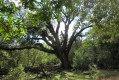
 Easy
Easy