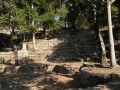
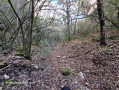
Circular loop around Montagne de la Loube

This challenging hike alternates between caves, springs, dolomite formations, rocky fissures, the remains of a few castrums, a remote chapel and old pastoral settlements, all of which this route invites you to discover.
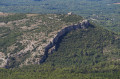
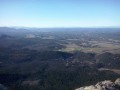
From the ridges, the view stretches far into the distance; the landscape is striking and ever-changing.

Details

14969833
Creation:
Last update:
Last review:
  • Walking
    Activity: Walking
  • ↔
    Distance: 13.48 km
  • ◔
    Average duration: 5h 40 
  • ▲
    Difficulty: Difficult

  • ⚐
    Back to start: Yes
  • ↗
    Ascent: + 647 m
  • ↘
    Descent: - 648 m

  • ▲
    Highest point: 818 m
  • ▼
    Lowest point: 365 m

Photos

Description of the walk

Park in the village of La Roquebrussanne. The hike can easily be done in the opposite direction to the description or by reversing the figure-of-eight shape it describes. The route described below allows you to cross the section by the ruined building and Source des Orris on the way up. As this section requires using your hands, it is also easier to find when approached this way.

(S/E) From Avenue du Portail, take the Chemin des Baumes.
Pass the Jardin d'Élie Alexis. The tarmac road becomes a track. Look out for a red cap nailed to a tree on the left-hand bend. This tree is about 750 m from Avenue du Portail.
From this point, take the path on the left that climbs uphill, pass a beautiful terraced field and then, at the barrier (a rope) marked ‘private property’, turn left. The path becomes a trail (marked by cairns). From there, you can see the chapel and the watchtower, which we will pass by.

(1) Leave the path and take another one on the left which, after a few steps, climbs up to a terraced plot and enters the undergrowth. Follow the arrows and pink dots leading to the chapel.
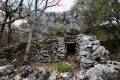
The climb across the terraces becomes steeper. Pass a small ruined hut on the left, ignore a path on the left, then reach the chapel.
Caution! The section between the chapel and the watchtower (ruins) has been roughly mapped out for about 200 m, as this path is not shown on maps. The route is fairly visible: follow the cairns and study the terrain carefully.
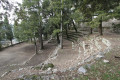
Go round the Chapelle Saint-André on the north side along an unmarked path. The path climbs steeply then levels out towards the north-west. Pass a small platform surrounded by monolithic rocks and turn right onto a path which, after a few metres, climbs up to the remains of the watchtower.
Return to the previous path and turn right. The path first descends and then levels out through the undergrowth. At the junction with another path, turn left (to the right, the other path comes from the chapel; it is visible on OSM). Then, follow the base of a rocky outcrop on the north side. Be careful as the path is sometimes barely visible: the app and the cairns are a great help. When you reach the junction with a path coming from the right, cross the wooden footbridge and continue north-east, then join the tarmac road.

(2) Follow the tarmac road for 300 m towards Pas Gravet. Before the bend, look out for the path on the right marked by a cairn.
Option: before taking the path, you can continue along the road for a few hundred metres (there and back) to view a remarkable group of rocks, then return to the start of the path.

(3) Take the path that descends to the right. At the start, it offers a beautiful view before heading into the undergrowth via a short slab where you’ll need to hold on with your hands.
200 m after leaving the road, pass in front of the ‘Grotte aux 400 Moutons’ (Cave of the 400 Sheep), the entrance to which is on the left between two rocks.
Pass some other small caves and a path coming from the right, then continue southwards for a while.
300 m after the cave, pass at the foot of a remarkable dolomite rock visible from the road: “the rock with its finger pointing skywards”.
Stay on the path furthest to the left, which enters the undergrowth and becomes hard to follow where it levels out as it reaches Les Orris: see practical information. Cross a wet area, climb up a terraced slope from which you can see a ruin on the left, built against the cliff: Les Orris.

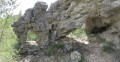
(4) Climb up to the ruin, head south, pass the spring and look for a path that climbs north-east, becoming very steep and requiring you to use your hands for about twenty metres. Follow the red markings to the left as you climb. Green markings lead to the right onto a promontory. Once past this section, the path passes through an arch, levels out again and joins another path marked with yellow dots. Several paths lead to a Y-junction. The path to follow is marked with yellow markings.
Alternative route to avoid the vertical section: from the ruins, take the path descending southwards. At the track, turn left onto it. Proceed to the Pas de la Nible, then turn left to reach a Y-junction to the north to rejoin the route.

(5) Head north, ignoring the various paths coming from the left and those descending to the right. Reach a Y-junction.

(6) Take the path on the right. The one on the left is the return route. Pass a meadow and a few paths on the right. Exit the undergrowth then climb gently northwards to a large crossroads (Alt.: 574 m).

(7) Pass the ruins of Jas d'Émilien, leave the path on the right and take the path on the left marked in blue. You will reach an open crossroads at the 574m mark.

(8) Take the path on the left, which heads westwards up a steep slope. About 500 m further on, take the path on the left, marked in blue. Join the tarmac road, turn right and head towards the transmission relay station.
Head to the viewpoint by following a concrete, very steep path alongside the first building of the relay station. There, a wide and beautiful view opens up before you.

(9) Head back along the tarmac road and, at the first bend marked by a large antenna, take the track on the right which ends at the summit of La Loube (Alt.: 830 m). Then take the fluorescent pink path which leads, after 50–60 m, to the fire lookout.

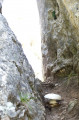
(10) From the lookout, return to the track and look out for cairns on the right marking the path through the undergrowth. Follow the description below rather than the OSM track, which diverges from the terrain. Head along this path towards the south-west. A large pine tree hides a crevice in the rock, which you enter. At the exit of the crevice, turn left, follow the cairns; the descent becomes steeper.
On the left, on a rock marked by a stone placed at eye level, turn left and cross a second, barely visible crevice, then follow the cairns and emerge from the woodland.
Pass at the foot of a dolomite outcrop, go past a path branching off to the right to reach a post by the roadside.
From this post, take the fairly wide path on the right (Blue), which leads into the undergrowth, then leave it for a barely visible path on the left, at the foot of a rock. Its start is marked by two cairns. This path veers around the rock and then climbs. As it is not very well marked, this path can be followed by estimation. It joins the tarmac road, which you follow to the right for about fifty metres until you reach a path on the left.

(11) Take this path on the left, which descends south-east. Towards the end, pass a ruin and reach the fork you passed on the way out.

(6) Turn right then continue roughly southwards until you reach the other fork you also passed on the way there.

(5) Take the path on the left (yellow) which becomes a track and leads to the Pas de la Nible at a three-way junction.

(12) Take the track on the left and continue to a Y-junction, then leave the track and look for a path on the left that descends south-west through the woodland.

(13) Take the path which, at the start, runs alongside the fence of a reservoir, enters the woodland amidst rocks covered in ivy and moss, and then leads to the Notre-Dame d’Inspiration Chapel.

(14) Walk to its amphitheatre, then take the path that descends through the woods and joins the tarmac road known as the “Chemin de la Chapelle Notre-Dame”.
Take this road straight ahead, heading east at first, then leave it to take Rue Saint-Antoine, then Rue Georges Clemenceau on the right and finally, continuing on, Avenue du Portail (S/E).


Waypoints

  1. S/E : km 0 - alt. 372 m - Avenue du Portail. Near the - Issole (rivière) - Var
  2. 1 : km 1.23 - alt. 432 m - Junction, path on the left
  3. 2 : km 2.17 - alt. 571 m - Tarmac road, on the right
  4. 3 : km 2.49 - alt. 612 m - Leave the road, take the path on the right
  5. 4 : km 3.07 - alt. 504 m - Ruined building and Source des Orris.
  6. 5 : km 3.5 - alt. 573 m - Common junction. Return
  7. 6 : km 3.99 - alt. 570 m - Common junction. Return
  8. 7 : km 4.93 - alt. 560 m - Jas d'Émilien
  9. 8 : km 6.31 - alt. 575 m - Trail junction
  10. 9 : km 8.2 - alt. 810 m - Viewpoint north of the belay station
  11. 10 : km 8.62 - alt. 818 m - DFCI lookout
  12. 11 : km 9.62 - alt. 699 m - Leave the road, take the path on the left
  13. 12 : km 10.98 - alt. 553 m - Pas de la Nible
  14. 13 : km 11.83 - alt. 464 m - Junction, on the left. Elevation 465
  15. 14 : km 12.15 - alt. 472 m - Chapelle Notre-Dame d'Inspiration (la Roquebrussanne)
  16. S/E : km 13.48 - alt. 372 m - Avenue du Portail.

Notes

- A short section of the route from the Chapelle Saint-André is followed by cairns. The OSM Trails map is the one that marks this path, unlike the others.
- The ‘Grotte aux 400 moutons’ can serve as shelter in case of rain.
- The Chapelle Saint-André, whose vaulted ceiling is in a fragile condition, has recently been closed to the public.
(3) At the foot of the cliff, there is a significant deviation between the route and the path. In the undergrowth, the cairns are regularly knocked over by wild boars.
- Water point at (4) to the right of the ruin leaning against the cliff: this is the only one on the route.
(4) A section requiring you to use your hands: it is not advisable to attempt this in wet weather. An alternative route allows you to avoid it.
- The app and GPS sometimes fail to provide guidance on the route between the first fissure and the dolomite (between (10) and (11)): follow the cairns and the description above carefully.

Worth a visit

During the hike:
- The Chapel of Saint-André, unique for its minimalist architecture, although isolated, remained a popular destination until 2021. Today, access is prohibited.
- Above the chapel: the remains of a watchtower forming part of a complex, the Castrum des Baumes, believed to have been built in the Middle Ages.
(2) Numerous dolomites dot the route.
- The Cave of the 400 Sheep, followed by a few others (a torch may be useful but is not essential).
(4) The Source des Orris and its ruin nestled against the cliff make this a true haven of coolness.
- After (4), a challenging section leads to a small arch before rejoining a comfortable path.
- Le jas d'Émilien, a remnant of a bygone pastoral life.
(8) A beautiful view stretching north and south takes in the surrounding countryside.
- Between (8) and (9), the path on the right, marked with orange dots, climbs steeply and passes through the undergrowth: this is a more challenging alternative to the one described.
(9) North of the transmission relay station: Tourves, Brignoles, Saint-Maximin and beyond...
(10) The lookout point at the summit of La Loube offers a fine view of Sainte-Baume and the Chapel of Saint-Probace. - 200 m further on (10) the path passes through a remarkable rocky pass and offers a fine view.
(14) The Chapel of Notre-Dame d'Inspiration with its commanding view of the village and its astonishing amphitheatre. The original castle was dismantled and then partly converted in the 18th century by the hermit Bormes into this open-air theatre.

Near the walk:
- To quench your thirst after the hike, there are a few bistros on Rue Georges Clemenceau.
- The Jardin d'Élie Alexis is located on the Chemin des Baumes (Tel: 07 68 34 32 83).
- L'Archéo-Poterie, which sells locally inspired, handmade pottery. The shop is situated on the D64 towards Mazaugues, clearly visible from the roundabout marking the junction between the D5 and the D64.
- The wineries offering a range of outstanding local wines include: Domaine du Loou, La Rose des Vents and La Roquière. In Garéoult: La Bastide des Oliviers by Patrick Mourlan,... This list is by no means exhaustive: there’s plenty more to discover!
- The remains of a Roman villa are located next to the Domaine du Loou on the road leading to Méounes.
- In Méounes (83136): a bakery and patisserie is open on Sundays. It is situated on the D554 before you reach the church when coming back from La Roquebrussanne. L'Assiette Mauve is a lovely little restaurant opposite the village square when, coming from La Roquebrussanne, you head towards Signes. Just before it, there is an antiques shop on the left, on the corner of the square. Drinking water flows from the fountain.

Reviews and comments

4.3 / 5
Based on 7 reviews

Reliability of the description
4.4 / 5
Ease of following the route
3.9 / 5
Route interest
4.6 / 5
madi83
madi83

Overall rating : 3.7 / 5

Date of your route : Apr 19, 2026
Reliability of the description : ★★★★★ Very good
Ease of following the route : ★★★☆☆ Average
Route interest : ★★★☆☆ Average
Very busy route : No

As clearly stated in the description and by some reviewers, this hike is difficult and demanding. The terrain is rugged and often rocky. Furthermore, finding your way is very tricky as the route involves numerous sections along faintly marked trails where sarsaparilla and its thorns (perhaps due to the season) grow rampantly. Progress becomes slow and arduous.
After a few setbacks, we decided to take less difficult routes, sacrificing some of the ‘thrill’ of the adventure but still enjoying, despite everything, the magnificent scenery of the mountain range.

Machine-translated

User 18054987

Overall rating : 4.3 / 5

Date of your route : Dec 29, 2025
Reliability of the description : ★★★★☆ Good
Ease of following the route : ★★★★☆ Good
Route interest : ★★★★★ Very good
Very busy route : No

A beautiful, somewhat challenging route with stunning panoramic views
Arrival at the lookout point with a 360° view – pure bliss
Thank you for this hike

Machine-translated

kgyorffy
kgyorffy

Overall rating : 5 / 5

Date of your route : Feb 18, 2024
Reliability of the description : ★★★★★ Very good
Ease of following the route : ★★★★★ Very good
Route interest : ★★★★★ Very good
Very busy route : No

A brilliant hike that took 6 hours.
We only came across one couple on a Saturday!

Machine-translated

gerardkev
gerardkev

Overall rating : 4.3 / 5

Date of your route : Nov 20, 2023
Reliability of the description : ★★★★☆ Good
Ease of following the route : ★★★★☆ Good
Route interest : ★★★★★ Very good
Very busy route : No

A lovely walk, but be warned: the terrain is often difficult and demanding.
However, the estimated time is significantly underestimated: it took us an hour longer… and we’re keen walkers!

Machine-translated

jean-michel.belouet
jean-michel.belouet
• Edited:

Overall rating : 4.3 / 5

Date of your route : May 29, 2023
Reliability of the description : ★★★★☆ Good
Ease of following the route : ★★★★☆ Good
Route interest : ★★★★★ Very good
Very busy route : No

It’s true that you have to look around a bit for the path that goes round the Source des Orris to reach the foot of the rocks. In dry weather, there’s no difficulty in climbing them. Otherwise, you can bypass this section by heading directly to the Pas de la Nible (at IGN elevation 492) and then the Trois Fontaines, but you’ll miss out on some of the charm of this route.
The GPX track is reliable but needs to be followed carefully in certain sections.
Thanks to the author of this guide.

Machine-translated

ducatman92
ducatman92

Overall rating : 4.3 / 5

Date of your route : Mar 24, 2023
Reliability of the description : ★★★★★ Very good
Ease of following the route : ★★★★☆ Good
Route interest : ★★★★☆ Good
Very busy route : No

A lovely hike with a perfectly marked route – which is just as well, as it can sometimes be tricky to find the paths. Watch out for little ones between points 3 and 4: you have to climb up some impressive rocks, so it’s best to have long legs.
As for me, my watch shows 780m and 7 hours 25 minutes, including breaks, as we took our time. Thanks for this hike.

Machine-translated

phildaix
phildaix

Overall rating : 4 / 5

Date of your route : Nov 30, 2022
Reliability of the description : ★★★★☆ Good
Ease of following the route : ★★★☆☆ Average
Route interest : ★★★★★ Very good
Very busy route : No

A truly magnificent hike, with stunning rock formations, mysterious caves and breathtaking scenery; and at this time of year, wild strawberries that are just the right amount of sweet.
That said, please note that
- at WP 1, the path you need to take on the left is actually a staircase in the terraced field: be careful not to miss it
- between the Chapel of St André and the road, the path requires a great deal of attention, as stated in the guidebook; you’re constantly on the rocks and, indeed, it’s ‘very steep’
- after WP3, the path leading down requires just as much attention, with many sections where you need to use your hands; the biggest problem is the overgrown vegetation, which has obscured the path (which is not maintained) and makes certain sections tricky.

All in all, whilst we usually take less time than the algorithm predicts, this time it took us so long between the chapel and the Source des Orris that we couldn’t complete the circular route: we had to return via WP12 after the spring. I think you need to allow for much more than the advertised 5 hours 35 minutes, due to the state of the paths.

Machine-translated

POULIN Gérard
POULIN Gérard ★

Good evening, rumax,
Please update your hike by adding these details directly.

Machine-translated

rumax
rumax

Please note!
I am the author of this walk and would like to inform you that, as of 13 September 2022, a landmark on the route is no longer there.
740 metres after the start, you need to leave a wide track and turn left onto another track.
At this junction, there used to be a sign on a tree on the left bearing the word ‘Lili’, but it is no longer there.
So, to ensure you don’t miss this change of direction, stick to the distance from the start and use the app available on your smartphone.
Best regards, rumax.

Machine-translated

stjo
stjo

Here is a hike that’s superbly described and illustrated, with a guide that really highlights not only the route itself but all the surrounding attractions. This description really makes you want to go there.
We’ve already covered a good part of this route, in sections and over several visits. I can confirm that it’s a magnificent route, just as the author so aptly suggests.
We’re therefore looking forward to doing it again, no doubt following this route, during our next stay in the Var.

Machine-translated

Other walks in the area

For more walks, use our search engine .

The GPS track and description are the property of this route's author. Please do not copy them without permission.