Lods circular route to Roche de Hautepierre

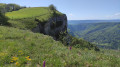
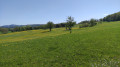
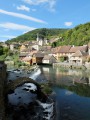
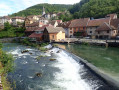
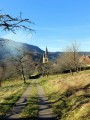
In a particularly remarkable setting, where the Loue has carved out a wide, deep gorge, this circular route passes through one of the “most beautiful villages in France”: Lods, nestled in the valley. Steep climbs take us, after a 510-metre ascent, to the Roche de Hautepierre and its sweeping panorama. From there, the route follows charming paths through unspoilt countryside. The descent is gentle. As a bonus, we discover the curious Roche de Sainte-Foy rock formation and the “village of character” of Mouthier-Hautepierre, which is also full of charm and boasts a rich architectural heritage.

Details

96490025
Creation:
Last update:
Last review:
  • Walking
    Activity: Walking
  • ↔
    Distance: 12.26 km
  • ◔
    Average duration: 5h 10 
  • ▲
    Difficulty: Moderate

  • ⚐
    Back to start: Yes
  • ↗
    Ascent: + 594 m
  • ↘
    Descent: - 592 m

  • ▲
    Highest point: 881 m
  • ▼
    Lowest point: 371 m

Photos

Description of the walk

The car park is located almost at the eastern exit of Lods. From the D67, cross the bridge over the Loue: the car park is on the right.

(S/E) Cross the bridge on foot, cross the D67 at the pedestrian crossing, turn left then follow Rue de Reine to the right and walk past the church.

(1) Continue straight ahead along Rue Lancrenon, which climbs steeply, and reach the junction with Rue du Bout d'en Haut. Turn right onto this and join Route d'Athose (D32).

(2) Ignore this road and turn immediately right onto the winding road; ignore the housing estate and a path on the left. You will come to a footpath on the left.

(3) Follow this marked path, which climbs steadily.

(4) A post with yellow and red GRP® markings indicates a right turn. Turn either there or a little further up if the grass is too high to see the post. The aim is to join a parallel grassy path and thus pass to the right of a hedge. Further on, cross a path and continue straight ahead to the D244.

(5) Follow this road to the left, continuing past the hairpin bend.

(6) Follow the marked path which climbs to the left. After about a hundred metres, take a path which climbs to the right, following the markings, and arrive at a long platform called the Roche de Hautepierre. All along this stretch you will be at the top of the cliff and can enjoy a magnificent panorama. You can proceed with caution along the promontory.

(7) Return to the route. Further on, you’ll find an orientation table and a bench. At the end of the cliff, the path descends to the Hautepierre-le-Châtelet cemetery. Continue on to reach the D244.

(8) Turn right to follow the GRP® path marked in yellow and red, running parallel to the road but on the left-hand side of the carriageway. It then moves away from the road and descends gradually.

(9) Leave the steeply ascending path on your right, which can serve as a shortcut on the way up: see section: Practical information. Carry straight on and rejoin the junction with the D244.

(5) Follow the road to the left as it descends, continuing to the hairpin bend.

(10) Leave the road and follow the path that continues down towards Mouthier-Haute-Pierre, leading out onto Rue du Petit Mont.

(11) Follow the street to the left, then turn right onto the D67.

(12) Turn right onto Grande Rue, continue straight on at the junction to follow Rue Robert Dame. As you approach the village exit, ignore Chemin des Carres on the right and you’ll reach a bench situated about fifty metres before the reservoir.

(13) Turn left onto the wide strip of grass, usually mown, which runs alongside a fence. It turns into a path that runs alongside a corbelled rock and rejoins the road you left earlier. Head left and follow this for about 400 m.

(14) Leave the road on the left onto a good track leading to Lods. Pass the castle on the left and arrive at the church.

(1) Take the street on the left. Once at the junction, turn left again.

(15) Go down the steps on the right leading to Rue de Reine, follow it to the left for about 60 metres, then go down a second flight of steps on the right which leads onto the D67. Cross it carefully, turn left towards the bridge over the Loue, then cross it to reach the car park on the right (S/E).

Waypoints

  1. S/E : km 0 - alt. 374 m - Car park
  2. 1 : km 0.41 - alt. 407 m - Church, junction of the circular loop
  3. 2 : km 0.63 - alt. 453 m - D32 junction
  4. 3 : km 1.21 - alt. 497 m - Start of the path on the left
  5. 4 : km 1.62 - alt. 554 m - Yellow and red signpost
  6. 5 : km 2.76 - alt. 666 m - Road junction, left
  7. 6 : km 3.65 - alt. 719 m - Path on the left
  8. 7 : km 4.1 - alt. 825 m - Viewpoint, promontory
  9. 8 : km 5.17 - alt. 806 m - D244 junction
  10. 9 : km 6.2 - alt. 693 m - Shortcut available
  11. 10 : km 7.08 - alt. 612 m - Hairpin bend
  12. 11 : km 8.79 - alt. 436 m - Arrival in Mouthier, Rue du Petit Mont
  13. 12 : km 9.21 - alt. 421 m - Grande Rue. Valley of the - Loue (rivière)
  14. 13 : km 9.92 - alt. 467 m - Passage through the grass on the left
  15. 14 : km 10.78 - alt. 464 m - Leave the road, take the path on the left
  16. 15 : km 11.98 - alt. 393 m - Stairs on the right
  17. S/E : km 12.26 - alt. 374 m - Car park

Notes

Water point at the Hautepierre-le-Châtelet cemetery.

Route characteristics: the ascent is very direct up to the Roche de Hautepierre, making it a fairly strenuous climb. Unlike other routes, this one follows the entire ridge. The descent is easy, along gentle, picturesque paths.

Take care with children when walking along the Roche de Hautepierre and its unprotected cliff.

Alternative route at (5): go from (5) to (9) and take the marked path on the left which climbs steeply: visible on the map at a high zoom level. Follow the road to the left to rejoin the route at (6).

Worth a visit

(S/E) The village of Lods was known for its forges and vineyards. The former home of the master smiths is situated below the Loue; flats have been converted there. In 1850, Lods had a population of 1,850. Today, it has between 250 and 300 inhabitants. There used to be nearly 130 hectares of vineyards. Phylloxera destroyed most of them; disease, wars and the hard work did the rest. The vineyards have been replaced by fruit trees. You can find out more at the Vine Museum.

(12) Mouthier-Hautepierre developed thanks to its monastery. Here too, wine-growing was a major industry, which explains the 1,000 inhabitants recorded before the phylloxera outbreak. This was followed by the planting of cherry trees for the production of kirsch.

Places to visit in the surrounding area: the Loue Valley, the town of Ornans and its Courbet Museum.

There are plenty of hiking opportunities throughout the rugged valley.

Other walks in the area

For more walks, use our search engine .

The GPS track and description are the property of this route's author. Please do not copy them without permission.