Bosse de la Momie

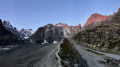
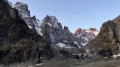
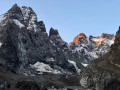
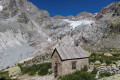
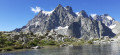
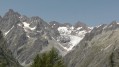
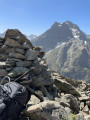
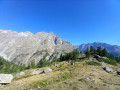
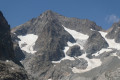
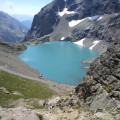
A challenging hike through a spectacular landscape where gigantic, jagged granite cliffs drop sheer down to a wild glacier. The lack of paths for most of the ascent helps to create an atmosphere of adventure and solitude reminiscent of expeditions in Patagonia or the Karakoram.

⚠️ It is essential to read the practical information before undertaking this extremely difficult hike.

Details

1610732
Creation:
Last update:
Last review:
  • Walking
    Activity: Walking
  • ↔
    Distance: 13.43 km
  • ◔
    Duration according to the author: 8 hrs 
  • ▲
    Difficulty: Extremely difficult

  • ⚐
    Back to start: Yes
  • ↗
    Ascent: + 1,252 m
  • ↘
    Descent: - 1,248 m

  • ▲
    Highest point: 3,047 m
  • ▼
    Lowest point: 1,872 m

Photos

Description of the walk

Information on how to reach the starting point, as well as details regarding difficulty levels, alternative routes and safety precautions, is summarised in the ‘Practical Information’ and ‘During the Hike’ sections. Any difficult hike requires preparation, and this extremely difficult hike demands thorough prior research.

(S/E) From the car park, take the path between the Chalet Refuge de Madame Carle and the Maison du Parc on the right bank of the Torrent de Saint-Pierre towards the glaciers to the north-west. Cross the Torrent de la Momie then the Glacier Noir footbridge and climb three hairpin bends.

(1) At the signpost, turn left due west to follow the signposted route to the Glacier Noir. The path quickly reachesthe very narrow ridge of the moraine and climbs steeply between the Ravin de l’Encoula and the Glacier Noir. The ridge path descends slightly shortly after reaching the level of the Balmes de François Blanc (see IGN map) and passes between two small cairns at around 2,450 m.

(2) At these two small cairns, carefully note the direction to take once on the glacier using the reference photo, then leave the ridge path to descend initially in the opposite direction (east) towards the glacier and a large cairn at the edge of the glacier tongue and the foot of the moraine. The passage is tricky; there’s no shame in sliding down on your backside for part of the way to improve your grip.

(3) At the cairn, head west along the crest of a small secondary moraine and try to follow the cairns dotted across the glacier, aiming for the eastern end of the rocky shoulder descending from Pic Coolidge, which you spotted in the previous stage.

(4) Weathered rocks form a barrier between the lower and upper Glacier Noir, see this photo. A permanently fixed rope should be avoided as it is worn and dangerously secured. Below this rope, follow the base of the pitted rocks southwards to reach a clearly visible cairn at the entrance to a fissure in the barrier. Climbing up this fissure is very easy and allows you to gain a foothold on the Upper Glacier Noir.

Head south-east towards the centre of the upper glacier, then cross to the right bank beneath a very steep moraine. At the top of this moraine, 40 to 50 m higher up, a grassy plateau can be made out. Reach the point where the base of the moraine and its summit are closest to one another.

(5) Climb straight up the moraine, due east, following the hollow of one of the gullies to find better handholds on a few rocks loosely embedded in the crumbly granite scree. This section is the most difficult part of the hike; crampons and an ice axe may be useful here (in the absence of any snow or ice).

(6) Once you reach the moraine ridge, head north-east towards a scree cone beneath a rocky shoulder. On the scree, turn right to climb east-southeast and pass the southern tip of the shoulder.

(7) Immediately after the shoulder, head left-northeast to cross a small rocky section and gain a foothold on a scree slope of large boulders. Then climb this scree gully eastwards and then northwards before reaching the western edge of a summit plateau gully, facing the Bosse de la Momie.

(8) Go round this plateau in a semicircle along its overhanging edge to reach, to the east, the north-eastern end of the Bosse de la Momie ridge. Locate the route using the reference photo and its annotated high-resolution version.

Then go round to the right (west face) of a first rocky outcrop to the south, to reach the small northern gap of the Bosse de la Momie via easy, almost horizontal rock ledges.

(9) From this breach, descend a few metres to take slightly ascending ledges that are a little more exposed but on very good rock, to also go round to the right (west face) of the final outcrop of the Bosse de la Momie, situated to the south-west. This brings you to a scree-covered area, where you turn due east to climb back up onto the ridge. Once on the ridge, follow it southwards to the cairn-marked summit.

(10) From the summit, the return route follows the same path back to the Pré de Madame Carle (S/E)

Waypoints

  1. S/E : km 0 - alt. 1,873 m - Pré de Madame Carle
  2. 1 : km 1.47 - alt. 2,037 m - Glacier Noir - Glacier Blanc junction
  3. 2 : km 3.59 - alt. 2,469 m - Cairns at Les Balmes by François Blanc
  4. 3 : km 3.73 - alt. 2,441 m - Cairn at the northern moraine base of the Lower Glacier Noir
  5. 4 : km 4.55 - alt. 2,454 m - Base of the Roches Moutonnées towards the Upper Glacier Noir
  6. 5 : km 5.16 - alt. 2,573 m - Moraine base beneath Bosse de la Momie
  7. 6 : km 5.27 - alt. 2,626 m - Moraine summit below Bosse de la Momie
  8. 7 : km 5.61 - alt. 2,803 m - Rocky ridge towards the valley below Bosse de la Momie
  9. 8 : km 6.15 - alt. 2,965 m - Bosse de la Momie summit plateau
  10. 9 : km 6.57 - alt. 3,034 m - Brèche Nord Bosse de la Momie
  11. 10 : km 6.72 - alt. 3,042 m - Bosse de la Momie summit
  12. S/E : km 13.43 - alt. 1,873 m - Pré de Madame Carle

Notes

?️ Park at the Pré de Madame Carle car park N 44.91753° / E 6.416068°. By clicking on this Waze link, you can enter these coordinates directly into your favourite navigation app. The car park is located near the Chalet Refuge du Pré de Madame Carle.

? Water is plentiful right up to the base of the Bosse de la Momie summit plateau (8). A filter may be advisable.

? The route is entirely within the Écrins National Park and is therefore off-limits to dogs, even those on a lead.

?♀️ This hike is ‘extremely difficult’, straddling the line between easy mountaineering and hiking. The most difficult sections are the descents and ascents of the moraines on both sides of the Glacier Noir between (2) and (3), then (5) and (6). The rocky sections are much easier, although they do require a great deal of concentration.

? The eroded rocks at the junction of the upper and lower Glacier Noir are very dangerous in wet weather. The same applies to the ledges leading to the summit of the Bosse de la Momie. The hike is only feasible in perfectly dry and stable weather.

? The hike is relatively short, but it is possible to camp at the top of the moraine on the right bank below the Bosse de la Momie (6), where there are several dry stone shelters.

? Standard hiking kit, plus a helmet, is sufficient. An ice axe and even crampons are useful but not essential when crossing the moraines. If hiking in pairs, a 30-metre rope will allow you to secure yourselves to rock outcrops on the ledges between (8) and (10).

⏰ At the start of the season, it is essential to set off very early to ensure the snow is firm on both the ascent and descent.

? Finding your way is straightforward if you have studied the reference photos and the details in the two sketches inthe tripalbum.

? There is only one emergency number in France: 112. Other numbers (15, 17, or direct numbers…) have no priority on mobile networks, do not connect via other operators’ networks when there is no signal, and in the event of an overload of calls, ongoing communications are cut off to prioritise 112. So forget about them as soon as possible; they are dangerous and serve no purpose (contrary to what some outdated guidelines claim). If you cannot speak or hear, use 114 to communicate via text message. 112 works on any mobile phone (and landlines, of course), including on a locked phone and even if the SIM is blocked (however, since 2004, France has been in breach of European recommendations and blocks calls to 112 when there is no SIM in the phone. This blocking required special investment, as the GSM standard naturally allows calls without a SIM card. Taxpayers will appreciate this particularly clever use of public funds).

Please note: if your call is cut off, it is up to you to call the emergency services again; they have no way of contacting you or locating you. Remember to note down your GPS coordinates before calling, as the French government has not deigned to equip emergency centres with AML (Advanced Mobile Location) technology, despite this having been made mandatory by the EU since 2018.

? In the mountains, switch your phone to 2G. The range of this technology is 4 to 8 times greater than that of newer technologies, and it uses significantly less power. Remember to switch off your Wi-Fi, which drains the battery quickly and serves no purpose outside homes and offices. Bear in mind that your phone’s GPS works even in flight mode (GPS has nothing to do with mobile phone signals).

?Checklist

  • ☑︎Essential in addition to standard hiking kit
  • ☑︎helmet
  • ☑︎head torch (if setting off early)
  • ☑︎1.5 L water bottle
  • optional
  • ☐telescopic poles (must fit in your rucksack)
  • ☐30 m rope and harness (to reassure those who are less confident, but be aware of the time lost)
  • ☐crampons (for climbing and, above all, descending the moraine)
  • ☐water filter
  • ☐ice axe (for climbing the moraine)
  • ☒not required
  • ☒nut
  • ☒quickdraws, etc…

⚠️ As a general rule, treat IGN topographic maps with a degree of scepticism (in my experience, the institute never corrects reported errors, even after serious accidents caused by these errors – see my profile for further details and an example). The base maps of the IGN topographic maps date back more than 25 years and have not been updated since (!). The free OpenStreetMap, updated by volunteers, is usually much more up to date; it is best to consult its OpenTopoMap version, which is easier to read.

You are hiking in the heart of the Écrins National Park.

The Écrins massif is an exceptional area, open to all, with a natural, cultural and scenic heritage that is truly unique. To protect these treasures, the heart of the park is marked by blue-white-red flags, where certain regulations must be observed. Please familiarise yourself with these regulations when planning your hike to help preserve this shared heritage, at https://www.ecrins-parcnational.fr.

Worth a visit

? Alpine wildlife is present, particularly chamois in the ridges above the Ravin de l’Encoula and the Balmes de François Blanc. From the top of the Bosse de la Momie or the summit plateau, you can see eagles circling below.

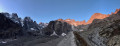
? The views offered by this hike are spectacular. See this interactive photo from the summit and this other spherical photo taken between the Lower and Upper Glacier Noir.The full album of the trip is available online and contains a few videos as well as annotated photos showing the route.

? Several minor variations are possible and essentially involve crossing obstacles via different routes. For example, on my first trip, I climbed the rounded rocks twice from Lower Glacier Noir, to the left and right of the fixed ropes shown in the photos, in order to find the best route. I also climbed up the moraine on the right bank of the glacier by ascending a narrow ravine near the waterfalls and glaciers descending from the Pelvoux. The terrain offers endless possibilities…

? Explanation of a few terms:

  • ‘La Momie’ does not refer to any embalmed body or Egyptian sanctuary. The term is of Savoyard origin and means ‘the middle’. The ‘Momie’ triangle is therefore the middle triangle of the Pelvoux face, and the ridges, cols and humps have been named accordingly.
  • ‘L’Encoula’ refers to the basin of the Lower Black Glacier. The IGN restricts its use to the ravine situated between the moraine and the foothills of the glacier’s left bank, but the ridge between Barre Noire and Pointe de la Grande Sagne bore this name, and the Upper White Glacier was so called because it lies behind L’Encoula.
  • ‘roche moutonnée’ takes its name from the analogy drawn by Saussure with the shape of the wavy wigs worn by 18th-century aristocrats, which were smoothed with sheep’s fat (wavy wigs ⇒ wavy rocks).
  • The Glacier Noir consists of two branches: the lower branch to the north and east runs along the foot of the Barre des Écrins; the upper branch to the south and west runs along the foot of the Pelvoux, Pic Sans Nom and Ailefroide.

Other walks in the area

For more walks, use our search engine .

The GPS track and description are the property of this route's author. Please do not copy them without permission.