Country:
 City:
City:


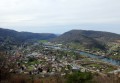
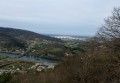
There is a small car park on the right, halfway up the Côte Blanche cul-de-sac. There are no signposts at the start.
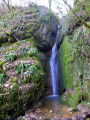
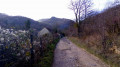
(S/E) Walk down the street to the stop sign and turn left onto Chemin de Maillot, then immediately right, passing in front of the Arbre de la Libération, to reach Rue de la Cascade, where you’ll find yellow-red and white-red markings. Turn left, walking alongside the wall of the beautiful house. At the fire hydrant, leave the street and take the small stony path on the left which runs alongside a vegetable garden, and follow the signposting to the waterfall. Unfortunately, the vegetation in spring and summer partially hides it. Continue on to join the tarmac-surfaced Chemin de Maillot.
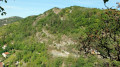
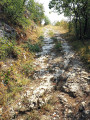
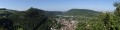
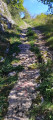
(1) Head back down to the left for 250 metres; look out for a sign on a telephone pole indicating you should turn right at the corner of the wall, onto the stony Sert path, to discover the ancient Roman road and its ruts carved into the stone (towards Bois de Peu). Shortly after the Roman road, take the sharp left-hand bend. At a large stone marked with signposts, turn left again and continue climbing through the boxwood and along the ledge (with care) until you reach the meadows and the viewpoint over the Doubs Valley, complete with a bench.
The signposted path continues from the bench, cutting across the pasture, but for now, carry on straight ahead along the edge of the trees lining the cliffs; after about fifteen metres, you’ll come across a small, inconspicuous path on your left which continues to follow the cliffs and leads you to the Baume Martin (a ‘baume’, derived from the Gaulish word ‘balma’, is a rock shelter). Turn back and, when you can see the bench again, turn your back on it and head straight across the meadow until you reach a fork in the path. Take the grassy path sloping gently down to the right. You’ll come to a hunting car park.
(2) Continue straight on along this well-graveled track, following the markings (Yellow-Red, Mountain Bike Route 114).
(3) At a sign for MTB Route 114, the path splits into three: take the grassy path in the middle, despite a Yellow Cross and Red Cross on the ground indicating it is off-limits, and leave the signposted route. You’ll pass through a pine forest, gradually drawing closer to the edge of the cliffs. At signposts nos. 29, 30 and 11, at another three-way junction, carry on straight ahead, passing signpost 30. A little further on, leave a footpath on your right that climbs perpendicularly up the hillside, and carry on straight ahead to the pylon and a viewpoint over Casamène, Velotte and Mont de Chaudanne (at least when the trees are not in full leaf).
(4) This is the trickiest part of the route description; despite my best efforts to make it as clear as possible, it will require your full attention and a bit of a sense of direction.
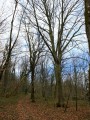
Head back about a hundred metres, and make a note of a large beech tree on the right – the largest tree on this side of the path ( see photo).
After this tree, turn immediately right, at an angle of about thirty degrees to the path, moving closer to the edge of the cliff, to quickly find a small, moderately visible track.
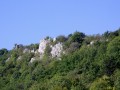
Walk carefully along the edge of the cliffs andyou’ll discover a beautiful forest of slender trees and superb rocky crevices cutting into the cliffs – but for safety’s sake, don’t venture onto the steep sections. The path was very easy to follow in early spring; in other seasons, you might find yourself caught up in some brambles.
(5) You’ll come out onto a ledge at right angles to the path. Turn right, towards the edge, for a view of the valley. You’ll come across a small boundary marker and a sign marked No. 28. Take the path that continues to run alongside the cliffs. You’ll pass through a grove of boxwood and continue straight on for about 200 metres. You’ll reach a steep, slippery ledge, which you’ll descend to the right, proceeding carefully to the edge of the promontory for a view of Rosemont and the Côte de Planoise.
Turn your back on the valley and walk back up for about fifty paces, keeping the ledge you descended on in sight; on your right, you’ll spot a path that takes you back up the hillside, passing once more by a beautiful rocky crevice. Climb this south-facing wooded hillside, passing either to the right or to the left of a hunting lookout (Post 3). Continue climbing with your back to the tower and, after 150 m (6), you’ll come to a perpendicular trail (No. 24) which you’ll follow up to the left. It widens and joins the hiking trail, which you’ll take to the right to reach the hunting car park.
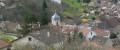
(2) At the hunting lodge, do not enter the meadow, but turn right onto the last path closest to the edge of the woodland, even though it is marked off by crosses. You will once again leave the signposted route. Two hundred metres further on, you’ll reach a junction of various paths; carry on straight ahead and, 100 metres further on, at a crossroads, take the path directly in front of you, ignoring the paths to the right and left. You’ll walk along the cliffs once more, passing through open areas with lovely views of Arguel Hill – where you can try to imagine it crowned by the old feudal castle, sadly now in ruins – as well as the Doubs valley, the forts of Planoise and Rosemont, and the new town of Planoise. You’ll come to another footpath, which you should follow down to the right. Walk past the water tower and you’ll reach the first houses of Beure. Finally, head back down the Chemin de la Côte Blanche to the car park (S/E).


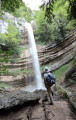

 A beautiful hike for couples, well described, ideal in early spring, lots of animal tracks, saw one pheasant; the opportunity to observe from the top of the ridges as there is still little vegetation obscuring the view... pure bliss. Corresponds to part of a trail des Forts completed in the past, but this walk is not difficult. Unfortunately, there was some rubbish left behind by irresponsible people. Recommended for all levels.
 Visorando Member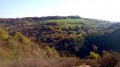
 Moderate