Country:
 City:
City:


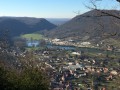
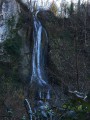
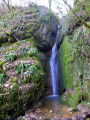
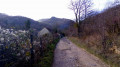
(S) Park in Beure, opposite the Calvary, on Rue de la Côte Blanche. If you cannot find a space, go halfway up the dead-end road of Côte Blanche to find a small car park on the left. Return to the Calvary. Yellow-red and white-red markings. Turn your back on the Calvary and walk down towards Rue de la Cascade, following the wall of the beautiful house. At the fire hydrant, leave the street and take the small stony path on the left, which runs alongside a vegetable garden, and follow the markings to the waterfall. Unfortunately, the vegetation in spring and summer partially hides it. Continue on to Chemin de Maillot, which is paved.
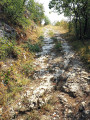
(1) Descend on the left for 250 metres and look for a sign on a telephone pole inviting you to climb to the right, at the corner of the wall, onto the Sert stone path to discover the ancient Roman road and its ruts carved into the stone. (Head towards Bois de Peu).
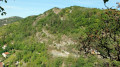
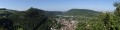
Shortly after the Roman road, turn left at the hairpin bend. At a large stone with markers, turn left again and continue climbing through the box trees to the meadows and the viewpoint over the Doubs Valley.
(2) Turn your back on the bench and head straight across the meadow. You will soon come to a fork; take the path sloping slightly down to the right. You will arrive at a hunting car park. Continue straight ahead along this well-graveled path, following the markings (yellow-red, Circuit VTT 114).
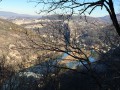
(3) When the path splits into three, in winter (otherwise the foliage will hide the view) you can take the path on the left (between the signs for Forêt communale Beure N°28 and 29) for an unsecured viewpoint over the valley. Or you can simply continue along the stony path on the right, following the markings.
(4) At the fork marked by a signpost, head towards Chapelle des Buis via the ridge path on the right (Circuit VTT 114). Soon, you will see another signpost. Despite the crosses, descend to the right to reach the viewpoint, leaving the paths on the left (white-blue markings not very visible).
(5) After 300 metres, look out for a small opening in the trees on the left and a path that leads to the viewpoint over the Vallée des Mercureaux, the Arguel valley and its jagged rocks. Continue downhill towards the hamlet of Maillot. You will come to a beautiful stone road which you follow downhill to the left, then right at the junction with the Chemin des Mercureaux.
(6) Pass two small bridges on your left and take the Circuit des Grands Prés (yellow-blue markings) on the left, next to an electrical transformer. Cross the Mercureaux stream via a small wooden bridge. You are now above the Bout du Monde waterfall. Climb this steep path, where you can see the tracks left by the iron-rimmed wheels of our old carts. At the highest point, look for a small path on the right, just visible a few metres away, to reach the viewpoint over the old village of Beure. But be extremely careful, as the viewpoint is not secure! Return to the path and continue climbing, glancing down to your right. You may be lucky enough to catch a glimpse of a chamois's tail.
(7) The path turns 90° and continues to climb towards the Arguel plateau. You can also continue straight ahead for 300 metres, following a stream below that has carved out small gorges (but again, be very careful, as the stones are always wet and slippery!), then retrace your steps. At the top, the dirt track turns into a "white" path and leads you to the first houses of Arguel.
(8) Cross the D111. To the right of the bridge, you will see an old Michelin plaque on the first house in the village of Arguel. Take the sandy path on the left, which will lead you to the old wash house. Walk up the lawn towards the road, cross it carefully at the pedestrian crossing and, at the corner of the house opposite, despite the presence of a yellow and blue cross on a low wall inviting you to turn back, climb the small path that leads up to the church. Take a quick tour of the church and its cemetery. Go up the path opposite the cemetery gate. At the fire hydrant, turn right onto the dead-end road, which becomes a pretty path climbing up the hillside (yellow-blue marker).
(9) At the Circuit des Grands Prés sign, continue to the right towards the viewpoint 150 metres away. You will soon reach the first viewpoint over Planoise, which is unprotected. Please be careful! There is another viewpoint over the Pugey valley and the Arguel hillside, and finally the viewpoint with a view of Mont Poupey. Turn back, but do not quite return to the sign. About 7 metres from the sign, take the unmarked path on the right that climbs towards the ridge and winds between beautiful rocks. When the leaves are falling, you will have a view of the Doubs valley on your right. This path leads you to a clearing, which you should enter quietly. I have often encountered a few chamois there in the morning. The clearing offers a beautiful view of the Fort de Planoise, the Rosemont and the village of Avanne. Cross the field in a straight line, at the end of which you should easily find a well-marked wooden path, which in some seasons is slightly hidden by ferns. In the hillsides, you may be lucky enough to spot a chamois. Turn left onto the D308, which climbs up to the hamlet of La Maltournée (in the municipality of Larnod). Continue straight on towards the village.
(10) Opposite a very old house with unmortared stones, turn right onto a stony path. At the beginning of the path, you will see traces left by the iron-rimmed wheels of our ancestors. Descend towards Beure, taking a yellow-red marked path shortly afterwards that leads into the woods on the right. We rejoin the D308.
(11) At the stop sign, cross the D141 and take the dead-end road, Chemin du Sinaï, marked in yellow and red. Follow the markings down a small staircase, then cross the D141 again and take another staircase. Go up Rue de la République on the right towards the centre of the old village. Visit the church. Cross the D141 carefully opposite the Lucien Roy Military Museum to take Rue de la Cascade, then turn left onto Chemin de Maillot, joining Chemin de la Côte Blanche and the car park.
 The route includes cliff paths and unsecured viewpoints. Rocky and slippery paths. Sturdy footwear is essential and walking sticks are recommended.



 , there is no sign for "La Maltournée" but for "Larnod", whether it's a terraced house or not... whereas the stony path is just to the right after the "Larnod" sign!



 Visorando Member

 Easy
Easy